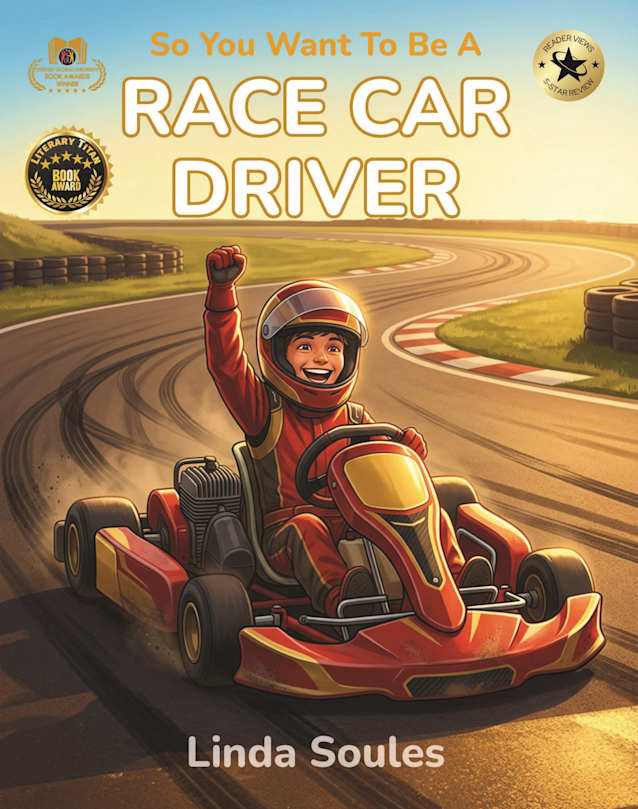
So You Want To Be A Race Car Driver (So You Want To Be A...)
About
WINNER — 2026 Literary Global Children's Book Awards (Sports Category)
WINNER of the Literary Titan Gold Book Award
The green flag drops. In that moment there is no yesterday, no tomorrow, no anything outside the forty feet of track directly in front of you. There is only the line — the precise, invisible path through the corner that separates fast from fastest — and whether you can find it before anyone else does.
So You Want To Be A Race Car Driver takes young readers ages 10–14 inside one of the most physically demanding and most technically complex professions in sport — not the highlight-reel version, but the real one. The years of karting and climbing that happen before a single professional contract. The specific discipline of driving at the edge of control, where the difference between a perfect lap and a catastrophic one is measured in milliseconds and millimeters. The team of engineers, strategists, mechanics, and coaches working in precise coordination so that one person, strapped into a machine they helped build, can perform at the absolute limit of what physics allows. The race that goes exactly to strategy — and the one that comes down to pure instinct in the final corner.
This is a book about what race car drivers actually do: the engineering they study so they can communicate exactly what the car is doing at two hundred miles per hour, the physical conditioning they pursue to withstand forces that would disorient most people, the mental preparation they bring to managing risk and pressure simultaneously, and the razor-sharp focus they maintain across every single lap of every single race. It’s also a book about what the work costs, what the life demands, and why the people who do it say that when everything comes together — car, team, driver, and track — there is nothing else like it on earth.
Inside, young readers will discover:
- What a real race car driver’s preparation looks like — from simulator sessions to race-day strategy
- The science of speed — aerodynamics, tire behavior, and the engineering that makes modern racing possible
- The physical and mental demands the sport makes — and how drivers train body and mind to meet them
- The history of motorsport and the legendary drivers who pushed the limits of what was thought possible
- What young people can do right now to discover if this might be their calling
Honest, specific, and genuinely illuminating, So You Want To Be A Race Car Driver doesn’t talk down to young readers — it brings them all the way in. Because the child who wants to know what this work is really like deserves a real answer.
For readers who feel the pull toward something fast and precise and fully alive. For the kid who watches the cars blur past and doesn’t just feel the speed — they feel something shift.
The track doesn’t reward hesitation. Neither does the dream.
Ages 10–14 · Nonfiction · Careers & Professions · Illustrated
Praise for this book
"An energetic and thoughtfully constructed introduction to the world of professional racing, So You Want To Be A Race Car Driver blends aspirational storytelling with surprisingly sophisticated nonfiction insight.
From its opening dedication—'For every kid who ever leaned into a turn... Faster!' —the book positions itself squarely in the imagination of young readers, inviting them not just to dream of speed, but to understand it. What follows is not a simple celebration of racing, but a layered explanation of what the job truly demands. Concepts that might seem too advanced for its audience—precision braking, telemetry data, and split-second decision-making—are broken down into accessible, engaging language. For example, it reframes racing as a mental discipline as much as a physical one: drivers are described not as reckless daredevils, but as 'calm, precise, and always three corners ahead in their minds.'
Structurally, the book is exceptionally well organized. Each spread introduces a new dimension of the profession—tools, teamwork, daily routines, risks, and rewards—creating a seamless, cumulative reading experience. Sections like 'A Day in the Life' and 'The People You Work With' provide a narrative flow that keeps readers engaged while steadily expanding their understanding. The pacing is brisk but never overwhelming, making it particularly effective for independent readers in the target age range.
The illustrations are vibrant, often carrying as much narrative weight as the text. High-speed track scenes, detailed cockpit views, and behind-the-scenes pit crew moments give the book a dynamic visual rhythm. These images don't merely decorate—they reinforce key ideas, such as the teamwork behind racing or the intense physical strain drivers endure. The consistent red-and-black palette and motion-focused compositions enhance the sense of speed and immersion.
What elevates the book further is its honesty. The section on 'The Hardest Parts of the Job' addresses fear, physical exhaustion, and the consequences of mistakes. At the same time, it celebrates the intellectual challenge and discipline required, reinforcing a message that success comes from focus and continuous learning.
The inclusion of real-world figures such as Ayrton Senna, Danica Patrick, and Lewis Hamilton adds historical and cultural context, while the glossary and practical advice sections encourage readers to take tangible steps toward their interests. The closing note underscores the book's central philosophy: racing is not just about speed, but about intelligence, precision, and perseverance.
If the book has a limitation, it's that its density of information occasionally edges closer to middle-grade nonfiction than a traditional picture book. However, this same depth is likely to appeal to curious, detail-oriented readers—especially those who might not typically engage with reading.
A polished, visually engaging, and intellectually respectful introduction to motorsport—this is a standout example of nonfiction picture books done right, balancing excitement with substance and inspiration with realism."
"Speed-loving kids who talk about laps and pit stops will find a clear, respectful match in Linda Soules's Race Car Driver. Part of the 'So You Want To Be A…' series, it treats future racers as thinkers, not just spectators.
This book demystifies the job with real clarity, explaining that racing is not simply pressing the gas, but solving dozens of corner problems per lap with braking measured to the meter. Readers meet the engineers, strategists, and pit crews behind every helmet, learn how telemetry works, and tour different disciplines from Monaco's street circuit to NASCAR ovals. Profiles of Senna, Danica Patrick, and Lewis Hamilton add human depth, while the closing activities (cone courses on a bicycle, sim racing, go-karts) give parents easy weekend ideas. The book even connects racing safety to everyday cars, which sparked a real dinner-table conversation at our house.
The writing is clear and enthusiastic, with memorable lines such as "smooth is fast" that young readers will carry with them. Soules is honest about the focus, stamina, and teamwork racing demands, without losing the excitement. The glossary and reflection questions are a real help, and the tone respects curious minds throughout.
For ages ten to twelve, this is a strong career guide: inspiring, well researched, and genuinely useful for shared reading. Parents and teachers looking for something beyond speed and spectacle will find real value here. A confident recommendation for any curious young reader."
"Have you ever tracked how fast you can go on your bike, then tried to go faster? Do you love playing those sim racing games that make you feel like you are really in the cockpit of a race car? If so, then the book So You Want to Be a Race Car Driver by Linda Soules just may be for you. Being a race car driver may be dangerous, but thanks to the team working with the driver and better technology in race cars, many racers thrive in this sport and achieve satisfaction with this career.
This book shares what it’s like to be a race car driver, as well as what race cars are actually like. The kind of car in a race is not the same kind of car that a person drives to work. A race car is equipped with several controls that help the racer to maneuver, drive, and control their car while racing at 200 miles per hour – or higher. The place where the racer sits is called a 'cockpit,' and like what a pilot has to do inside the cockpit of a plane, the driver has to do while inside the car. The steering wheel is not like the steering wheel in a regular car; it is shaped differently, and it has many buttons on it to help control the car, the tires, and to help the racer. The pictures in this book provide good examples of the equipment the team uses during an automotive race, and that includes an example of what the steering wheel in a race car can look like. The driver also has a radio inside their helmet that allows them to communicate with the engineers while racing.
These are just some of the very interesting facts young readers will learn about being a race car driver when they read this book. They will also learn about the different types of races, the challenges that a driver can face, as well as what it takes to be a good race car driver.
Readers will also get to experience a typical 'day-in-the-life' of a race car driver and understand the kind of people a racer will work with. And that’s not all. They will also get to learn just how automotive racing has helped to improve the cars that everybody else drives. As it says on page 25, 'Race car drivers are the test pilots of the automobile world.' Items tested on race cars and in automotive racing have been added to regular cars to help them perform better and be safer. These improvements include better brakes, seatbelts, and fireproof technology for the cars on the road.
Finally, another thing which young readers may appreciate about this book is how automotive racing is not just a sport for boys. Girls can be race car drivers too. In fact, this book shares about one particular female race car driver who was the first woman to win the pole position at the Daytona 500. So young girls who dream of growing up to be a race car driver just might be inspired by the information they glean from this book.
So You Want to Be a Race Car Driver by Linda Soules is a perfect introduction to the world of automotive racing for young readers who dream of achieving speed behind the wheel. Filled with information about the sport and what it takes to be a racer, this book will inform and inspire readers who dream of driving those laps and achieving their next level of speed and stamina."
"So You Want To Be A Racecar Driver is an engaging installment in a career-focused series that introduces young readers to the exciting world of professional racing. The book explores what it takes to become a racecar driver while offering a realistic look at the responsibilities, training, and dedication required for this profession. It presents the information in an accessible, age-appropriate way and includes additional facts and resources for children who may want to learn more about this career path.
I appreciated the level of detail provided throughout the book. It is both informative and entertaining, giving readers a strong understanding of the career while also sharing interesting facts and trivia about racing. The book offers a look into a day in the life of a racecar driver and highlights the work involved in preparing for a race, both on and off the track. It makes clear that racing requires preparation, discipline, teamwork, and commitment. I especially enjoyed the inclusion of information about the pit crew, one of the most fascinating aspects of racing.
I would recommend So You Want To Be A Racecar Driver to young readers who are beginning to think about what they might want to be when they grow up. This book is a fun and informative introduction to a unique career path, filled with facts and trivia that will keep curious readers engaged from start to finish."
"Speed gets the attention. Precision wins the race.
That distinction sits at the heart of Linda Soules’ So You Want To Be A Race Car Driver, an energetic introduction to professional motorsports that gives young readers plenty of horsepower while showing them just how much preparation and teamwork exist behind the spectacle.
Soules quickly dismantles the idea that racing is simply about having the courage to push a car to 200 miles per hour. A professional driver must understand braking points, communicate with engineers, interpret the behavior of the car, maintain extraordinary concentration, and make decisions in fractions of a second. Even the steering wheel becomes a lesson in
complexity, packed with controls far removed from anything children see in the family car.And the driver is only part of the equation.
Pit crews, engineers, mechanics, and strategists emerge as essential characters in the racing story. By taking readers behind the scenes and through a typical race day, Soules reveals a sport built upon hundreds of coordinated decisions. The result is a surprisingly effective lesson in teamwork disguised inside a book about going very, very fast.
The history and personalities of racing receive attention as well. Ayrton Senna, Lewis Hamilton, and Danica Patrick give young readers recognizable examples of where talent, determination, and preparation can lead. Patrick’s story also reinforces an important point for young girls picking up the book.
Soules does not pretend that racing is easy or without danger. Physical exhaustion, fear, pressure, and the consequences of mistakes are acknowledged. At the same time, readers discover how innovations developed through racing have influenced the safety and performance of everyday automobiles.
Colorful illustrations of cars, cockpits, tracks, and pit crews give the book plenty of visual energy, while practical activities, racing terminology, and technical details provide substance for children who want to dig deeper
Young readers may open this book because they want to go fast. They will finish it understanding why the best drivers know when—and how—to slow down."
"Loved the time stamped play by play of a day in the life of a race car driver. Such a cool book for kids that are interested in F1."
"Another great book in the series! So many great facts and interesting details for those interested in race car driving, the sport itself, or just random people. Gives the reality of the seriousness and danger behind racecar driving."
"I never would have thought reading about race at driving could be so interesting....The author's choice to not only highlight male drivers in the sport but also female drivers... allows young readers to relate on a personal level."
"I still love these books. They are formatted well and well thought out. It is easy to read and learn a lot of information. Beautiful and vibrant illustrations too...Some of the best parts include a day in the life; realistic parts of the jobs, tools of the trade, glossary, and just brief narratives about what is awesome and not so awesome about the job. I highly recommend these books."
"My child absolutely loved this book! If you have a little one who is obsessed with race cars, engines, or anything fast, this is such a fun read. The story does a great job introducing what a race car driver does in a way that is easy for kids to understand while still keeping them entertained. The illustrations are bright, exciting, and really hold their attention."
"I also appreciated that it teaches about the job itself — not just driving fast, but the hard work, practice, and teamwork involved in being a race car driver. It’s a perfect mix of educational and fun. We’ve read it several times already and it continues to be one of his favorites at bedtime. Definitely recommend for any young racing fan!"
"This book is so cool and teaches you everything you need to know to become a race car driver...I will definitely be reading more of this series!"
"This is a great book for teenagers. It explains what the reality of being a race car driver is like. The physical aspects, the mechanical knowledge they need, the amount of work and training involved. It also shows a day in the life of a driver and some biographies of famous race car drivers."
"I definitely recommend this book to anyone who loves race car drivers...Truly a great book to read."
"I love how it focuses more on the engineering aspect rather than just the driving."
"As a girl who enjoys watching Formula 1 racing and NASCAR racing, this book was great for learning more about what it takes for each driver to do what they do. I feel as though I know much more about the sport after reading this book. It is a quick and educational read. I recommend to anybody who is interested in becoming a race car driver, or who is simply interested in the sport."
"I read this book with my 6 year old grandson because he is always saying he wants to drive race cars and go fast. His dad raced go karts when he was young. He was especially excited reading about the legendary drivers and the teams of engineers and mechanics that help make racing possible. The book explains how drivers train, stay focused, and work together with their crew before every race.
My grandson loved the sections about the powerful race cars, safety gear, and learning how drivers handle sharp turns at high speeds. He kept pointing at the illustrations and asking questions about the pit crews and what drivers do on race day. I liked that the book showed racing is not just about going fast, but also about discipline, teamwork, and practice."
"So You Want To Be A Race Car Driver does a great job showing that racing is about far more than just driving fast. I liked how the book breaks down the different paths into racing and explains the importance of practice, teamwork, safety, and sponsorships, which made the career feel realistic instead of glamorous. This book mattered to me because it gave a clear picture of what it actually takes to succeed in motorsports, and I’d recommend it to young racing fans, students exploring careers, or anyone curious about life behind the wheel of a race car."
"If you have a child who is completely fascinated by race cars, racetracks, and the excitement of motorsports, 'So You Want To Be A Race Car Driver' by Linda Soules is a book they’ll probably want to read more than once. What made this one stand out to me is that it feels less like a simple children’s book and more like a real introduction to the world of racing written in a way kids can actually enjoy and understand.
One thing I really liked was how the book talks about legendary drivers like Ayrton Senna and explains how even famous racers had to practice constantly and learn control before becoming champions. The section discussing the idea that 'smooth is fast' was especially memorable because it teaches kids that racing is not just about slamming on the gas pedal. The book explains how staying calm, making smooth turns, and keeping control of the car are what actually make drivers faster and safer on the track. I thought that was a really smart lesson to include for young readers.
The book also does a great job showing what happens behind the scenes during race day. I liked the parts explaining how pit crews work together during tire changes and how engineers help adjust the cars to improve speed and handling. Those details made the racing world feel real and exciting instead of just flashy. It helps kids understand that racing is a team effort, not just one person driving a fast car.
Another thing that stood out was how the book walks readers through the early stages of becoming a driver, starting with kart racing and basic track safety. It makes the dream of becoming a race car driver feel achievable because kids can see the actual steps drivers take to get there.
The illustrations add a lot of energy too. The colorful race scenes, speeding cars, and track action make every page feel lively and exciting. You can tell the book was created for kids who genuinely love motorsports.
Overall, this book feels informative, encouraging, and genuinely fun. It mixes real racing knowledge with kid-friendly storytelling in a way that keeps young readers engaged while teaching them important lessons about focus, patience, teamwork, and practice. It’s a great pick for any young racing fan who dreams about one day crossing the finish line under the checkered flag."
"This book was so fascinating even for an adult! I read this book to pick up a few race car facts for my son who is 3. He loves cars and is constantly racing them."
"I was very impressed with this book. It is very well researched and the art work is extraordinary. I had no idea the foot pedal area of the race car can get 130 degrees or that the drivers could lose 10 pounds in sweat!"
"It explained that racing is more than just sitting in a car and driving. It takes a whole team effort to successfully drive a race car. It also explains the ups and downs along with different safety protocols."
"As a teacher, So You Want to Be a Race Car Driver by Linda Soules is an engaging and inspiring resource for young readers who are curious about exciting careers beyond the traditional classroom discussions. Linda Soules does a wonderful job breaking down the fast-paced world of race car driving in a way that is both accessible and educational for children. She has a long list of books dedicated to different career paths that I like. It gives students options. As a teacher that helps teach so many more students too.
Just like her other books, she has a way of making things stand out. Her book goes beyond just the thrill of racing and highlights the dedication, training, teamwork, and perseverance required to succeed in this profession. From learning about vehicle safety and the mechanics behind racing to understanding the discipline and focus needed to become a professional driver, the book provides meaningful insight while keeping readers entertained.
From a classroom perspective, this book is a fantastic way to spark conversations about goal setting, determination, STEM connections, and career exploration. Students who love cars, speed, or hands-on learning will be especially captivated, but even reluctant readers may find themselves drawn in by the exciting subject matter.
The writing is age-appropriate, informative, and encouraging, making it an excellent addition to classroom libraries, career study units, or independent reading collections. Linda Soules has a wonderful talent for introducing children to fascinating career paths in a way that makes big dreams feel possible. A highly recommended read for young aspiring racers and curious learners alike!"
"This book really opens your eyes to what it takes to race. Not just as a driver but on your bike or even on foot. It really helps explain the terms you need as a professional racer as well. Marvelous series. My son loves these books."
"This book is a great one to read if you or your children are interested in racing. I love the fact that it includes a 'glossary' of different terms for racing and what they mean to someone who’s not familiar. Love that these books include images to help the reader get a visual representation. I also like that the author points out how very different these cars are compared to the ones sitting in our driveway. It truly gives you an insight into what drivers experience and deal with from the inside!"
"It gives you facts without sugarcoating it. I was surprised about how much I didn't know about the profession... A very genuine approach to what being a race car driver entails."
"Another great entry in this series of books, it covers Nascar and Formula1 type racing specifically. Many of the tools and ideas also apply to other forms of racing, like Drag Racing. Kids and adults in that side of the racing sport need to have many of the same qualifications.
I’d recommend this one for kids who have that extra energy and the need/desire to understand how things work."
"If you have a son or daughter passionate about racing this is a great book. Very informative, easy to read with beautiful illustrations as well. As a parent and adult that enjoys watching NASCAR this was informative and I learned things I didn’t know."
"Learned a lot reading this book. I didn't know it was going to be in depth as it was. It explained what actually goes into being a race car driver."
"An in-depth look at what it takes to be a race car driver. To kids, car racing might look like fun, but this book details the physical and mental stress the drivers through along with the intense training and knowledge it takes to be successful. As a racing fan myself, I enjoyed this book very much. It’s easy to read, very informative with colorful illustrations."
"Part of a great series for children to learn about what it takes to enter a field or occupation for which they have an interest or passion. Race driver is especially interesting. This book shows what it takes, the challenges, the things you need to know. It also highlights famous drivers like Danica Patrick. A fun read!"
"My 7 year old has recently decided he wants to be a race car driver after going to watch the races for the last few weekends! He absolutely loved this book!"
"Much more information than i was expecting. You can feel the passion. Makes you feel like you are preparing for a big race. Anyone who loves racing should read this book. Great information in a tiny package."
"This is another great So You Want To Be A book! I've loved all of them I've read! This one focuses on the real job of being a race car driver, which I think would be very interesting for kids. It would be great to add to a classroom library or to use specifically for career week. The tools of the trade section is cool because it talks about the race car, steering wheel, fireproof suit, helmet, and HANS device. I had never heard of a HANS device before, so it gives good information even for curious adults. The most surprising part of the job fact was actually INSANE, and I won't spoil it...but you have to read that part!"
"This book hit close to home as my father-in-law is a retired race car driver and I've listened to my husband tell me stories of his family's time traveling from track to track, and the thrill of being in the pits cheering on his dad. Beautiful illustrations throughout the entire book. I appreciated the realness of both the pictures but also how it spoke of racing. Very informational but also engaging. Less of a bedtime story and more of a "let's learn!" (The glossary in the back with racing lingo explained was super helpful.) But with that being said, any kiddo with a love for fast cars will enjoy this book!"
"This is a great book for anyone interested in racing or who would like to learn more about the sport. I would definitely recommend it for an upper-elementary classroom library, or for a child who wants to know if racing is for them. As an adult, I learned the ins and outs of professional racing and the level of athleticism, skill and expertise these people have.
At the end there is a glossary, recommended books, websites to explore and organizations to familiarize yourself with.
Overall, great addition to your library."
"This exciting book teaches kids what it’s really like to be a race car driver. It is perfect for any child who loves cars and sports. It shows that winning a race takes more than just hitting the gas pedal. Drivers need to be brave, smart, and work well with their team!"
"So far I’m loving this whole series! I have 3 boys and it’s really cool to see books that are geared towards things they’re interested in. This race car one was their first choice but they’re already talking about the others that fit their individual interests."
"So You Want To Be A Race Car Driver by Linda Soules is a wonderful book, it goes far beyond the common idea that race car drivers simply drive fast. This masterpiece gives young readers a fascinating insight into the incredible symbiotic relationship between technology, teamwork, fitness, strategy, and dedication required to succeed in motorsports.
The way this book explains the technological aspects of racing, really impressed me. Readers learn about engineering data, sensors, simulators, telemetry, vehicle setup and also how the racecar drivers must work closely with engineers to make constant improvements to their performance and their vehicles. It explains how modern racing is mostly about understanding data, problem-solving, communication, and driving skills.
This book also does an amazing job at highlighting the physical and mental aspects demands of this sport. Drivers must maintain exceptional fitness levels, as well as concentration, endurance, and remain in control under pressure. Young readers will have a new appreciation for the discipline and hard work required to compete at the highest levels of racing.
Another aspect I love about this book is the way it emphasizes the importance of teamwork. It shows how a complete team must work in sync for the driver and the team to be successful, from engineers and mechanics to pit crews and strategists, it makes it clear that success on the track comes from hundreds of people working together towards the same goal. I love this lesson because it will teach young readers about collaboration, communication, and trusting the people around you.
Two of the most important lessons of this book, if not the most important, are about perseverance and dedication. It shows that disappointment, mistakes, obstacles are part of the path, that champions must go through to gain wisdom, it shows that drivers become great drivers by continuous learning, commitment to improvement and resilience. These are takeaways you can apply to almost any career.
This book is perfect for any young reader who is interested in racing, engineering, technology, or any sport. Its writing is engaging, it has beautiful illustrations and many valuable life lessons.
I strongly recommend it for young readers who always have big dreams and want to have an idea of what it takes to be successful."
"I chose to read this because I grew up at the track. People don't understand the physical, mental and mental toll racing leaves on the body. Physically preparing not only means working out but hydrating days, even weeks before hand. The mental toll is takes, especially on your spotter can leave permanent scars. The fact that you can't see hardly anything and you're relying on someone else hundreds of feet away to basically be your eyes is crazy by itself. Really enjoyed this one."
"'I picked up this book because when I was younger I really enjoyed racing. My dad watched it on TV all the time and he even took us to a few races. This book helped me relive those experiences, except I got to put myself in the driver's seat. What a fun, factual delve into the world of racing! The pictures on every page along with easy to read information and fun facts grabs your attention, makes you feel like the driver yourself, and create an actual understanding and appreciation not just for the sport itself, but for everyone involved. I can see how this series inspires children to find and go after their passion, I almost want to be a race car driver again myself!"
"Start your engines! This interesting, informative book gives all the details on what it takes to be a race car driver. Topics include what exactly different types of racers do, what a day in the life looks like, the best and hardest parts of this job, qualities needed, fun facts, famous race car drivers in history, and much, much more. You are guaranteed to learn new things on every page of this book!"
"Read this book with my 7 year old tonight before bed and he loved it. He didn't realize how fit you had to be to be a race car driver. I loved the facts at the end. I cannot believe Indy car pit crews are so fast! We are looking forward to reading more in the series."
"These books are cute. I really enjoy reading them to my little one. It opens up their imagination and lets them know they can be anything they want to be if they set their mind to it."
"So you want to be a race are driver?! What a thrill! Who didn’t love cars when they were little? This story gives all you need to know about becoming a race car driver. The thrills, the highs, lows, the equipment and the costs. inside one of the most thrilling and demanding careers on the planet. This is not a book of fun trivia alone — though it is packed with jaw-dropping facts about the fastest cars, the most powerful engines, and the incredible vehicles that have shaped motorsport history. This is a book about what it actually takes to become a professional race car driver, told with honesty, depth, and genuine respect for young readers who want the real story. Start with the science. Modern race cars are rolling laboratories of physics and engineering."
"For a boy mom, this was cute and my nine-year-old loved the book. He wouldn't stop telling me all the cool, facts, and things he found out. Which made me extremely happy."
"This is a wonderful book for children interested in being a race car driver! It highlights the difference between Formula 1 and Nascar, breaks down the protective gear that must be worn, like the fire suit. It has details about the card components and how race car drivers have to have mental and physical stamina. It even has a section where it mentions some of the historical and modern famous drivers and a brief section about each one."
"A very in-depth introduction to race car driving. The author does great at going past the basics of racing (who can drive their car the fastest?) and also introduce the other roles at play in a race, like your engineers and pit crews. She also includes a great list at the end of the book, as always, of information for really pursuing this career: websites, books, and things to try right now, like go-kart racing and racing simulators on the computer. An interesting read for anybody, but it is a real gold mine for a kid already interested in race cars."
"My son and I learned so much about race car driving that we didn't know. It was great to hear about all that a race car driver needs to know. It's not about just driving. They are engineers and it's almost like they are one with the race car."
"I do like the detail that this book goes into. The kids reading this book will be intrigued by the extra insight!"
"I had no idea all takes to be a race car driver. Very informative and Interesting. Any kid interested in car racing would love this book."
"My child loved this book! It’s fun, easy to understand, and does a great job showing what it takes to become a race car driver. A great read for any young racing fan."
"If you think all it takes to be a race car driver is to hop in and start driving, think again! This book takes you deep into the world of a formula 1 driver. From confidence to science to math, this book explains it all. The full color pictures are great! Any young reader who dreams of becoming a race car driver should read this book.
The author includes all aspects of living the life of racing. She explains about all of the people behind the driver - from the crew chief to the pit crew. The different sections of the book help the reader understand the good and difficult parts of this career."
"This was a fun little book, especially for anyone who has ever been interested in what it’s actually like to be a race car driver. I liked that it goes beyond just the excitement of driving and talks about things like the training, teamwork, equipment, mental toughness, and some of the less glamorous parts of the job.
The illustrations throughout are a nice touch and make it more engaging, especially for younger readers. I also enjoyed the fun facts and the section about famous race car drivers.
I think this would be a great book for a kid who is really into racing and wants to learn more about what goes on behind the scenes. It’s an easy read and does a good job of making the sport feel exciting while still explaining the work that goes into it."
"As a 3rd grade teacher, I appreciated how Linda Soules never talks down to kids. She digs into real skills — the racing line, braking points, reading the car through your hands. The honesty about physical demands stood out too: heart rates like a marathon runner's, 130-degree cockpits. 'Smooth is fast' is a line my students will remember. The glossary and reflection questions make it classroom-ready. A strong pick for any kid who loves speed and wants the real story behind it."
"A fun, informative book for kids who are interested in race cars and racing. It does a great job of introducing the world of racing in an easy-to-understand way, with engaging information and an exciting presentation. A great choice for young racing fans!"
"Such a fun and interesting read! I never realized how much actually goes into being a race car driver!! It covers a day in the life, the best and hardest parts of driving, and the mechanics of it!! Really, really cool!"
"This book is excellent in explaining different type of racing. From NASCAR to Formula one to drag racing the book covers each. It covers the jobs behind the racing as well as what the driver actually does when driving. It has terminology for kids to learn in the art of racing. Children can read about famous drivers and how racing is on the human body."
"I really enjoyed this book because it goes far beyond the usual facts about race cars. It gives young readers a real look at what it takes to become a professional driver, from physics and engineering to fitness, mental preparation, teamwork, and race-day strategy. I especially liked how it explains the important role of engineers, mechanics, coaches, and strategists instead of making racing seem like a one-person sport. The illustrations and practical information also make the subject easy and exciting to follow. For kids who already love cars or dream about racing, this feels like a genuinely useful guide that takes their ambitions seriously. It’s informative, exciting, and inspiring without talking down to young readers."
"The book does a great job of making racing feel exciting while also showing the hard work that goes on behind the scenes. I especially liked the way it encourages young readers to follow their dreams and understand that success comes from dedication and never giving up. The racing theme makes the book fun and engaging, while the lessons about determination and teamwork make it meaningful. One of the things I enjoyed most about this book is the way it introduces readers to what life as a race car driver can really be like. Racing may look easy and exciting from the outside, but the book helps explain how much preparation goes into every race. Drivers need to understand their cars, learn how to handle different tracks and conditions, listen to their teams, and make quick decisions while traveling at high speeds. I liked that the book presents racing as both an individual challenge and a team effort.
The book is also a great reminder that achieving a dream takes time and hard work. Becoming a race car driver is not something that happens overnight. It takes practice, patience, learning from mistakes, and being willing to keep improving. I think this is one of the most valuable messages for young readers because it can apply to almost any dream or career they may want to pursue. It is an entertaining read, but it also leaves readers with a positive message: if you have a dream, work hard, keep learning, and do not give up on it."
"I love this book. It's perfect for children or adults because it gives you all the information you could possibly need when it comes to being a race car driver. There's a glossary, there's tips & tricks to help you get started if you're interested, fun facts and more. Most of the information in this book was new to me, I didn't think half of these things were important when it came to being a race car driver to see everything that goes into dragging laps on a track is amazing."
"Any kid who loves cars or racing will love this book. Younger kids will love the pictures, older kids will like the information. This book provides details about the life of Racecar drivers that most people never think about. It is not just about speed, but mental and physical stamina.
The book also tells about famous car racers such as Ayrton Senna, Danica Patrick, and Lewis Hamilton. It explains important racing terminology and all of the people behind successful cars and drivers. Then it has fun facts that will fascinate the reader.
The provides a list of things kids can do to prepare for that type of career. It also provides realistic information. Kids will be fascinated."
"This short book is a wonderful introduction piece for any age to learn about racing. Whether it’s circuit track, oval racing, or anything in between, it gives an in depth understanding of what goes on behind the scenes, and what it takes to be a race car driver."
"I enjoyed this book. The animation makes it easy to follow and understand what the author wants you to know about becoming a race car driver. It shows that even though we might think it's an easy career, there is a lot of dedication, long hours, many other people help to make this happen. It's not just a one person's job but a team. A team that will help you succeed. It gives you an idea of what to expect when you start off."
"I honestly didn’t realize how much goes into being a race car driver until I read this book. I always thought it was mostly about driving fast, but So You Want To Be A Race Car Driver really shows the precision, focus, skill, and physics involved, especially the key details when taking corners at high speeds. The writing is easy to follow and keeps things interesting from beginning to end, and I know this is a great read not only for those interested in racing but also for anyone who gets excited about cars. It is definitely a fun and eye-opening read for racing fans or anyone interested in becoming a driver!"
"Fun, fast-paced, and packed with real info, this book makes the dream of racing feel exciting and totally achievable for kids. Linda breaks down the steps, skills, and mindset needed in a way that’s easy to understand but still inspiring.
Perfect for young gearheads it’s equal parts motivational guide and racing adventure .Kids will love the behind the scenes look at pit crews, training, and what a race weekend really feels like. A perfect gift for any child who watches the races and says, That’s going to be me one day."
"I thought this book was very well laid out and explained a lot of detail without it being too overwhelming. As a parent I feel like I know how I can help my son going forward but he also understands the commitment it takes too."
"This book is very informative and full of fun facts about race car drivers and how a race car works and how a driver is supported in numerous ways before during and after every race. Would recommend for people who are interested in formula one racing or just cars in general."
"This book does an excellent job of showing that race car driving is about much more than speed. It explains the focus, strategy, teamwork, physical endurance, and technical knowledge involved in racing in a way that is exciting and easy for young readers to understand.
I especially enjoyed the surprising facts about pit crews, safety equipment, g-forces, and how drivers communicate with engineers. The “Day in the Life” section makes the career feel real, while the activities and practical suggestions give children ways to begin exploring their interest right now. I also appreciated that the book presents both the thrilling and difficult sides of the profession without talking down to its audience.
Informative, engaging, and encouraging, this is a great choice for curious young readers—especially those who love cars, racing, engineering, or learning how things work."
"The author of this book wrote in a very passionate and moving way that could really fill kids with wonder at the life a race car driver lives especially with the really good images in the book to provide a visual representation. The book also gives some life advice as well with the way it talks about how the best race car drivers don't just drive fast. They are smart and precise about their movements which could help people to learn not to rush things and really think things through. Overall the book was very good."
"*So You Want To Be A Race Car Driver* by Linda Soules is an absolute winner for young readers with a big imagination and a passion for motorsports.
From start to finish, the book does a fantastic job of sparking curiosity and making a child's dream feel completely achievable. The artwork is vibrant and action-packed, capturing the thrill of the track and keeping kids engaged with every turn of the page. Beyond the exciting racing elements, it delivers a wonderful message about determination, practice, and confidence that resonates well with young kids.
It’s no surprise this book has picked up multiple awards—it truly earns every star. Highly recommended for parents, relatives, or educators looking for a motivational, fun read for any young racing fan in their life!"
"What an awesome book. Super informative and very detailed on all the ins and outs of racing. I love formula 1 and have a lot of knowledge about the sport and the dynamics of how it all works. This book captured it all brilliantly. The illustrations are amazing as well."
"So You Want To Be A Race Car Driver opens with an idea that changed how I thought about racing: going fast in a straight line is the easy part; the skill is knowing when to brake, turn, and accelerate through a corner. The book returns to that idea in its 'day in the life' section, where a driver studies a lap with an engineer and looks for a tenth of a second lost at turn seven. That example makes the work behind a race feel much more real than a simple description of fast cars would.
I also appreciated how much attention the book gives to the team. The driver talks to engineers, responds to data from the car, and relies on mechanics and the pit crew. It covers the difficult side of the job, too, including heat, exhaustion, danger, and the need to make clear decisions under pressure."
"This is a captivating entry in her expansive career-exploration series designed for curious young minds. Aimed primarily at middle-grade readers, this non-fiction book shatters the common myth that racing is merely about pressing the accelerator and driving fast. Instead, Soules frames motorsport as a sophisticated blend of rapid problem-solving, physical endurance, and seamless teamwork.
The book shines in its ability to break down complex automotive concepts into engaging, digestible insights. Readers learn that the true skill of a driver lies in mastering corners, managing tire grip, and delivering precise, smooth inputs at 200 miles per hour. Soules highlights the massive support system behind every cockpit, emphasizing that racing is a collaborative effort involving engineers, mechanics, and pit crews. Fascinating details—such as drivers losing five to ten pounds of sweat per race, maintaining a marathon runner’s heart rate, and training their necks to withstand severe g-forces—make the physical demands of the sport vivid and surprising.
Beyond the mechanics, the text focuses heavily on character and mindset. Attributes like calculated courage, technical curiosity, and adaptability are presented as essential tools not just on the track, but in life. The inclusion of practical, real-world activities—such as timing bike lines, practicing sim racing, or keeping a performance notebook—empowers kids to start developing these skills immediately. Richly detailed visuals complement the narrative, offering dynamic depictions of cockpits, pit stops, and historic racing figures like Ayrton Senna, Danica Patrick, and Lewis Hamilton."
"I really enjoyed this book because I’ve always been interested in fast cars and racing. I was curious to learn more about what it takes to become a race car driver. I liked how the book explains the dedication, skills, and excitement involved in racing in an easy-to-follow way. It kept me engaged and helped me appreciate how much work happens behind the scenes. I think it’s a fun read for anyone who dreams of getting behind the wheel and turning a love of cars into a career."
"What makes this book stand out is its refusal to romanticize the job. It's refreshingly honest about the 'iceberg' of over 200 people behind every driver, the punishing physical toll (drivers can lose 5-10 pounds of sweat per race, with heart rates matching a marathon runner's), and the psychological weight of managing genuine fear and crushing disappointment when mechanical failures end a race through no fault of the driver's own.
The 'Day in the Life' section is a highlight, walking through a realistic schedule from 7 AM simulator laps to a 5:30 PM data debrief — showing racing as a job built on repetition and feedback loops, not just adrenaline. The profiles of Ayrton Senna, Danica Patrick, and Lewis Hamilton add inspiration without straying into invented drama, sticking to their real, well-documented achievements.
Perhaps the most valuable sections are the practical ones: concrete, doable suggestions like practicing racing lines on a bicycle, timing a friend's laps, or trying sim racing, paired with a genuinely useful glossary and a resource list pointing to real organizations like STEM Racing and the SCCA.
This is a book that trusts kids with nuance treating racing as an intellectual and physical discipline rather than just a thrill ride. For any young reader curious about motorsport, it offers a clear-eyed, encouraging, and thoroughly researched starting line."
"There are plenty of those 'Wait, seriously?!' facts that make you want to keep reading. I especially liked that it doesn't pretend being a race car driver is all glamorous, it shows the training, pressure, technology and hard work too. I also love the history about some of the famous Race Car Drivers and everything they went through to make it. Definitely a winner for kids who are obsessed with cars!"