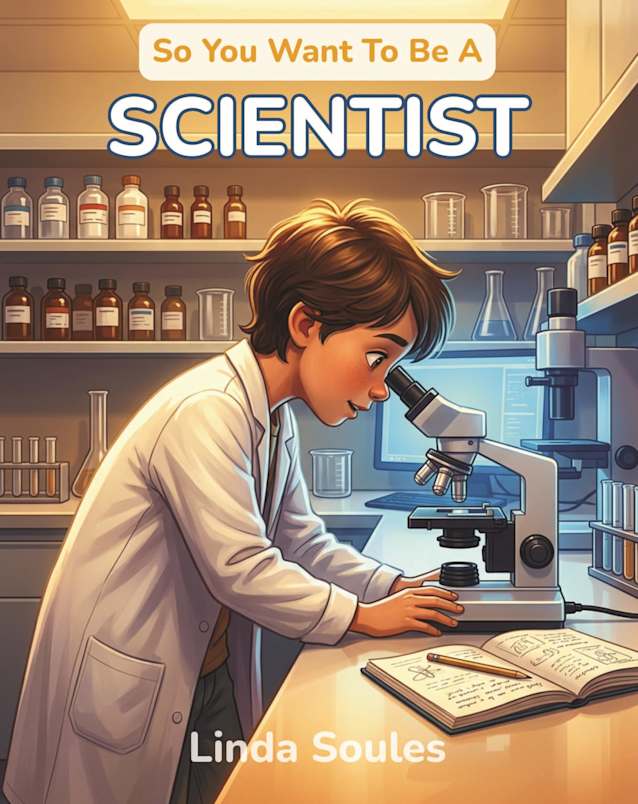
So You Want To Be A Scientist (So You Want To Be A...)
About
WINNER — 2026 Purple Dragonfly Book Award (1st Place), STEM
The question arrives before the answer. It always does. That is not a problem to be solved — it is the entire point. The scientist is not the person who has all the answers. The scientist is the person who cannot stop asking the questions — and who has learned, through years of rigorous practice, how to make the universe give them up one at a time.
So You Want To Be A Scientist takes young readers ages 10–14 inside one of the most expansive and most demanding pursuits in human history — not the laboratory-coat version, but the real one. The years of training and failed experiments that happen before a single discovery. The specific discipline of designing a question carefully enough that reality can actually answer it — because a poorly formed question, no matter how brilliantly pursued, leads nowhere. The team of researchers, statisticians, peer reviewers, and fellow scientists working in careful coordination so that what one person finds in one laboratory becomes knowledge that belongs to everyone. The experiment that confirms the hypothesis — and the result that overturns it entirely and opens ten new questions where one used to be.
This is a book about what scientists actually do: the research methodology they master to design studies that reveal rather than mislead, the data analysis they use to find the signal inside the noise, the peer review process they participate in to ensure that what gets called knowledge has actually earned the name, and the intellectual honesty they bring to a pursuit where being wrong — and admitting it — is not a failure but a fundamental part of how the work moves forward. It’s also a book about what the life costs, what it gives back, and why the people who do it say that the moment a discovery lands — the moment something previously unknown becomes known, and you are the person who found it — is unlike anything else the human mind can experience.
Inside, young readers will discover:
- What a real scientist’s working life actually looks like — from forming a hypothesis to designing experiments to publishing findings that change what the world knows
- The full range of scientific disciplines — from biology and chemistry to physics, neuroscience, climate science, and beyond — and what each demands
- The intellectual rigor and creative imagination the profession requires — and why the greatest scientists are as much artists of inquiry as they are masters of method
- The history of science and the remarkable figures whose questions — and whose willingness to follow them wherever they led — changed everything
- What young people can do right now to discover if this might be their calling
Honest, specific, and genuinely illuminating, So You Want To Be A Scientist doesn’t talk down to young readers — it brings them all the way in. Because the child who wants to know what this work is really like deserves a real answer.
For readers who feel the pull toward something that rewards curiosity more than any other human pursuit. For the kid who always needs to know why — not just what.
Every fact the world now accepts as true was once unknown. Someone had to find it. Someone had to ask the right question, design the right test, and follow the evidence wherever it led. That someone was a scientist. Maybe the next one is you.
Ages 10–14 · Nonfiction · Careers & Professions · Illustrated
Praise for this book
"Did you know that anyone can be a scientist? All you need is to be curious about the world around you. In So You Want To Be A Scientist, author Linda Soules shows what it entails to be a scientist. Many scientists stumbled upon some of the most important discoveries in history by trying to figure out what went wrong. Scientists work in various environments, including the laboratory and the field. They gather data, conduct experiments, analyze the results, check for errors, consult with colleagues, and write down their findings so others can evaluate them and build upon their research. This picture book highlights the tools of their trade and takes you through a day in their life. You will also learn about some of the famous scientists in history.
So You Want To Be A Scientist doesn't just cover the fundamentals of being a scientist; it also delves into the different types of challenges scientists face throughout their careers. Author Linda Soules has done a fantastic job with the 'So You Want To Be A...' series of picture books so far. And this book continues to be as informative, engaging, and fun as the previous installments. Children will find it both educational and entertaining. Soules sets a similar narrative pattern as the rest of the books, highlighting the career, the tools of the job, its unique challenges, and a day in the life of the professionals. I have enjoyed every book in this series, and this one follows the trend. It's a must-have on the bookshelf for anyone with children."
"For parents of curious 10-12 year-olds, So You Want To Be a Scientist is the rare science book that feels inspiring and rigorously grounded. It doesn't talk down to kids; it trains their 'why?' into a habit of noticing, testing, and thinking clearly.
Soules begins where kids actually live: questions about the sky, seeds, and dreams. From there, she eases them into the real work—make a guess, test it, write it down, and try again—without turning it into a lecture. The real-world examples (penicillin, the microwave, Kevlar, the 'Wood Wide Web') are the kind that stick and make kids want to tell you about them later. What I liked most is that it pushes the curiosity off the page: start a notebook, try small experiments at home, and treat "that didn't work" as part of the process.
Soules has a friendly, confident voice and she explains big ideas without making them feel 'school-ish.' The pages move quickly, and it's easy to stop after a section and talk — exactly what you want with this age group. I also appreciated how she normalizes mistakes and keeps circling back to honesty and responsibility ('can we?' vs 'should we?'). The only quibble is that a couple of list-heavy stretches may slow down kids who prefer more narrative flow.
In our house, I'd hand this to a kid who loves asking 'why?' and doesn't want the conversation to end. Dip in a few pages at a time, and expect it to spill into real life—kitchen experiments, notebook scribbles, and better questions. That's the point."
"Have you ever wondered what makes ice slippery? How our eyes see? Why rainbows appear after it rains? If so, then you have the mind of a scientist. And if you have the mind of a scientist, then you just might be able to become a real scientist one day! Until then, you don't need a lab coat or special equipment. But reading the book So You Want to Be a Scientist by Linda Soules is a good start. In this book, you'll learn about scientific discoveries that happened by accident, how curiosity got the scientist to make a discovery, and how doing simple things like combining two liquids to see what happens can be the work of science at home.
Being curious about the world around you is an important skill for any budding scientist. It is the desire scientists have to explore ideas and test theories. Curiosity is what gets a scientist started with an experiment and keeps them determined to see it to the end. As Soules writes on page 9, 'What drives scientists is curiosity in its purest form - not the desire to appear knowledgeable, but the actual need to know.'
This book offers an easy-to-follow explanation of what science is, the types of scientists, and what sort of tools a scientist will use. The accompanying pictures show these examples as well as the scientist in action.
Readers will also learn about peer review. This term applies when a scientist is having their work read and reviewed by other scientists, their peers in the community or lab. This is an important part of the scientist's work because it allows the scientist to learn about what other scientists think and to get feedback on the work that was done.
Another part of this book that readers may enjoy is the part titled 'A Day in the Life,' where they will get to explore what a scientist's day may be like. They mostly have their work days filled with scientific activities that are listed within the book. Some of these activities include things like writing in their notebooks, setting up equipment, analyzing data, attending meetings, and doing research.
What I loved most about this book is that some of the pictures featured female scientists. It is so important for young girls to know that they, too, can grow up to be scientists as well. Women in STEM are unfortunately lacking proper representation, so it was refreshing to see female scientists in these pictures. I also appreciated how this book shares the ups and downs of being a scientist. There will be good days, and there will be bad days. This happens with every profession. What matters is a person's dedication to their work and their determination to get answers to a puzzle.
So You Want to Be a Scientist by Linda Soules is an informative introduction to the life of a scientist for a young reader interested in pursuing such a career. This book offers clear and specific insights about what being a scientist is all about, as well as instructions on how young aspiring scientists can practice science right now. With colorful pictures depicting real-world scientists in action, lists of tools and techniques to implement, and a glossary of scientific terms, this book is a must-have for young readers who are in search of an introduction to a scientific career."
"This book is an excellent guide and introduction to becoming a scientist. It explains each step and what a scientist does. It also shows kids that any time they are curious is a part of being a scientist and that they are on the path of discovery."
"One of the things I liked is it talked about embracing failure as a scientist. You have to be persistent and not get discouraged."
"It explains what it means to be a scientist in a simple, easy-to-understand way for kids. I especially liked how it mixes information with engaging illustrations that keep children interested on every page. Perfect for curious kids who ask lots of questions and want to understand how the world works."
"I really liked this book for kids interested in science. It talks about the different fields and different areas of being a scientist. I like that it talked about just more than being in a lab coat and so many different jobs to help study and discover the topic you are researching."
"I love how it begins by relating to the things children are naturally doing, recognizing that they are already scientists. The book shows a wide range of scientists, diverse in age, race, and gender, showing that there is a place for all in the field."
"My kid came away from this one with a whole new appreciation for what scientists actually do all day. The section on how most experiments fail, and why that's actually the point, was a favorite. The 'day in the life' format works really well here too. Great pick for any curious kid, especially one who can't stop asking questions."
"Another great book in this series. These should be in every school for students to read. I love each section but especially the best and hardest parts of the job, the people you work with, and what you can do to prepare now."
"Fantastic book for children! Gave all the facts you need to know to become a scientist. Brought truthful information straight to their reader. Straight to the point and clear information."
The book 'So You Want To Be A Scientist' gives a thorough and comprehensive overview of the work scientists do and what qualities are essential for a successful scientist to have."
"Great read for all kids who love science."
"Very well written book about science and being a scientist. Gives good insight and should be easily read and understood from 4th grade up. Pictures are extremely specific. Great work!"
"This book is really interesting. I read it with my daughter who found it inspiring. She actually started a science journal. This is her favorite so far in this series."
"It goes over so much detail and seems way more realistic and down to earth than other kids books I've seen. States important truths and disappointments they might face but also why it's worth it... It's so inclusive with great illustrations."
"The illustrations and approachable writing style make complex topics easy to follow, while the stories about scientists encourage creativity and critical thinking. It’s a strong choice for classrooms, homeschool shelves, or any young reader interested in discovering how the world works."
"This book is part of a series on professions that a kid may want to explore. This book talks about being a scientist. It goes over the mindset and aptitude needed to succeed in this field. It outlines what a scientist 's day is like, starting with lab notes, setting up equipment, doing experiments and taking and reviewing notes.
The book has photos that add to the text. It also has a glossary and a bibliography as well as notes on the author.
It is a great book for a budding scientist, at home study and also the school library. Try it. Buy it."
"This book is part of a great series that helps kids answer the million-dollar question, 'What do you want to be when you grow up?' The illustrations pull you in and supply great information. It covers a wide range of scientists for your child to learn about! My favorite is explaining that most experiments are wrong and that you keep trying and trying again."
"This is the second book I have read in this series and my son really enjoys them. They are full of information in an easy to read and understand way. I love how at the end it has info on real people and what they did. This book goes through every aspect of what it means to be a scientist and after reading it my son is even more interested in the idea."
"Thoroughly enjoyed this book, it is perfect for those kids who ask the questions we have no answers to that will help to discover the world of science & being a scientist!
Beautiful artwork & representation of the writing on every page. Very detailed but still attention grabbing for young kids!
I also liked how they gave suggestions at the end for kids to be able to start their own scientist journey right at home!
Definitely recommend especially for a science class full of students ready & eager to make discoveries!"
"Another great book by this author!!!! My kids and I love the 'So you want to be…' series. The information is relevant and interesting. The pictures are so engaging and the ratio of text to images keep young readers going."
"Loved this book. Science has always been my favorite subject and I loved reading more about it. Being a scientist is my passion and this book is very useful. Highly recommend."
"I've read three books by this author so far and I have to say, the excellence I've come to expect is incredibly consistent. She gives a thorough and concise summary of job expectations, shares scientific history, and also shares some incredibly useful resources for further study. In addition to the information, she really cuts to the depth of what a person in the profession requires mentally to do the job."
"Perfect career day discussion topic! I initially downloaded this book for my students to read for an upcoming career discussion. I didn't realize how detailed and informational it would be! My students absolutely loved it and I noticed that they huddled around the i-pad in groups having in depth discussions over what they were reading. I noticed that there are other books with career topics from the same author. I will definitely be purchasing these books to have in my classroom next year!"
"As a person who values education and lifelong learning, I thoroughly enjoyed reading this book. This book does an excellent job of introducing young readers to the exciting possibilities that come with a career in science. I appreciated how the author makes science feel accessible and achievable. The book explains that scientists come from many different backgrounds and work in a variety of fields, from studying animals and plants to exploring space and developing new technologies. It encourages children to stay curious, ask questions, and never stop learning."
"This gives a clear view of what it means to be a scientist while promoting fun and excitement about not always being right! Perfect for little explorers wanting to know more about the world!"
"Amazing! This was so full if interesting facts about how science is really used in all of our daily lives! It also really points out how failed experiments are so common and yet the root of success. Great tips for aspiring youth as well."
"This book is perfect for encouraging children with inquisitive minds to put that to use in the scientific field. It doesn’t just show the glorious side of being a scientist, but also the amount of failure that can come with science. This book also does a good job of incorporating images that will keep a child intrigued, while still communicating the important details. As a working scientist, I would recommend this book for any young person considering science as a further pursuit in life."
"This is a 39 page book about what a scientist does for work and all things to be expected. This is a great book for a kid who really shows an interest in science and possibly being a scientist one day. This book goes through all the expectations, day to day jobs, and anything else you would expect a scientist to do. This is a great learning experiment and helps educate children on something they are interested in."
"I think this book works great as an addition to a classroom or a museum giftshop where kids can explore what actually goes on in this job. The section of attributes is a personal favorite because it reads like an aptitude guide. I recommend this book for teachers and guidance counselors."
"This book is perfect for any curious and persistent kid that asks "Why?" over and over again. It breaks down the job of a scientist and I think more kids will want to be scientists after reading this book (I'm wanting to be one now 😆). I like that it talks about a few famous scientists, as well as discoveries made by mistakes that have saved lives."
"My son wants to be a scientist when he grows up and this is the perfect book for him! It has so much information that will help him with his decision. I love that it even shows what a scientist's day may look like!"
"Linda did it again! Educational but no hard/heavy feeling that school can give.
The illustrations are 10/10. Wish we had books like this growing up."
"I just read this book, and even though I am an adult I found it really interesting and a great introduction to being a scientist. I also learned something new about how Kevlar was invented."
"I immediately sent this to my nine year old. This book is so wonderful. I hope they come out with more of them. It's a deep dive on a career in science, how/where/good/bad/crazy. I love it!!"
"As a middle school science teacher, I am always looking for resources that go beyond teaching scientific facts and instead help students understand how science actually works. *So You Want To Be A Scientist* does exactly that.
What impressed me most is that the book treats young readers with respect. Rather than oversimplifying the scientific process, it walks students through the real work of science—asking meaningful questions, developing hypotheses, designing experiments, analyzing data, and communicating results. These are the same skills we strive to develop in our classrooms, and this book presents them in a way that is both accessible and engaging for students ages 10–14.
I particularly appreciate the emphasis on critical thinking, perseverance, and the reality that failure is often part of the discovery process. Students are often surprised to learn that scientific breakthroughs rarely happen on the first attempt, and this book does an excellent job of showing how persistence, collaboration, and evidence-based reasoning drive progress.
The sections highlighting different scientific fields and the scientists who shaped them provide valuable career exploration opportunities as well. Many students know they enjoy science but have little understanding of the wide range of careers available to them. This book opens those doors in a meaningful way.
From an educational standpoint, I can already see numerous ways to incorporate this book into extension assignments, independent study projects, STEM enrichment activities, and classroom discussions about the nature of science. It would also be an excellent resource for gifted learners and students who consistently ask questions that go beyond the curriculum.
If you're an educator looking to inspire curiosity and help students think like scientists, this book deserves a place in your classroom library. It encourages students not just to learn science, but to embrace the mindset that makes scientific discovery possible."
"I felt that this book was well written and the illustrations were captivating to the reader to give a visual of what was being read. I really enjoyed how the author went into the mind and tasks of science as a career and what to expect working in this field. It’s a perfect description for young readers to really understand the blueprint of what scientists do day to day. I also liked how the author described how everyone has a scientific mindset when we all question each day about something the trigger our curiosity. The author details the scientific methods in a way for the young reader to understand."
"This was well written in language older children and teens will understand and appreciate. It doesn't talk down to its audience. The author explains the qualities of a good scientist as well as the amount of work involved. The book lets readers know that sometimes the work is tedious, but stresses the importance of research. There are questions the readers can ask themselves to determine if they have what it takes to be a scientist. There are also fun facts, a glossary, and additional readings which can help further engage readers. The illustrations were well done also."
"Another great So You Want To Be Book! Explains what a scientist does and how they work with other scientists. Explains the arduous process of experiments and tells stories of famous scientists and how their struggles helped society. What I love about these books they don’t glamorize these professions. They explain truthfully the good and the hard things."
"Being a scientist is incredible. The amount of knowledge that this one book gives you is amazing. I believe that all kids are scientists, especially when they're younger because all they do is ask why. That’s the first question that the scientist will ask, then they figure out how to solve that why. But to be a scientist, it takes a lot of hard work, long hours, frustrated days, and a lot of failure before you get to the root of success. But it’s an excellent career of endurance because all those failed test aren’t truly failed tests, they’re just one way of why it’s not why."
"This is a wonderful book for late elementary to middle school-aged kids who have that endless curiosity! It explains how they can take that interest and expand on it - use it - and give them direction for understanding what their simple curiosities could do for the world. I also love that additional resources are provided to give options for doing further research into topics of interest to keep that wonder going!"
"This was a lovely little book. The illustrations were engaging and lively, and the text kept me interested. Admittedly, I am an adult, and this book is meant for a child; however, I was drawn to read it as I have children myself who may be interested in becoming scientists. The book's text explained things in a way that would make it fun for kids to read. It is a high-energy, in-depth dive into why science matters, how to use it responsibly, and the building blocks that it is made up of. I especially loved the examples used, as they are things that we are all familiar with but might not have the full story- like the invention of the lightbulb and how many failures it took to come up with the right material. I would highly recommend this book."
"So You Want To Be a Scientist is one of those rare books that manages to be genuinely educational without ever feeling heavy or 'school-like.' Linda Soules speaks directly to curious kids in a way that respects their intelligence and fuels their natural desire to ask questions. Instead of lecturing, she invites them to notice the world, test ideas, and treat mistakes as part of the adventure.
What I appreciated most is how the book starts with everyday wonders — things kids already think about, like why ice is slippery or how plants know which way to grow. From there, Soules gently introduces the real habits of scientists: making predictions, running simple experiments, writing things down, and trying again when something doesn’t work. It’s practical, hands-on, and immediately usable.
The book also does a great job showing the range of science. Kids get a look at different types of scientists, the tools they use, and the environments they work in — from labs to forests to oceans. The 'Day in the Life' section is especially fun because it breaks down what scientists actually do all day, from setting up equipment to analyzing data to talking with colleagues. It makes the career feel real and reachable.
Another strength is how Soules weaves in real discoveries — including the accidental ones — to show that science isn’t about perfection. It’s about curiosity, persistence, and paying attention. The book also introduces important concepts like peer review in a way that’s simple enough for young readers to understand.
The illustrations deserve a mention too. They’re bright, diverse, and full of energy. Seeing women and people of color represented as scientists is powerful, especially for kids who don’t always see themselves reflected in STEM fields.
Overall, So You Want To Be a Scientist is an engaging, confidence‑building introduction to what science really is and how kids can start practicing it today. It’s the kind of book that sparks kitchen experiments, notebook scribbles, and better questions — exactly what you want for a young scientist in the making."
"This book about becoming a scientist was short, easy to read, easy to understand, and gave all of the basics that a child would want to know right away. It includes what a scientist does, the tools they use, how to use data and where scientists usually work. There are pictures of scientists at work so kids don’t get bored and it also talks about the best parts of the job, the hardest parts, and how inventions help people. What I found especially interesting were the fun facts because kids really need to know how their participation would make a difference in their life, and in the lives of others especially when it comes to science - when things that are invented every day are meant to help people. I teach in a high school and so often, highschoolers really don’t know what they want to do with their lives and yet they are faced with making decisions when they’re only 17 years old about college and what they want to study. I think that if this whole collection of books was purchased for all school libraries, they would be the most checked out books in the entire place. I found this to be extremely helpful and organized and very informative even for families to discuss with their kids. I definitely give this a thumbs up and recommend it highly!"
"Linda Soules’ book is a refreshing addition to children's STEM literature because it respects the intelligence of its young audience. Instead of dressing science up in cartoons or oversimplifying the work, it pulls back the curtain on what being a researcher actually entails—both the thrilling breakthroughs and the quiet, everyday discipline."
"My 7 year old son really loves science and has been talking about becoming a scientist in the future. He was definitely engaged as we read the book. It has interesting pictures and plenty of helpful information about what it is like to be a scientist and the different things to expect. He really seemed to enjoy the book and I feel like it taught him something new about his potential future profession."
"Very interesting!! Great book for children to learn all what a scientist does, where they can work, and talks about some famous, well known scientists. The reading and writing is detailed but in an easy to understand way, this book was fun to read and even provided a lot of interesting facts that were new to me."
"A great introduction to being a scientist. This book explains that being a scientist means being curious, asking questions, making failures, being persistent, collaborating with others and documenting it all."
"I enjoy reading these to my little one. I think we have almost read most of them. It opens his imagination and he's so curious about all the things he can be when he grows up."
"I ABSOLUTELY love these kinds of books. There are all kinds of pictures, information about the job, who you'd work with, the easy and hard parts of the job and all kinds of other information! These are such cute exciting books."
"I read this to my 8 year old daughter and she was very engaged. I think that this book works well for children from third grade all the way up to eighth. Each grade can benefit from this book in different ways. Third grade starts a foundation in science about what scientist do and what a hypothesis is so this book would engage the children in that fashion.
As the children get older they can start to focus on different sectors of scientist and this book can help them to pick a specific area, find a person in that field and write a report based on that person.
Even for me, as an adult, I loved reading about Marie Curie and her radioactive books.
Classrooms all over would benefit using this as a book to read in science class."
"Great for a middle school science classroom! This is also good for teachers who are interested in becoming scientists. It’s very informative and has great pictures."
"This is an excellent book for kids interested in science. It gives good explanations of the various fields, what's involved and what there is after. Great book for students. Very informative."
"I really enjoyed the way So You Want to Be a Scientist introduces children to the world of scientific discovery. The scene showing the young scientist carefully examining something through a microscope especially captures the curiosity and hands-on exploration that makes science exciting. The colorful illustrations and encouraging message make this a fun choice for young readers interested in becoming scientists."
"So You Want to Be a Scientist by Linda Soules was such a fun and interesting read, and I honestly think this is the kind of science book I would have enjoyed when I was younger. This is the third book in Linda Soules's So You Want to Be A....series, and I really like the idea behind these books--giving younger readers a look at different careers in a way that's actually interesting and easy to understand. Instead of throwing a bunch of facts and complicated terms at kids, this one focuses on what being a scientist is actually about --being curious, asking questions, experimenting, and sometimes getting things completely wrong.
One of my fav ideas in the book is that scientists aren't people who keep asking questions because they genuinely want to understand why something happens. I especially liked the section about curiosity and how important it is to scientific discovery. It makes science feel much more approachable for kids who might think you have to be the smartest person in the room to become a scientist.
I also really liked how the book talks about failure. Experiments don't always work, and sometimes the things that went wrong ends up being more interesting that what was really supposed to happen. The story about Stephanie Kwolek and the discovery that eventually led to Kevlar was a great example of this. Instead of throwing away something because it didn't look right, curiosity made her investigate it. I think that's such a great lesson for kids, and not just when it comes to science.
Another thing I appreciated was that the book shows science as an actual career instead of just something that happens in a school laboratory. Scientists work in different places, study all kinds of things, analyze information, communicate their findings, and have their work questioned by other scientists through peer review. I thought explaining that process to younger readers was really interesting.
The illustrations also help keep everything engaging and make the information feel less overwhelming. Biology, chemistry, physics, neuroscience, climate science--there are so many different directions a curious kid could eventually explore.
Overall, I really enjoyed this one. It's educational without feeling like a textbook, and it doesn't talk down to younger readers. More importantly, it encourages kids to ask questions, make mistakes, try again, and stay curious. I especially loved the message that you don't have to know everything to think like a scientist. Sometimes all you really need to start is the courage to ask, 'Why?'"
"This is very educational, entertaining and inspiring. Lots of lovely pictures. As a scientific, systems thinker, I understand the scientific process. This book is more. I especially love the 'A Day in the Life' section. This is part of an entire series that I believe should be in every school library. Excellent source for teaching children career options."
"So You Want to Be a Scientist shows curious kids how things work. It proves that making mistakes and working together are part of the fun, encouraging children to start doing real science today."
"So you want to be a Scientist by Linda Soules is an inspiring and easy to read book for someone younger who is curious about science and what it’s really like to pursue it as a career. I enjoyed how the book makes science feel approachable while encouraging readers to stay curious, ask questions and explore their interests.
It’s a great choice for young readers who are thinking about becoming scientists, as well as parents, teachers or anyone looking for an encouraging introduction to the field. The book does a nice job of showing that science is about discovery, persistence, and a willingness to learn.
Overall, I found it informative, encouraging, and enjoyable."
"I really enjoyed this book. It does a good job of explaining what scientists actually do in a way that’s easy to understand without making it feel too complicated. I especially liked how it talks about things like making observations, testing ideas, keeping records, dealing with experiments that don’t work, and working with other people.
The illustrations also make the book more interesting and help bring the different ideas to life. It feels like a good book for someone who’s curious about science or thinking about becoming a scientist. I liked that it focuses not just on the exciting discoveries, but also on the patience, mistakes, questions, and hard work that come with being a scientist.
Overall, a really enjoyable and informative read. I’d definitely recommend it, especially for younger readers who are interested in science."
"The book shows young kids being a scientist is about asking questions, forming ideas, testing them, analyzing results, and being willing to change their mind on evidence that may say they were wrong. It shows the important steps towards discovery."
"This is a great introduction to science for curious kids! I really like how it explains the scientific method, experiments, and the process of asking questions in a way that feels approachable rather than like a textbook. It encourages kids to be curious and think about how and why things work, which is exactly what you want from a book like this.
The mix of science concepts, experiments, and stories about curious minds makes it engaging and easy to pick up. It would make a nice addition to a home library or a thoughtful gift for a child who is always asking questions and wanting to understand how the world works. A fun way to encourage a genuine love of science!"
"This is a terrific light reading for young kids that love to ask questions, curious how things work. They may have a science heart and this book helps show them where to start, how many things were discover by failing. And that failing is okay just keep trying. I can’t wait to share this book with my toddlers."
"This book is excellent for showing children (and really anyone of any age) the ups and downs of what it means to be a scientist. I love how, throughout, it gives examples of different scientists, what they did, and how they did it. I also love how they show the downside, the hard parts while still making it exciting. It feels less like discouragement and more like a challenge."
"As a mom of children who can’t read yet (they’re 2) it’s my choice to decide what books to read and I like to do test runs on the longer books because their attention spans are short of course .. but I can say this is a seemingly interesting book. Especially since I believe I may be raising little scientists (things change of course) but right now they’re asking all the 'why’s' as the book mentioned, they’re loving rocks, and much more. A good read whether you’re buying it to read to your kid or for your kid to read themselves."
"This book will grasp this generation's attention very quickly. It's a must-have on the bookshelf for anyone with children. Especially when your child love exploring all kinds of different things around them."
"Such a light touch of a curious mind for a child! A great book for a child! It has interesting images, detailed descriptions and examples for a kid to have a better understanding!"
"If you have a child who is always asking questions, especially ones related to science, let them read this book. It shows that it’s ok not to have all the answers and to keep experimenting and questioning things. This book will help them grow their love for the scientific world!"
"Do you have a kid who’s always asking 'why' and really wants to know and is willing to do the work to find out? They may want to consider a field of science. This book shows you what a day in the life of a scientist would be like. Could be just the book your kid's needs."
"Wonderful book telling about scientists and what they do. I believe kids that are interested in what a scientist does and where they work would enjoy the information in this book. I highly recommend it."
"If you have a kid in your life who is constantly asking 'why,' So You Want To Be A Scientist by Linda Soules is an absolute must-read. It is part of her massive 'So You Want To Be A...' career series, and it basically reframes science from a boring school subject into an awesome real-world adventure. It is written for tweens and young teens (around ages 10–14). The tone is super friendly, confident, and never feels like a lecture or a textbook. Soules does a great job explaining peer reviews and the importance of experimenting without talking down to kids."
"Soules makes the case that persistent curiosity is a scientist's skill, proving it with examples: Fleming noticing mold that killed bacteria, Kwolek pursuing a plastic sample her lab called ruined (it became Kevlar), Simard tracing how trees share resources underground. It doesn't sugarcoat the work — rejected papers, Edison's thousands of failed filaments, honest talk about results that don't replicate. A day-in-the-life section and glossary add substance. Warmly illustrated, candid, and inspiring for curious kids 9+."
"I really enjoyed the way this book makes science feel like something kids can discover in everyday life. One detail that stood out to me was the Wood Wide Web—the idea of underground fungal networks connecting trees. I thought that was a fascinating example because it turns an ordinary forest into something much more complex and surprising. The book’s hands-on, question-driven approach also makes these scientific ideas feel approachable rather than like facts to memorize."
"As a STEM girlie, I loved this book. This is the perfect thing to spark an interest or to answer some questions from already sparked young minds. It helps kids realize that science is all around them and that some of their habits or inquisitive natures is already marking them as scientists."
"This is such a fun and educational book for kids. I love how it makes learning about science interesting! Definitely a great book to add to your kids' bookshelf!"
"I thought this book was great for any child or adolescent whose looking into pursuing a career in a scientific field specifically in research. I like that this book breaks down every part of being a scientist from a possible daily schedule, to the community that a scientist participates in. The details that are included about the life of a scientist are presented in such a way that children can understand. This book breaks the stigma that science is only for those who are 'smart'. Science can be for anyone who simply asks the question why? 'Every question has a door. Science is the key. And behind every door is something nobody has ever seen before.' I also loved the added touch of the glossary of scientific words!'
"Very well written. The illustrations are wonderful. It's great for children to learn about the different aspects of science. I liked the way its informative without being over complicated with scientific terms. Its easy to understand while explaining about the different approaches to science experiment and the equipment needed. Engaging and colourful without being overloaded with information. Love the snippets of the important discoveries made by some of our historic scientist. Great quick read which should keep children engaged and also showing how interesting and important science and experiments are to everyday life and health."
"This book is a beauty. All of 39 pages and yet it has addressed beautifully what it means to be a scientist. The core values explained is perfect for curious young minds who are too scared to ask the why. The book has philosophical undertones and helps incorporate the fact that failure too is learning for a true scientist. What struck me is the beauty in the writing and the lucidity, felt like poetry."
"I really enjoyed So You Want to Be a Scientist by Linda Soules. The graphics were especially well done. What I liked most is that it doesn’t just tell children that being a scientist is exciting, it actually explains what scientists do and what it takes to become one.
What a scientist actually does was very descriptive and would teach a child what to expect from that profession. It did not sugar coat but told the actual steps a scientist needs to take.
The book does a great job of showing that science begins with something children already have: curiosity. Asking 'why?' and wanting to know how things work can be the beginning of scientific discovery.
What a scientist actually does was very descriptive and would teach a child what to expect from that profession. It did not sugar coat but told the actual steps a scientist needs to take.
Why do birds fly in V formation, what makes ice slippery, why do we dream? How does a seed know which way is up – even planted in total darkness. I would have loved the book to answer all these questions, not just the last one. Even I wanted to know why birds fly in a V formation and had to google it.
The answer to the question How does a seed know which way is up – even planted in total darkness was very informative. I did not even know this!
I liked that the book talks about experiments that don’t work. Children are often taught to think of mistakes as failures, but this book shows them that in science, getting the wrong answer can actually lead to the right discovery. That is such an important lesson, not only in science but in life. I especially liked how the book revealed how some important discoveries came about. The Kevlar vest discovery was very impactful.
The book also introduces young readers to different areas of science, the tools scientists use, how they work with other people, and what a typical day might look like. The illustrations help bring everything to life and make what could be a complicated subject easy and interesting to understand.
I also appreciated that the book is realistic. It doesn't make being a scientist sound easy or glamorous all the time. It talks about patience, persistence, hard work and continuing to ask questions even when things don't go as planned.
I really like the line science is how we learn that we belong to something bigger than ourselves.
Overall, this is an educational, interesting and encouraging book for curious children. I think it would be an excellent addition to a home or school library, especially for a child who is always asking, 'But why?'
This book is aimed at younger read 10 to 14 but at 71 I learned things. I want to read more in her series now!
5 stars from me!"
"I really enjoyed this book because it made science feel exciting, approachable and something anyone can start exploring. I especially liked the idea that being a scientist begins with simply being curious, asking questions, making observations and being willing to learn from mistakes. The stories about scientists like Marie Curie, Stephanie Kwolek and Alexander Fleming made the book even more interesting and showed how unexpected results can lead to important discoveries. I also loved the practical suggestions, such as keeping a science notebook, doing simple experiments and joining citizen science projects. I would definitely recommend this book to young readers who are curious about how the world works and may be interested in becoming scientists someday."
"So You Want to Be a Scientist is an interesting introduction to scientific discovery that shows how curiosity, patience, and asking questions can lead to important breakthroughs. What I found particularly interesting was the example of Stephanie Kwolek, the chemist who discovered Kevlar while working on a new type of strong plastic.
Her discovery stood out to me because the material she produced did not look the way she expected. Instead of discarding it, she decided to investigate further. The resulting fiber was incredibly strong and eventually became an important material used in bullet-resistant vests. I thought this was a great example of how an unexpected result can lead to something valuable. It also shows why scientists should be willing to investigate unusual findings instead of immediately assuming something has gone wrong.
Another memorable example is the Wood Wide Web, which describes how trees can be connected underground through networks of microscopic fungal threads. The discussion of Suzanne Simard's research illustrates how trees can share resources and communicate signals through these networks. I found this especially fascinating because it shows that a forest may be much more interconnected than it appears on the surface. It is a wonderful reminder that there are still things in nature waiting to be discovered.
I also liked how the book explains that science is not always about dramatic discoveries. Scientists spend time repeating experiments, examining data, checking for errors, and learning from unexpected results. This realistic perspective helps readers understand the patience and careful thinking required in scientific work.
The illustrations complement the explanations and help readers picture scientists working in laboratories and conducting research outdoors. I also appreciate the book's message that curiosity can begin with everyday observations. You do not need to have all the answers to start exploring a scientific question.
Overall, I think So You Want to Be a Scientist offers an engaging look at scientific discovery. Stephanie Kwolek's story and the Wood Wide Web example were particularly memorable because they demonstrate how asking questions and investigating the unexpected can lead to remarkable discoveries. I would recommend this book to young readers who are curious about science and anyone interested in learning how scientific discoveries happen."
"Inspiring yet honest and practical depiction of all it takes to be a scientist! I love how the book takes the reader through everything that a scientist does, both good and challenging. It provides example of the daily job, tools of the trade, and things kids can do even now to practice their science skills! You definitely need this book if your little one wants to be any kind of scientist!"
"A brilliantly written, accessible book that encourages readers to learn more about what scientists do, how they work, and the tools they use; it is full of interesting facts and inspires a spirit of discovery through asking questions and exploring the world."
"I have two daughters; this book presents science not as a distant or difficult subject reserved for adults and experts, but as a natural way of looking at the world. My kids ask a hundred questions a day - why the moon changes shape, how birds find their way home, what makes rain fall. They wonder so much about nature and science and technology. So often I rush to give them a quick answer just to move on. This book stopped me. It reminded me that those questions aren't interruptions. The book shows that science is about noticing, wondering, trying, failing, trying again and again. That made science feel human and possible for my kids as well."
"So You Want To Be A Scientist by Linda Soules is an absolute winner for curious kids! Instead of taking a dry, textbook approach, Soules shows young readers what scientists actually do every day—testing ideas, solving problems, and learning from failure. The layout is engaging, the explanations are crystal clear, and the message is empowering: anyone with a curious mind can be a scientist. Highly recommended for ages 8 to 12 or any young thinker eager to explore how the world works!"