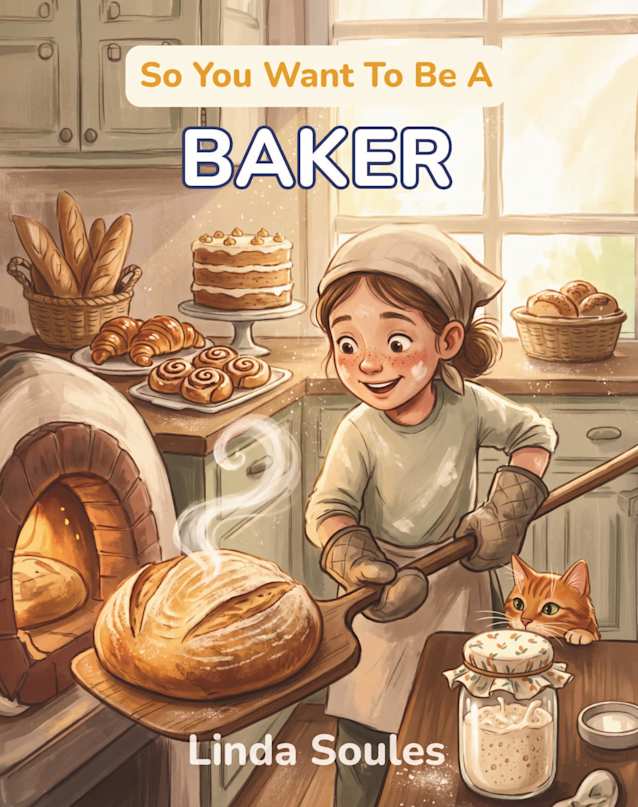
So You Want To Be A Baker (So You Want To Be A...)
About
From the award-winning So You Want To Be A... Series
GRAND PRIZE - 2026 Purple Dragonfly Book Awards
SILVER AWARD - 2026 CIPA EVVY Book Awards, Children’s Nonfiction
Bread rises because of yeast burps. That is just the start of what young readers learn in this book. So You Want To Be A Baker shows kids that baking works more like chemistry than cooking. Readers learn how yeast and gluten trap millions of tiny bubbles, why baking soda needs an acid to fizz, and how bakers fold butter into dough to create the flaky layers of a croissant. Along the way they pick up real bakery words like proof, crumb, oven spring, and lame.
A Day in the Life starts at 3:30 AM, when the head baker unlocks the door in the dark, and follows the team through singing loaves, flat cinnamon rolls, and a birthday cake shaped like a dragon. The book is honest about the hard parts too, from early hours and burns to thin profit margins and food allergies, and explains how people become bakers.
Baking history is full of surprises, from 14,400-year-old bread crumbs found in Jordan and 81 loaves preserved at Pompeii to the Great Fire of London, which started in a bakery. Profiles feature Malinda Russell, Kimura Yasubei, Ruth Wakefield, Dominique Ansel, Nadiya Hussain, and Bryan Ford. Readers also meet bakeries with big hearts and the Bread Lab, where scientists grow purple and black wheat.
Hands-on activities let kids blow up a balloon with yeast, test kneaded dough, and grow a sourdough starter with an adult. The back matter includes a 24-term glossary, recommended books and websites, and baking organizations to explore.
Written for ages 10 to 14 and accessible to younger readers with a grown-up, this illustrated nonfiction book is a perfect gift for kids who love baking and kitchen science, and a great fit for STEM lessons, homeschool families, and school libraries.
Part of the award-winning So You Want To Be A... career exploration series by Linda Soules.
Praise for this book
"So You Want To Be A Baker by Linda Soules is another terrific addition to the So You Want To Be series. Many of us love the smell of freshly-baked bread, but do you know what goes on in the bakery while most of the world is still asleep? This book takes eager readers to a real bakery before the sun rises to show how those loaves and those pastries make it onto the shelves, from why the dough rises to why bakers measure everything and don't just use cups and spoons, to how to become a baker. You may think it sounds like an easy job, and it can be, but there's a lot of science and a lot of work in that dough. Who knew a loaf of bread could be so mysterious?
So You Want To Be A Baker by Linda Soules is filled with glorious pictures, easy language, and readily understood explanations as to how and why baking works. She discusses the why of bread needing yeast (to make it burp, as she puts it), why croissants are all layers, why my all-time favorite pies are hard work, and why those treats we all love may have some of the strangest ingredients. It's more like a chat than an instructive I'm-telling-you-what-to-do book. A Day in the Life follows a team in a bakery from daybreak to late at night and remains brutally honest about what is tough and what is great. There are interesting facts throughout too, including how bread began in the ancient world and life in medieval London. And at the back is a good glossary, a selection of other suggested books, and some at-home experiments (make a yeast-driven balloon) to make the book come alive. If there's a youngster who's eager to bake or learn the whys and wherefores of baking, this book is what they need. This would be equally at home in a school library or as part of a science lesson."
"Do you enjoy working in the kitchen? Making bread from scratch? Did you know good cooking involves chemistry? In Linda Soules’ So You Want To Be A Baker, there’s a lot to consider if you think you want to make good bread, not just on occasion, but all the time, and to make a living making bread. And it is all about chemistry. You have to consider how fresh the ingredients are, especially the yeast, and the quantities (and this is where kitchen math takes precedence). Other things to consider are the hours spent in the kitchen, starting at 3:30 in the morning, which is the best time to start bread rising if you want it ready to enjoy by midday. And there’s the issue of safety to consider – after all, you’ll be working with a hot oven, and the bread will be hot when you take it out of the oven. There’s a lot to consider when baking, especially if you want to make baking your career choice.
Linda Soules’ book, So You Want To Be A Baker, is another interesting introduction for young people considering a career in baking. The author discusses the art and science of baking, the joy of creating something worth sharing, and the math and chemistry of making the best product possible. There are interesting stories that surround the history of baking, an art that dates back tens of thousands of years, to findings of 14,400-year-old bread crumbs in Jordan and 81 loaves preserved at Pompeii. And there are the famous bakers throughout history who excelled at the craft and bakeries that made a unique mark on the art of fine breads. At the end, there’s an interesting glossary of baking terms, some fun activities to try in the kitchen like blowing up a balloon with yeast, resources for further study, and so much more. A great way to introduce young readers to the world of baking."
"Have you ever thought about how much effort goes into making a loaf of bread? In So You Want to Be a Baker by Linda Soules, readers find out what this profession is really like. There's more to being a baker than most kids (and even adults) realize. For one thing, it involves quite a bit of math. They have to measure everything carefully, and getting even one ingredient wrong can cause problems. Children also learn about the different places these professionals work and some of the equipment they use. Soules explains what happens to dough when yeast is added and why it makes a loaf rise in the oven. This book takes us through a typical day at a bakery, beginning long before most people are awake. Of course, the job has its challenges, too. Readers are introduced to several famous bakers and discover some interesting facts about bread throughout history. Did you know that the sliced kind was invented in the U.S. in the 1920s? There are even activities kids can try at home. Could you see yourself doing this job someday?
So You Want to Be a Baker by Linda Soules is one of my favorites in this series so far! It’s fantastic how much attention was given to math. Kids often wonder when they'll ever use certain things they're learning in school, and this book gives them some good examples. The historical information about bread was very interesting. I had no idea people once used bread as an eraser! Soules explains everything in a way that's easy to understand without talking down to young readers. My students would love to read this book because they love to talk about food. A few fun follow-ups could include comparing different amounts of flour, practicing using measuring cups, or even making something simple together. The illustrations are colorful, full of detail, and look very realistic. Young learners who like helping in the kitchen or want to know more about what it takes to be a baker will want to read this one. Baking isn't just about getting the measurements right. There's room for imagination, too!"
"Linda Soules invites young readers into the warm, flour-dusted world of baking in So You Want to Be a Baker, a children’s book that explores what it takes to turn simple ingredients into delicious creations. From crusty loaves and flaky croissants to elaborate birthday cakes, the book captures the creativity, science, and dedication behind a profession that touches people’s lives every day. Soules begins by explaining the fascinating chemistry of baking, including how yeast makes bread rise and how different ingredients work together. She has a friendly, enthusiastic way of presenting information that encourages curiosity. Readers who love helping in the kitchen will recognize familiar activities while discovering just how much goes into the treats they enjoy.
One of the book’s most engaging qualities is its detailed look at a baker’s daily life. Soules introduces readers to the tools, techniques, responsibilities, and challenges involved in running a bakery. She explains everything from measuring ingredients accurately to managing early mornings, working with teammates, and keeping customers happy. A particularly interesting section follows a neighborhood baker through a typical workday, giving children a sense of the profession’s demanding schedule. The book also explores the qualities that make someone successful in this field, including patience, precision, creativity, and stamina. Along the way, readers discover how math, science, and even an understanding of the weather play important roles in baking.
The illustrations bring plenty of warmth and personality to this colorful picture book. Cozy kitchens, glowing ovens, bustling bakeries, and tables overflowing with freshly baked goods create an inviting atmosphere. The detailed artwork features expressive characters of different ages and backgrounds, helping readers imagine themselves working in a bakery. Some illustrations are especially playful, including a humorous flour explosion and cleverly imagined sourdough starters with distinct personalities. Other scenes highlight the relationships between bakers, their customers, and their communities. The golden lighting and rich colors make the bread and pastries look especially tempting. Although many pages contain substantial amounts of text, the artwork provides appealing visual moments that complement the information and help keep young readers interested.
Soules also gives the book a meaningful sense of history and community. Readers meet notable bakers from different backgrounds, learn surprising facts about bread through the centuries, and discover how bakeries contribute to neighborhoods through generosity and shared traditions. Sections featuring amusing baking mishaps, unusual facts, and simple experiments add variety, while practical suggestions encourage children to try baking at home with an adult. A glossary and additional resources offer opportunities to keep exploring. Best suited to curious older elementary readers and children who enjoy nonfiction, So You Want to Be a Baker combines career exploration with food science, history, and hands-on inspiration. It’s an appealing introduction to a profession built on skill, imagination, hard work, and the pleasure of making something other people can enjoy."