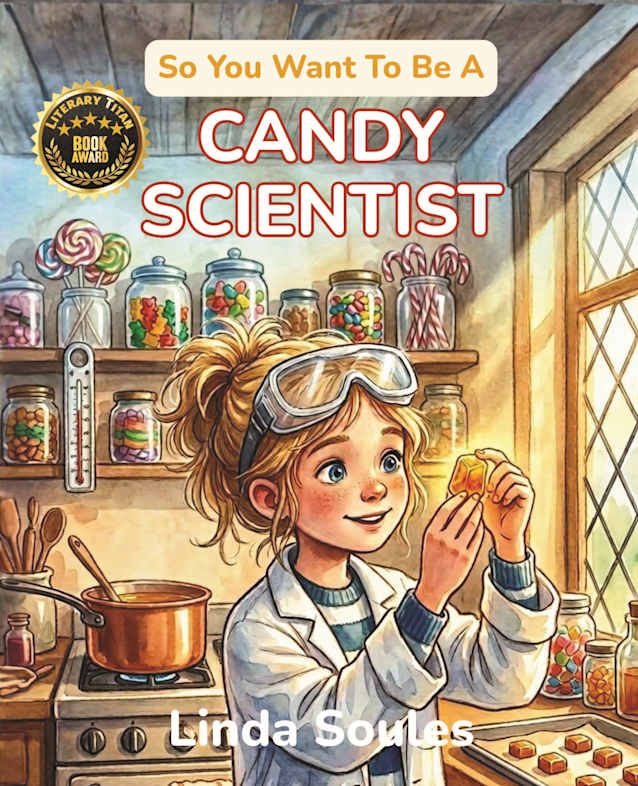
So You Want To Be A Candy Scientist (So You Want To Be A...)
About
WINNER of the Literary Titan Gold Book Award
What if the candy your kids eat every day is actually one of the most fascinating science experiments on the planet — and someone had to figure out exactly how every step works?
So You Want To Be A Candy Scientist pulls back the curtain on a STEM career most people never think about: the food scientists who turn plain sugar into hard candy, silky caramel, airy marshmallow, and so many other treats we love. Written for curious kids ages 10 to 14, this richly illustrated, visual guide makes chemistry feel like an adventure — fun, surprising, and easy to follow, even if your young reader has never picked up a science book before.
The stories inside are as wild as the candy itself. Kids learn why the same sugar becomes chewy at one temperature and glass-like at another. They find out how chocolate is coaxed into a precise crystal form for that signature snap. They explore the real chemistry behind sour candy, discover why cocoa butter makes chocolate the only candy designed to melt at body temperature, and uncover how food scientists use color to trick the human tongue. Every section reads like a conversation, not a textbook, because the best science writing takes young minds seriously.
This book also introduces kids to real pioneers in food science — the chemist who fought to make candy safe for children, the inventor who cracked shelf-stable milk chocolate, and the researcher who found a natural blue dye hiding in red cabbage. Their stories show that a career spent perfecting something as small and joyful as candy is meaningful, rigorous work.
Then it is time to get hands-on. Science experiments and activities guide kids through growing rock candy at home, making edible sugar glass, and running a chocolate snap test — all connected to the food chemistry concepts they have just learned. A glossary of candy-science terms and a roadmap to next steps help young readers keep exploring long after the last page.
For kids who love asking “why,” for families who want STEM reading that sparks real curiosity, and for anyone who has ever wondered what it takes to make delicious happen on purpose — this is the book that answers.
One molecule. Endless possibility.
Praise for this book
"Have you ever wondered who creates your favorite candies? So You Want to Be a Candy Scientist by Linda Soules explores a typical day on the job as a candy scientist. This children’s book pulls back the curtain on how candy scientists dream up and create everything from gooey caramels to crunchy lollipops. Readers see how sugar transforms, check out the cool tools they use, and find out how teamwork makes all that magic happen. Making candy may sound perfect, but like all careers, it isn't always easy. It takes patience, lots of trial and error, and a willingness to try again when things don't work out the first time. After learning about this “sweet” job, would you want to give it a try?
I’ve read several of the books in this series, and So You Want to Be a Candy Scientist by Linda Soules is as enjoyable as the others. It’s packed with a lot of information, but it was still easy to understand. I learned a lot, like how something as simple as changing a temperature can completely change the final product. As a teacher, I’d read it during a unit on careers, the food pyramid, or around Halloween. I'd follow up by talking with my students about favorite candies, experiments, and how science is used every day. I’d also have them design their own candy, including a written explanation and a drawing of it. The illustrations are colorful, detailed, and full of energy. Anyone looking for a behind-the-scenes look at an interesting career or learning how everyday things are made will want to pick this book. I finished reading with a new appreciation for the work that goes into creating candy. Who knew candy could make science so interesting?"
"So You Want to Be A Candy Scientist is a delightful and informative children’s book that turns candy into a gateway for scientific discovery. Written for curious young readers, the book explores the fascinating work of candy scientists, showing how chemistry, creativity, and problem-solving come together to make the treats kids know and love. From gooey caramels and crunchy lollipops to chocolate that melts just right, Soules explains how small changes in temperature, texture, and ingredients can completely transform the final product.
One of the book’s greatest strengths is how accessible and engaging it makes STEM concepts feel. Rather than reading like a textbook, the book feels conversational and inviting, helping readers understand topics such as sugar stages, chocolate tempering, sour candy chemistry, and the science behind color and flavor. Young readers learn that a lollipop is technically glass, cotton candy is mostly air, and chocolate gets its satisfying snap from carefully formed crystals. These fun facts make the science memorable while encouraging children to keep asking “why.”
Author Linda Soules also does an excellent job introducing the real people and teamwork behind candy making. Readers meet pioneers such as Harvey Wiley, Milton Hershey, and Rebecca Robbins, whose discoveries helped shape candy safety, shelf-stable chocolate, and food coloring research. The book highlights that being a candy scientist is not just about tasting sweets all day; it takes patience, careful testing, communication, and the willingness to try again when experiments fail. This career-focused angle makes the book especially useful for classrooms, STEM lessons, and career exploration units.
The hands-on experiments and reference materials at the end make this book even more valuable. Activities such as growing rock candy, making edible sugar glass, and testing chocolate snap allow children to turn their own kitchens into mini laboratories. The colorful illustrations, clear explanations, glossary, and next-step resources all work together to inspire curiosity long after the final page. So You Want To Be A Candy Scientist is a fun, educational, and inspiring read for families, teachers, and young learners who want to discover how science helps make the world a little sweeter."
"So You Want To Be A Candy Scientist by Linda Soules takes a question kids actually ask and gives it a proper answer: how can one ingredient become fudge, caramel, or a glass-clear lollipop? The book treats candy science as real work, not a novelty topic.
Far more than a career snapshot, this guide builds a clear path through crystallization, flavor chemistry, factory scaling, and a realistic day in the lab, connecting each topic to candies children already know. What stayed with me was the saffron caramel passage, where one timing miscalculation becomes a sharp lesson in patience and scientific method rather than a simple mistake. Back-of-book activities and a thorough glossary support independent reading for ages 10-12, while parents and teachers will find solid material for guided discussion and hands-on follow-up at home.
Soules does not flatten the science into empty phrases. She explains crystalline fudge versus amorphous sugar glass, and why a Brix reading matters, in language a ten-year-old can follow. As part of the So You Want To Be A... series, the tone sits closer to a good talk than a lecture. I liked that the pictures of refractometers and texture probes match what the text describes, which helps the lab sections land instead of feeling abstract.
I would keep this within reach of any kid who keeps asking why candy behaves the way it does. It probably will not put a lab coat on everyone, but it does change how you look at a bag of sweets sitting on the kitchen counter."
"My kids really enjoyed this book! It was a fun way to learn about how candy is made and the science behind it. The information was interesting without being too complicated, and it brought up lots of questions and conversations while we read together."
"As an elementary school teacher, I am always looking for books that spark curiosity, encourage learning, and introduce students to exciting career possibilities. So You Want to Be a Candy Scientist by Linda Soules does all of that in a fun, engaging, and age-appropriate way.
This book offers young readers a fascinating look into the world of candy science, blending STEM concepts with a career that instantly captures children's attention. Linda Soules does an excellent job of explaining what candy scientists do while introducing readers to the science, creativity, and problem-solving skills involved in creating the sweets we enjoy every day.
What I especially appreciated as a teacher is how the book makes science feel accessible and exciting. Students who may not initially see themselves as scientists can easily connect with the topic because it relates to something familiar and enjoyable. The clear explanations, engaging writing style, and interesting facts make learning feel natural and fun.
The book also encourages students to think about future careers in a positive way. It highlights the importance of education, curiosity, teamwork, and perseverance while showing that science can lead to unique and rewarding opportunities. I can easily see this book being used in a classroom during STEM lessons, career exploration units, or as a read-aloud to inspire discussion.
Overall, So You Want to Be a Candy Scientist is an informative, entertaining, and inspiring read that will appeal to young learners and educators alike. Linda Soules has created another wonderful resource that encourages children to dream big, explore science, and discover the many exciting careers available to them. I highly recommend this book for classrooms, school libraries, and families looking to nurture a love of learning."
"This might be a children’s book, but this adult thoroughly enjoyed it and learned so much about the science of candy making! Readers will be fascinated by topics such as how candy is made (spoiler - every kind of candy starts with the same single ingredient!); what the day in a life of a candy scientist looks like; the best, hardest, and most surprising parts of this job; famous candy scientists in history; what qualities are needed to be successful at this job, and much, much more. Anyone who loves candy will love this interesting, fact-filled book about the life of a candy scientist!"
"Very innovative and scientific without overpowering the reader. Excellent read for any young person interested in cooking."
"So You Want to Be a Candy Scientist by Linda Soules is a fun book that shows kids how science and sweets go together. Instead of telling a fictional story, the book talks directly to the reader and explains how candy is made, starting with just one ingredient, sugar, and turning it into many different treats like caramel, fudge, and lollipops. It describes how candy scientists carefully heat, cool, and mix ingredients to create different textures and flavors, and it even explains cool ideas like why some candy is smooth while others are crunchy or glass-like. Readers also learn about the exciting parts of the job, like inventing new flavors, as well as the challenges, like getting the temperature exactly right so the candy doesn’t fail. The book feels like a mix of science lesson and adventure, encouraging kids to stay curious and experiment.
The illustrations make the book even more engaging by showing colorful candy, lab tools, and step-by-step processes that bring the science to life. These visuals help explain tricky ideas, like how sugar changes at different temperatures or how scientists test candy texture and color. Bright, detailed images of candy and equipment keep readers interested and make the learning feel hands-on. Together, the clear explanations and eye-catching illustrations make this a delightful and educational book for kids who love sweets and science"
"Such a fun bright and colorful but educationally engaging book. Great for readers 8 and up. Learn all about the science behind candy in such a charming way with this book."
"This was a great read with my babies. I think they will appreciate candy more now that they know the process. Chemistry at its best!!!"
"I learned so much from this book and if you’re interested in becoming a candy scientist you will too. From learning the different temperatures of sugar and what happens to seeing the steps each piece goes through before it hits the shelf. They even have a safety scientist to make sure it’s safe. Would recommend this book."
"This was a really interesting book, and I learned a lot about the methods of working with sugar. All candy exists in only 1 of 2 molecular states: Crystalline candy or Amorphous candy; fudge/caramel or lollipop/glass candies. Who knew?! Loaded with info, this was a fun read. Highly recommend."
"My daughter is homeschooled and she was so excited to learn all about food science and candy making for a science project! She loves testing out different hypotheses and this is a fun way to introduce her to many science topics which she is now eager to learn. I loved this book too as a parent. The explanations for creating candy are written from a scientific point of view and brought back to tools or concepts in science."
"Very cute read for anyone interested in how candy works! I enjoyed this book as an adult who was always interested in how the process worked. It was so helpful to learn about how they test and I love the fun facts section. As usual, these books have amazing imagery, vivid colors, and a way of showing rather than just telling."
"This book is perfect for anyone who loves candy and chocolates. It is full of information on how it's made and the science behind it. It also includes some things you can try out to practice being a candy scientist now!"
"Great topic! This book is very interesting, especially since so many of us enjoy eating candy. I'm especially interested in the fact that this is a potential job. I'd love to share this with young candy enthusiasts to see what they thought. As always, the author does an amazing job telling about this career."
"These 'So you want to be' books are amazing! I love them and my kids love them from 13 years old down to 5 years old. These books are for children but I think many adults would appreciate them as well. This one in particular was interesting. A candy scientist sounds like a fun career especially to children. The books are written to give insight into what the daily work looks like for a candy scientist and what they need to learn in order to do their jobs. The end gives a glossary for terms used in the book for explaining what certain scientific words mean."
"This book is so educational, it hurts! I know every kid LOVES Willy Wonka and this just absolutely breaks it down to the basics. Personally my middle and me read this and afterwards, we found a candy making kit on here so we can make our own!!"
"From cover to cover, this book was a truly SWEET 🍭 and enjoyable read. Not only would this book be easy for young children to read and appreciate, but adults, teens, people of all ages can appreciate, and enjoy learning fascinating and educational facts about candy, the science of how different and various types of candy are made, and the many different types of jobs that people do to learn about candy, and keep it fresh, delicious and safe for consumption. With the book being just 39 pages, it's a quick and easy read, but still filled with valuable information. Personally, my favorite part of this book was the instructions on how to use the amazing and wondrous powers of science 🧪 to make different types of candy. Anyone with a sweet tooth 🦷 or a craving for knowledge would appreciate this wonderfully written book. 10/10 would read it over and over again!"
"This is a very interesting book about being a scientist. The author takes time explaining how one ingredient can make all different kinds of candy. Who doesn't love candy! I was like a kid in a candy store just reading about it (lol). The author even talks a little about a few people in history and how they contributed to the candy we eat now like Hershey's chocolate. The author shares that scientists can have fun developing and trying (taste testing is always fun). The graphics were really good and entertaining as well as the story."
"As an elementary teacher, I LOVED this book and I cannot wait to use it in my classroom. There’s so many elements to use for a multidisciplinary lesson for kids that hone in on special interests. I mean who doesn’t like candy right? There are bold headings to talk about text structure and central ideas, the science aspect where you can discuss traits of different candies and get hands on with experiments and microscopes, the historical timeline of important candy scientists, and various writing prompts that can keep students engaged (opinion: favorite candy, descriptive: create a new candy, narrative: pretend you're a candy scientist, etc). You can even graph the different temperatures where the different type of candies melting points! The author is informative and simplistic yet rich in vocabulary with great explanations of new words."
"Recently found this series for my classroom and want to add more topics. Kids love candy so this was an instant yes! The illustrations are well done and I love that a wide variety of reading levels can access this book. There is also extra information at the end of the book that adds to the overall reading experience. This includes the glossary, fun facts, a look in the day, questions to ask, and other fun things! I also love that the focus of the book is on the science instead of just the candy."
"My 6 year old granddaughter (who loves candy and anything sugary) and I loved this book! We both learned how chemistry and science are involved, who candy scientists/inventors are and what they do, the lab and factory work, equipment needed, texture, flavor, visual design, and testing until the perfect candy is made. The author gives a quick snapshot about famous candy scientists like chemist Harvey Wiley whose beliefs resulted in the Pure Food and Drug Act in 1906, Milton Hershey and his Hershey Chocolate Company, and Rebecca Robbins and her candy color research. There are also fun facts and tips for young readers to prepare now for this exciting occupation. This book is easy to read and understand with delightful drawings."
"In this book, Linda Soules helps give an in depth look into the careers of those behind the calculated chemistry of all the creative confections that have brought delicious fun and sweetened smiles to the world. We get a glimpse at the precision demanding process that has been perfected with patience and science to keep our favorite sweets consistent, safe, and tasty from small batch trials to shelf worthy mass distribution scale. Learn about how the Millard Reaction is implemented to give us the vast variety of candies we have come to know and love. Meet the different members of a candy creating collaboration team, that through trials and experiments, and with cooperation, teamwork, and communication, deliver sugary delights. Part chemistry, part cooking, candy making is a science for the senses and Soules explains the workday of the scientific chefs brilliantly.
My favorite section of the book is the reference section at the end which gives a very thoughtful list of resources for anybody wanting to learn more about this career path or about the field itself. Even better, included in this section is a personal note from Linda herself that I happen to agree with, that while yes, science is extremely important, and serious sciences like medical do exist, that doesn't mean that the time and care put into the more 'for happiness and fun' sciences, like candy making, isn't just as important or worthy of that dedication and effort. Yes, the world needs medicine to help treat and cure, but, the world also needs things like candy, to remind us of the sweetness of life."
"It is such a great introduction to candy making and being a candy scientist, which most kids don’t even realize is a type of scientist! The book explores types of candy, what a candy scientist does and traits to being successful. It lists in detail what an average day of work looks like for a candy scientist. It details the pros and cons of being a candy scientist and includes fun facts about candy. This is another great addition to the 'So you want to be a … Scientist' collection."
"Everything you wanted to know and more about the career of making candy. I love how it gives you so many fun facts and realistically useful ideas and expectations! This book series is amazing for kids looking to explore career goals!"
"We absolutely loved this one! The illustrations are so life like and really draws you in. The book breaks down how some of our favorite candies are made and the science behind it all. The book teaches about some of the great minds that have made candy today so wonderful. There's also a few recipes/science experiments to try out at home as well."
"Love all of these job books including this one! Very well written & packed with tons of information for all ages. These books really give a compact, but deep dive into various careers. Really enjoyed learning everything about the candy business!"
"Loved the illustrations & such a fun read! Truly walks through in a way that’s interesting for kiddos to follow along with!"
"I really enjoyed So You Want to Be a Candy Scientist by Linda Soules. It's a fun and educational book that does a great job introducing young readers to the science behind something almost everyone loves...candy. Rather than simply explaining how sweets are made, the book explores the chemistry, creativity, and teamwork involved in developing new treats, making STEM feel both approachable and exciting.
One of my favorite parts of the book was learning about Milton Hershey's and his delicious chocolates.
The hands-on activities throughout the book were another highlight. I always appreciate books that encourage readers to experiment for themselves instead of simply reading about a topic. The kitchen experiments are simple enough to make learning interactive while reinforcing the scientific concepts discussed in each chapter. I can easily see this being a great resource for classrooms, homeschool families, or curious kids who enjoy asking 'why' and 'how'...I also appreciated that the book doesn't just focus on the finished product but gives readers a glimpse into different careers involved in food science. From developing recipes and testing ingredients to working with quality control and manufacturing, it shows that creating candy is a true team effort. I think that's an important message for young readers because it demonstrates that science isn't limited to laboratories...it can be found in creative, everyday careers that many people never even considered.
Overall, I thought this was an enjoyable read that makes science both accessible and fun. Even as an adult, I came away from learning interesting facts. Even though I'm not the target audience, I still found myself learning several things I never knew before. Books that can make learning this enjoyable are always worth picking up, and I think young readers with curious minds will have a lot of fun with this one."
"My son love hearing about the candy lab and all the different equipment used to test things like how hard or chewy the candy is. The part about rock candy having bigger crystals and lollipops being more like a glass really gave me something simple to explain to him. We also talked about caramelization and the Maillard reaction, although I definitely had to explain those in 'kid language.' 😂 The saffron caramel example was another one I liked because it showed that making candy isn’t just throwing ingredients together. The scientist had to figure out that the saffron would lose its delicate flavor if it was added too early, but would bloom when added after the heat."
"I love this series! Even as an adult I am so intrigued by these books. There are so many jobs I didn't realize existed. As a teacher, this book and so many within this series open up children's minds to all the possibilities of careers. The illustrations are such a key part to this book and would draw in so many readers, young and old. This book is full of fun facts both about candy, but candy scientists in our history. Hershey is a well-known creator, but it was interesting to learn about the other two scientists. I appreciated the author showing a woman candy scientist who paved the way with natural ingredients for the perfect blue color."
"This was such a fun and interesting book to read with my kids! This book takes something children already love [candy] and uses it to introduce them to the fascinating science behind how it’s made. We especially enjoyed learning how changes in temperature can turn sugar into everything from soft fudge and chewy caramel to hard candy, and how scientists use chemistry, testing and taste panels to create the perfect treat. The colorful illustrations kept the kids engaged, while the behind-the-scenes look at candy labs and factories made the science feel approachable and exciting. This is a great book for curious kids, especially those interested in science, cooking, or, of course, candy!"
"This book is fun and educational and does a great job introducing young children to the science of candy. The kitchen experiments are easy and interactive which keeps kids engaged. I thought this was a great book to make science fun for children who have an interest."
"The So you want to be series 196 books and I am now on a quest to read them all! SO well researched, always learning something new or adding t my knowledge, love the profiles of specific people who made a difference in candy making. I learned the backstory oof how candy scientists make and improve candy. How Harvey Wiley and is volunteers improved. Food safety literal volunteer, Guinea pigs in human form testing food additive. Safety. He made the FDA possible more than a century ago, and Rebecca Robbin’s making a true blue candy color, from purple cabbage. After learning a big ball of cotton candy only has about one spoon of sugar in it I won’t feel half as guilty eating the fluffy ball of sugar. Such a good fun book, for career of a child’s dreams!"
"This book is amazing! I love the idea of making science fun and relatable for kids. It also introduces a new career path that many kids would never know even existed. This story takes the reader on a path of what some different types of candy are, the science used to make them, and then how to get to the end result. As a woman in science, I love showing kids some under represented careers and making them look as amazing as they are. Read this with your kids, your family, and just for you!"
"Growing up, I was always someone who loved candy, so I thought I had a pretty good idea of what went into making it. However after reading this book I realized there is actually so much more science behind something I would normally just enjoy without thinking twice. I found it really interesting learning how things like temperature, sugar crystallization, and the way ingredients are combined can completely change the texture and outcome of a candy. I also enjoyed learning about the different tools and testing methods candy scientists use to make sure everything comes out the way it is supposed to.
What stood out to me most was seeing that being a candy scientist is about much more than simply creating sweets. There is a lot of experimenting, problem-solving, patience, and attention to detail involved, especially when taking something from a small recipe to large-scale production. Overall, I thought this was a fun and informative read, and it definitely made me appreciate candy a little differently. Now, the next time I have a piece of candy, I’ll probably think about the science that went into making it before I eat it."
"Tells you everything you could need to know about a candy scientist. There are small chapters on what they do, where they work, pros and cons of the job, what kind of tools, what they should expect, and so much more. It also explains different types of sugars, textures, sourness, and more. Very informative while being easy to read for elementary age kids and up."
"This is a fun and engaging book about the science behind candy making written in a way that young readers can easily understand.
I especially enjoyed how the book explains that small changes in temperature, stirring, and ingredients can completely change the texture and outcome of candy. Candy making is definitely harder than it looks!
The sections on the best and hardest parts of the job give children a realistic picture of what a candy scientist actually does, including experimentation, teamwork, and learning from mistakes.
The colorful illustrations make the information more inviting and help bring the science concepts behind candy making come to life.
This would be an excellent choice for elementary and middle-grade readers (like ages 9-12) who enjoy science, cooking, or discovering unique careers."
"I think This book would be fantastic for anyone between the ages of 10 to 12 years old who loves candy! It gives a sneak peek into what it takes to be a candy scientist.
The reason I choose this age group is because it's not too heavy of a read but full of important information while also keeping the reader interested with the beautiful illustrations."
"The book takes us into a lovely informative journey on what the Candy Scientist does and who they work with. It is a complete book which tells the reader the tools used, the place where Candy is made, how it is made, the fun facts about candy, a day in a life of a candy scientist and famous candy scientists.
A candy scientist invents , transforms & improves recipes. They have a sharp sense of taste and are very creative in kitchen. They work in factories, food labs in companies & universities. Basically they work with trial and error , perfecting the candy for us. They mix colors, flavors and textures to make new treats. They test ingredients to make sure that they are safe to consume. They work with different temperatures to see the shelf life of candy and how the candy will stay in hot or cold climate. A group of candy scientists work together and taste the stuff.
The candy scientist is part chef, part inventor and part tester.
Must read book for knowledge as well as if you are going to choose this career."
"So You Want to Be a Candy Scientist is an interesting and entertaining book that shows readers that making candy is much more than simply mixing sugar and adding flavour. It explains how science is involved in creating the sweets we eat every day, making the book both educational and enjoyable. I would recommend it to anyone who likes science, food, or experimenting with new ideas.
One of the best things about the book is the way it connects science to something familiar: candy. Instead of making science seem complicated or boring, it uses sweets to explain concepts such as temperature, texture, crystals, and chemical changes. This makes the information easier to understand, especially for younger readers. The book encourages readers to think about why candy behaves differently when it is heated, cooled, stretched, or mixed with other ingredients.
I also liked how the book introduces the idea of being a candy scientist as a real career. It shows that scientists can work in creative industries and that science is not limited to laboratories or textbooks. Candy scientists need to understand chemistry and physics, but they also need imagination and problem-solving skills. This is an important message because it demonstrates how different subjects can work together in unexpected ways.
Another strength is the book's engaging approach. The subject itself is fun, and the explanations make you curious about what happens when different ingredients are combined. Readers may find themselves looking at ordinary sweets differently after reading it. A simple piece of candy can suddenly become an example of an interesting scientific process.
Overall, So You Want to Be a Candy Scientist is a fun and informative read. It successfully combines science with something that most people already enjoy: candy. I especially liked how it encourages curiosity, creativity, and experimentation. The book proves that learning science can be exciting and that even making sweets can involve fascinating scientific ideas. I would recommend it to young readers who enjoy discovering how things work."
"Very informative but cute book! Would suit pre-teens or advanced 8-10 year olds. Love that it has thought provoking elements to it."
"This gives you a great insight into the world of candy whilst also educating you on so many things. I’d never thought about how a small test recipe that’s works great can react in a different way when scaling up. And white chocolate not being chocolate...well, that I agree with. Love how it also gives you a day in the life of… the best bit was the images to go alongside. Very eye catching."
"Very good book and very informative. I highly recommend it to anyone wanting to know more about how candy is made and the science behind it. I feel kids would enjoy this book and learning how candy is made"
"This book is super interesting! The illustrations are nice and colorful! This book would be fun to read and then do a project of making candy, using the science that was discussed. Love how it incorporates a STEM side to the book. What a great way to incorporate fun, reading, and science all into one lesson. Great book for adolescents to read with adults and do group activities. This book makes learning fun! It literally had me thinking outside the box for this career, as I never would have thought of things I might not have expected to need. Like how there’s additional resources at the end of the book for books to read next, additional websites to explore and even more things to do if interested in this as a career."
"I thought this book was very good. The writing and language is great for an advanced young reader looking for a lot of detail in a smaller book. The candy making process was very interesting and taught me a lot about the behind the scenes making of candy. Who would have thought a treat bought thousands of times a day was so complex? I liked the brief biographies at the end of the book to give you information on famous candy makers! Hershey is one of my favorite chocolate makers!"
"So You Want to Be a Candy Scientist shows that making candy isn't just luck—it's a real science. Author Linda Soules explains how basic ingredients like sugar, chocolate, and water turn into all kinds of treats using heat, timing, and chemistry."
"This book is a fun and engaging introduction to the world of candy science. It makes learning about science feel exciting and easy to understand."
"My kids and I read this book together and I feel that I learned just as much as they did about candy. The reality that candy in all forms is created from Sugar.
As a child it was creative and held their attention , as an adult it explained the sugar heat requirements to transform from sticky, fluffy to chewy.
Interesting, entertaining and informative. never knew so much work went into something so small, simple & sweet/sour. Candy makes the world a happy place!
Worth the read!"
"I really enjoyed reading this book. It was very informative, and honestly, I hadn't given much thought to how various types of candy are actually made until I read it. Kudos to the writer for opening my eyes to this process and now I even see myself as a bit of a scientist too haha. My kids will love this!"
"This book was so interesting! When I usually think of candy, I don't think much of it, just that it tastes good. It was so cool to learn that there is actually a lot of science to it. This would be a great book for a child (or adult) learning about creating candy and all that goes into it. The day in the life section was especially interesting (there is so much that goes into it) and I liked learning about the famous candy scientists in history. This is a cool book that shows an occupation that a child might not naturally think of on their own. I will be showing this to my daughter!"
"This book is really informative and targets the children to better help educate them in the science of everyday living. What it takes to be a scientist whether that be with food or with the curiosities of the world. I recommend for children and parents that are really into the how to’s of how candy works."
"The book was a very informative book, at an age appropriate level. Excellent for an elementary age kid to use as a reference material. The pictures were cute with lots of fun details!"
"Fantastic and FUN little science book! Great illustrations and pictures, it's a perfect kid's book that breaks down the technical side of candy making, without getting complicated."
"This was the first book I have purchased of this series and I thought it was very well written with excellent illustration. My 13 year old grandson enjoyed this book a lot and wants to read all of the others to decide what he wants to do in life."