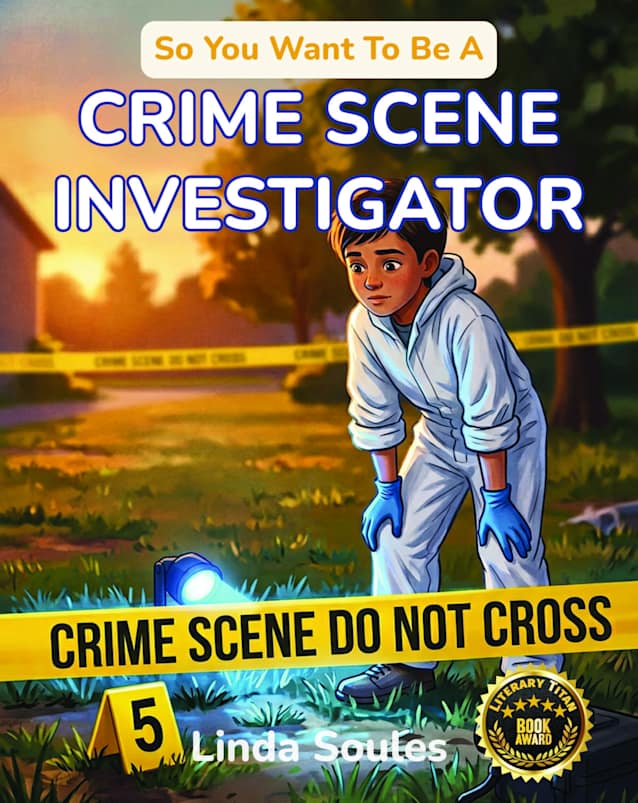
So You Want To Be A Crime Scene Investigator (So You Want To Be A...)
About
WINNER of the Literary Titan Gold Book Award
The call comes in at 2 a.m. By the time you arrive, the scene has already begun to change — temperature dropping, evidence shifting, memory fading. In the time it takes to pull on your gloves and cross the tape, you have already begun reading. The position of objects. The absence of things that should be there. The story the scene is trying to tell before anyone has thought to ask the right questions. Crime scene investigation is the discipline that never stops demanding precision — and the investigators who reach the highest level are the ones who never stop looking closer.
So You Want To Be A Crime Scene Investigator takes young readers ages 10-14 inside one of the most rigorous and most consequential careers in law enforcement — not the television version, but the real one. The years of scientific training and methodical field experience that happen long before an investigator works a case that goes to trial. The specific discipline of developing a mind that can move through chaos without disturbing it, document what others overlook, and apply the principles of biology, chemistry, and physics to questions that matter more than almost anything — what happened here, and how do we prove it? The team of forensic specialists, detectives, medical examiners, and prosecutors working in careful coordination so that the evidence collected at a scene becomes the foundation of justice. The investigation that comes together perfectly — and the one that demands you find an answer no one else has thought to look for yet.
This is a book about what crime scene investigators actually do: the evidence collection techniques they execute with a precision so practiced it becomes second nature, the forensic science they apply by understanding how the physical world records every action whether anyone intended it to or not, the documentation discipline they maintain to preserve a chain of custody that can withstand challenge in a courtroom, and the mental steadiness they cultivate to work calmly and carefully when the stakes are highest and the pressure to get it right is absolute. It’s also a book about what the career costs, what it demands, and why the investigators who do this work say that the cases no one else could solve are the reason they never stopped learning.
Inside, young readers will discover:
- What a real crime scene investigator’s training and professional life actually looks like — from forensic science coursework to field work to the specialized disciplines within the field
- The science behind elite forensic investigation — DNA analysis, fingerprint examination, trace evidence, digital forensics, and what separates a thorough investigation from a compromised one
- The mental demands of working at the intersection of science and justice — and how investigators develop the focus, objectivity, and analytical discipline the work requires
- The history of forensic science and the pioneering investigators whose methods transformed criminal justice from witness testimony into evidence-based truth
- What young people can do right now to discover if this might be their calling
Honest, specific, and genuinely illuminating, So You Want To Be A Crime Scene Investigator doesn’t talk down to young readers — it brings them all the way in. Because the child who wants to know what this work is really like deserves a real answer.
For readers who feel the pull toward a career that rewards patience and scientific thinking in equal measure. For the kid who notices what others walk past, who asks how we know.
The tape is up. The scene is waiting.
Praise for this book
"So You Want To Be A Crime Scene Investigator by Linda Soules is a well-written book capable of inspiring children who want to be crime scene investigators in the future. Linda starts by explaining what a crime scene investigator does, including taking photographs of crime scenes, collecting samples, and fingerprints, among other evidence, while following standard procedures so that the evidence collected is admissible in court. At the lab, some evidence from the crime scene is further analyzed with various scientific instruments and methods. Linda also talks about the equipment crime scene investigators use, the best, worst, and most surprising aspects of their jobs, and the qualities a crime scene investigator possesses.
This book was a lot of fun to read as an adult because it explained the fundamentals of forensics in a simplified way, with respect to the collection, preservation, and analysis of evidence from a crime scene. This book would also be a wonderful way to educate children who want to be crime scene investigators about what it takes to be a CSI. They would also appreciate the advancement of science and how it has helped in solving complex crime cases more efficiently. The illustrations and fun facts were brilliant; they made this book more engaging and visually appealing. The writing is concise, well-paced, organized, and easy for kids to comprehend. Themes featured include teamwork, science, patience, critical thinking, and more. I recommend So You Want To Be A Crime Scene Investigator by Linda Soules to all children aspiring to be crime scene investigators and adults who enjoy reading children's books."
"So You Want To Be A Crime Scene Investigator by Linda Soules is a fascinating and kid-friendly guide for young readers who are curious about forensic science and what crime scene investigators actually do. Instead of giving kids the flashy TV version of CSI work, this book explains the real job in a clear and honest way. Readers learn about photographing crime scenes, collecting fingerprints and samples, documenting evidence, protecting the chain of custody, and making sure everything is handled carefully enough to hold up in court.
What makes this kids book especially interesting is how well it connects science to real life. DNA analysis, fingerprint examination, trace evidence, bloodstain patterns, and lab work are all explained in a way that feels easy to understand without being boring or watered down. The book also shows that crime scene investigation is not just about finding clues. It takes patience, focus, teamwork, critical thinking, and the ability to stay calm when the pressure is high.
The detailed illustrations and fun facts add a lot to the reading experience. They make the information more engaging and give young readers something to look at and really imagine the job. I also liked that the book talks about different kinds of forensic work, the history of forensic science, and even the emotional side of the job. The book states, “Crime scenes are places where something bad has happened…” That honesty helps kids get a fuller picture of the career, including both the exciting parts and the serious responsibilities.
This is a great choice for children who are interested in science or future careers in crime scene investigation. It’s organized, informative, encouraging, and has extra resources that help kids keep learning after they finish the book. So You Want To Be A Crime Scene Investigator is not only useful for young readers, but also enjoyable for adults who like learning about forensic science in a simple and engaging way."
"Linda Soules's Crime Scene Investigator stands out as a career guide that meets young readers on their level while refusing to dumb down the science. Brisk, honest, and free of thriller gloss, it suits curious kids ten to twelve and the adults guiding them.
The book invites curiosity with a clear, respectful tone that never talks down to its audience. It explains field and lab work, why evidence cannot be replaced once disturbed, and how DNA, fibers, and fingerprints tie to chemistry and biology classes. Cases such as the Atlanta fiber evidence make the science feel immediate without sensationalism. Parents will value the honesty about emotional strain, long waits, and science that can free the wrongly accused. Hands-on activities, a glossary, and reading lists finish a capable, well-rounded career guide.
The writing carries energy and vivid metaphor that most fifth graders can follow with ease. The tone meets young readers eye to eye, and the TV-myth busting is a genuine highlight. Share it aloud or let curious readers explore the illustrations first; either way, the series invitation works beautifully.
For curious, methodical readers, this title earns a lasting place on the shelf. It treats forensic work as real science with real stakes, honoring both the patience the job demands and the quiet courage behind every carefully logged photograph. That respect is exactly what future investigators need to hear before they ever step into a room wearing gloves."
"So You Want to Be a Crime Scene Investigator by Linda Soules takes young readers beyond the exciting version of crime scene investigation they may have seen on television and shows them what the profession actually looks like. I think there is something naturally fascinating about walking into a room and realizing that almost anything could tell a story if you know how to look at it. A fingerprint, a shoeprint, a fiber, or something that simply seems out of place could become important. Soules uses that curiosity to draw children into the book, but what I appreciated is that she doesn’t stop at the mystery. She shows readers just how much science, patience, documentation, and responsibility go into handling evidence that could eventually affect someone’s life.
One of the things that really made me think was Soules’s emphasis on seeing what is actually there instead of what you expect to see. Can you imagine walking into a room where a chair is out of place, or there’s an empty spot on the wall where a painting used to hang? Would you even be suspicious? Most of us could probably walk right past those things without giving them a second thought. A crime scene investigator can’t. I liked that because it shows children that being a good investigator isn’t necessarily about being the smartest person in the room or dramatically figuring everything out before everyone else. Sometimes it means being patient enough to slow down, pay attention, and notice what everyone else overlooked.
'Linda Soules turns the science of crime scene investigation into a fascinating lesson in observation, patience, and discovering the truth hidden inside the smallest details.'
I also enjoyed how much actual science Soules manages to fit into the book without making it feel like a science lesson. Readers encounter DNA, fingerprints, fibers, shoeprints, biology, chemistry, geometry, and physics, but they learn about them through what those sciences can reveal during an investigation. Some of the unexpected evidence was especially interesting to me. A shoeprint, for example, may reveal more than the size and brand of a shoe. Investigators can sometimes learn something about the way a person walks. Pollen caught on clothing may offer information about where someone has been, and the fracture patterns in broken glass can help investigators determine which side the impact came from. These are exactly the kinds of details I think young readers will remember long after they finish the book because they are just plain interesting.
The history of forensic science was another part I really enjoyed. Frances Glessner Lee immediately stood out to me. Her incredibly detailed miniature crime scenes, the Nutshell Studies of Unexplained Death, were created to train investigators to observe scenes carefully. There is something fascinating about imagining a tiny, dollhouse-sized room containing details that could help explain what happened if you are observant enough to find them. Soules also introduces Edmond Locard and his principle that every contact leaves a trace, along with Paul Kirk’s work in bloodstain pattern analysis and Juan Vucetich’s pioneering work with fingerprint classification. I liked having these historical figures included because it shows children that forensic science didn’t simply appear fully developed. The methods investigators use today grew out of people asking questions, testing ideas, and finding better ways to let physical evidence speak for itself.
Another strength is Soules’s honesty about what the profession actually requires. Crime scene investigation is not only about fingerprints, piecing the puzzle of crime scene together, or microscopes; investigators can also find themselves encountering unsettling scenes, working unpredictable and long hours, and still maintain focus to handle a scene with accuracy. There is photographing, measuring, labeling, documenting, taking detailed field notes, waiting, cross-checking, and following careful procedures. Soules makes it clear that patience is not just a nice personality trait in this profession—it is part of the job. I appreciated that because children deserve to understand both sides of a career before deciding that it sounds like something they would like to pursue.
'More than a career guide, Soules’s book shows young readers that uncovering the truth requires more than curiosity—it takes patience, integrity, science, and the courage to follow the evidence wherever it leads.'
I think one of the most important messages in the book is that a crime scene investigator’s job is not to prove someone guilty. Their responsibility is to accurately document and follow what the evidence shows, even when it contradicts what people already believe happened. Soules makes that point very clearly when she explains that a good CSI follows the evidence even when it clears someone who seemed guilty or points toward someone who seemed innocent. She also discusses how DNA evidence has helped free people who were wrongly convicted, including some who had already spent years in prison. That gave everything else I had been reading about fingerprints, photographs, measurements, samples, and documentation a much deeper meaning. Getting something right isn’t simply about solving a mystery. Someone’s freedom may depend on it.
The illustrations also work especially well with this subject. Young readers can see investigators photographing scenes, examining evidence, working in laboratories, using specialized equipment, documenting what they find, and eventually presenting their findings in court. The visuals help children picture themselves inside the profession while also breaking up some of the more detailed scientific information.
I also appreciated that Soules gives children things they can safely try themselves. They can practice memorizing details in a room, make fingerprint cards, improve their observation skills, practice describing exactly what they see, and learn to separate evidence from assumption. That last lesson really stood out to me. Soules is essentially teaching readers to ask themselves, What do I actually know, and what am I only assuming? That’s a valuable critical-thinking skill whether a child ever becomes a CSI or not.
Overall, So You Want to Be a Crime Scene Investigator is an engaging introduction to a fascinating career that combines science, mystery, observation, critical thinking, and a tremendous amount of responsibility. Linda Soules gives young readers plenty of interesting facts to capture their attention, but she also shows them the patience, integrity, emotional steadiness, and scientific knowledge the profession really requires. I would recommend this book for children who enjoy science, mysteries, puzzles, detective stories, or simply figuring out how things happened. After reading it, they may discover that solving a mystery isn’t always about finding the biggest clue. Sometimes the answer was there all along—you just had to know where to look."
"This book is fantastic for a young person to read. I especially love how the author does a timeline of a day in the life. Plus the graphics are great and so detailed."
"I love watching crime procedurals and if I had this book when I was young, I would have been in the field of forensic science today. I like how the author doesn’t gloss over any aspect of the job but rather gives her honest perspective on what makes one a good fit for the job. Moreover, I find the section where the author breaks down the daily life of a CSI, from being called to the crime scene to going back to the lab and documenting everything, particularly insightful and informative. That part alone could help young readers decide if it’s something they would want to do in the future. I would definitely recommend this book for young readers interested in a career in forensics."
"This book is a great read for aspiring crime scene investigators. It lays out everything from what's required in the profession, to what can be expected during a day in the life of a CSI, to pioneers in the field of crime scene investigation. The author lays out what kids need to know in easily digestible bites, while at the same time making the book accessible for adults as well."
"I liked this book a lot. It shows you different things that crime scene investigators have to do and learn to investigate. From finger printing to shoe print analytics. This book also goes over some fun facts about people who started investigations as we know them today. If you are interested in this science field of work or are trying to show your youngster something new and interesting you should show them this book. The images in the book are also clear and well done. 5 stars!"
"I picked this book up out of interest and to be truthful, I found it extremely interesting. The topic of crime scene investigation was delivered and explained in a clear, uncomplicated and not at all boring way. The illustrations/examples helped a lot to convey the points and I found it to be great as they covered both sides of the coin as it was talking about the scientific aspect but the other 'real life' aspect. An interesting, understandable and throughout engaging read. Well worth picking up for kids or even anybody who would find the idea of crime scene investigation or forensic science interesting."
"This was such an interesting book! It was age appropriate for young audiences as well, which I appreciated. It mentions crime scenes as places where bad things have happened but doesn’t get into any gruesome details. It actually talks about the science of the job a lot and stays very factual while still being fun to read. The day in the life gives an example schedule of a typical day and talks about working closely with detectives and others in the field. The best and hardest parts of the job are told, and in an age-appropriate manner."
"Detailed and clearly explained, this book is a treasure for kids wanting to be a CSI. Even practicing how to be observant is included. Go for it!"
"So my kids and I are trying to read all the books in this series. We absolutely love them. This book shows what a CSI actually does. It covers the elements of evidence collection such as photographing scenes, securing physical samples and maintaining strict legal procedures. It then transitions into the lab to show how tools and technology solve complex cases. The illustrations are beautiful as always and makes the book even more interesting to read. Even as an adult I was excited to read this book especially since I once thought of going into that field."
"I wish I had a book like this when I was a kid. It is an excellent primer for any youth looking to learn about crime scene investigation. It goes far beyond the basics, but still keeps it manageable for younger readers. There are tons of terms defined, stuff about what's expected at every level of the work, and even a concise list of further reading. Such a well done primer and inspiration for a future career."
"It is very satisfying to see the differences between real crime scene investigators versus what you see on tv. This book presents the differences well and explains all the types of specialists and other workers that complete the crime scene."
"Being a LEO for the past 27 years, this book does an amazing job of showing what a true CSI investigator does and how forensics work. It gives real life truth! It is not like TV, so having books like these for youth to get as a guide is excellent! My favorite parts were how the author showed famous crime scene investigators in history and then did a fun fact section about forensics in general and a glossary too! This book is a wonderful tool for anyone who may be interested in this career path!"
"This is one of the most interesting books of this series for me. I watch so many shows on tv and read so many crime books that I really found the little section about the history of fingerprints and fibers very interesting. I think this is also a popular possible future career choice for kids these days."
"As someone who worked closely with CSIs for years, this book is a perfect choice for anyone interested in the field - both youth & adults. The book is packed with everything you need to know and is written clearly & concisely. I especially love that the author doesn’t glamorize the job as we often see on TV, but rather discusses the various challenges you may face daily. Great book!"
"I got this book for one of my nieces who is curious about this profession. I really like how this book skips the TV version of CSI work and gets real. You learn how evidence actually gets collected, photographed, and protected so it can be used in the court.
I also really like the illustrations, making the topic come to life very vividly. In think the book is perfect for any kid who’s into science or true-crime mysteries."
"Very age appropriate. It provided insight to the tasks with definitions throughout the book. It was very well explained as to the detail, as well as the importance of role in daily investigations."
"As to be expected, another great title from the author in this series! I enjoyed this book, and it was fun that the author compared TV to what really happens. I used to be a huge fan of CSI Vegas, and this book explained a lot of their methods. Fun facts that I found most interesting include idiolect- which is each person’s unique way of talking and writing, which can help scientists to identify who wrote a note or letter (like a ransom note.) It’s kind of exciting that we are all so unique! Highly recommend this book."
"This award‑winning book gives kids a true inside view of crime scene investigation — not the TV version, but the real science and discipline behind the job. It explains how evidence is collected, documented, and analyzed, and shows the teamwork that makes forensic work possible. Clear, engaging, and hands‑on, it’s perfect for curious readers who want to understand how real investigations happen and what it takes to become a CSI."
"This book is perfect for anyone who loves to watch CSI shows or kids who love investigating things. It's full of facts and famous CSI in history. It even has some things a kid can do that will prepare them to be a CSI later in life."
"As someone who watches a lot of crime shows even I found this book cool. It explains some of the cool tools they use to help further break down a crime scene and really draws you into the book. It leaves you wanting to know more about what mysteries are uncovered by a CSI. Very great option for kiddos that are very curious about how things work and the mysteries behind how something happened. It’s intriguing and tells how you use a lot of critical thinking to get down to the truth. It’s got me wanting to be a CSI myself. Very informational and fun book in kid terms for children to read."
"This book is a great spark for kids who love science and puzzles. It shows them that while the job takes real hard work, putting clues together to solve a mystery is super rewarding."
"As an adult fascinated in True Crime, I loved reading this book! I would definitely recommend it for any kid who is interested in learning what it's like to become a Crime Scene Investigator (CSI). The author presents the information in an engaging and easy-to-understand way, helping young readers decide if this could be the right career for them.
The book shows that if a child loves solving puzzles, has an eye for detail, and enjoys critical thinking, this could be a very rewarding and worthwhile profession. It covers the basics of the job, highlighting both the most exciting and the most challenging aspects.
I especially liked the simple breakdown of a day in the life of a CSI, along with practical suggestions for how kids can start preparing now if they hope to pursue this career in the future.
If you have a child who is curious about forensic science or dreams of becoming a CSI, this is definitely a must-read!
(I wish this book was available when I was growing up!)"
"I like the details about the crime scene investigator career. My daughter is a teen and she is considering options for her future. This series of books has been a great resource or the good, bad and ugly of each career. It’s nice to see females depicted on the illustrations."
"This is a fun and engaging introduction to the world of crime scene investigation for curious kids! It explains forensic science, evidence collection, and crime labs in an easy-to-understand way while showing how important observation, critical thinking, and teamwork are. A great read for young mystery lovers and future investigators!"
"I enjoyed this book because it is a pulled back curtain view of what it is really like to work in crime scene investigations. I think far too often people watch TV shows and think that is true to life. This books cuts through all of the fog and mythmaking and shows the reader what real life CSI workers do and the expectations. This series is great for that and I have enjoyed being able to learn more about the ins and outs of jobs that most of the time I wouldn't pay attention to. The author has taken the time to read, research, update and edit. I learned a lot and really enjoy the sections breaking down the equipment and also liked the end of the book where it lists other books that a reader should read. Buy this book and add it to a classroom or counselors office."
"Very cool book! There are so many crime shows on TV these days it's easy to forget the reality of what an actual CSI does day to day. It is very tedious work, whereas tv just shows the glorified high points of solving a case. This type of jobs require so many areas of knowledge from biology to physics to geometry....it's not just taking photographs and samples. Very interesting read!"
"I picked this up for my middle schooler, who loves mystery shows, and it did a nice job separating real forensic work from TV drama. The explanations of evidence collection, chain of custody, and how different specialists work together made the career feel both exciting and grounded in science. What stood out most was the emphasis on patience and careful observation instead of flashy detective moments. It left us with a better appreciation for how much discipline goes into solving cases the right way."
"My 12 year old is VERY into true crime right now, and this was a great read for her. So much goes into this job that you don't think about!"
"Very informative little book for anyone interested in this field. It describes all the steps you have to take to process a crime scene, and let's the reader know some cases will be mentally and emotionally rough which I think is important to know. It also has a glossary of terms used in the field as well. They also make it clear that it's not like what you see on TV which is good to know. It doesn't take long to read either so you're not overwhelmed with information. I finished it in about 15 minutes."
"This book is perfect for kids as well as for adults. It breaks down complex concepts like evidence collection and detective reasoning into accessible, exciting explanations.
The book features a captivating narrative and hands-on learning activities, encouraging families to explore forensics together. It sparks curiosity while teaching foundational principles of crime-solving, making it a must-have for any young aspiring investigator eager to dive into the thrilling world of forensic science!
As I read this book, I felt like I was back to learning again because it connects to biology, chemistry, and physics while finding the truth, using the evidence like 'A fingerprint is biology and chemistry- the unique pattern of your skin and the invisible oil that leaves on every surface you touch. DNA is biology. While fibers, hair and dust are chemistry.' The crime scene is the question, but Science is how you find the answer.
I would recommend this book to ages 8-12 because this is the same age as my nephew, who is enthusiastic."
"This book is perfect for your young budding scientist. It's very informative and breaks things down in a way that your young scientist will understand. I would gladly allow my young scientist to read this book series."
"This was such a good read for children. It is fun and engaging. It also identifies several areas that they can begin to develop right now. For instance they could start with photography as it is an important skill. It really keeps their attention. This was a fun way to learn about a set of skills in a way we hadn't thought about when researching careers. We loved it."
"So you want to be a Crime Scene Investigator is actually a pretty informative read. CSI, Law and Order, and Criminal Minds are some of my favorite shows, but obviously they are not 100% accurate. I like that the book points out that fact, and even mentions sometimes having to just wait around (pointing out that it's not all action and consistent). I'm sure there's a lot more involved in real life CSI work, but this book is a great read for any young person that just wants information and a to start thinking about whether they may be interested in that field of work."
"So I actually read this book with my 4 year old. I know it says geared 9-15 years of age but we actually had quite fun with this book. The photos on the pages were captivating. The words kept her engaged. Of course it is a little above her age level but she had lots of great questions. The author was very tactful regarding topic of crimes and gave a great layout of what the job is like. I was intrigued about the case solved in Atlanta with only a carpet fiber and dog hair. Just shows how important every piece of evidence is at a crime scene and the skill it takes to determine what is valued evidence.
If your child has an interest in becoming a crime scene investigator. This book is a must read! Mom approved and very tastefully written regarding this line of work. ⭐️⭐️⭐️⭐️⭐️ to the author."
"This book swaps the TV version of CSI for the real science — fingerprints, DNA, trace evidence, chain of custody — explained clearly for ages 10-14. It respects young readers enough to give them real answers. A great pick for classroom libraries, sparking genuine interest in forensic science careers."
"An in depth look at the science of CSI. This book will spark interest in the child who reads it. Science that isn't boring research but actual hands on help."
"This was a very real, and very detailed account of what it is like to be a CSI. From the detailed accounting of a day in the life of a CSI to the education and personality needed to be able to handle this type of work, this gives a very real representation of the CSI profession. I also loved the bits of history and a few fun activities you can do to get a feel for it at home."
"This is an Excellent Learning Book for younger readers! The pictures make it that much better! Honestly I'm in my 40s and loved the book and learned from it."
"I picked this book because I wanted to be a crime scene investigator and let me just say, this book made me want to even more! It's interesting and informative. This would be a wonderful book for a child that is interested in this line of work!"
"This book is so detailed. For a young person considering a career in criminal forensics, it touches on the grueling tasks and the exciting kinds of discoveries that could be very important...and satisfying. It describes the job without the glorification that we see on TV."
"So You Want to Be a Crime Scene Investigator by Linda Soules is a nonfiction book that introduces young readers to the fascinating world of forensic science. Written in a conversational style, the book explains what crime scene investigators do, the science behind collecting evidence, and the important role accuracy and observation play in solving mysteries. Rather than glamorizing the profession, Soules presents a realistic look at both the rewards and challenges of the job, helping readers understand how biology, chemistry, and physics are used to uncover the truth. The book encourages curiosity, critical thinking, and a respect for scientific evidence, making it especially appealing to students who enjoy puzzles, STEM topics, and real-world problem solving.
The illustrations are one of the book’s greatest strengths. Throughout the pages, colorful and detailed images help bring forensic concepts to life, showing crime scene equipment, evidence collection techniques, laboratory work, and investigative tools in a way that is easy for children to understand. The visuals complement the text without overwhelming it, making complex ideas more accessible and engaging for middle-grade readers. The combination of striking artwork and clear explanations keeps the book visually appealing while supporting learning. Overall, So You Want to Be a Crime Scene Investigator is an educational, well-designed introduction to a unique career that will inspire young readers to look more closely at the world around them and appreciate the power of science in solving mysteries."
"This is another great book in this series!
As a middle school teacher, I see a lot of potential for use in a life skills class or careers class.
My son and I actually read this together. My husband was a crime scene investigator for 10 years. So my son was interested in learning about this. He likes the information and images.
My husband was impressed with the level of knowledge."
"Super cool book that explains what a Crime Scene Investigator does. They love puzzles, have to pay attention to detail, be meticulous and very patient. Some work on the scene as like a CSI gathering evidence and trying to see the full picture. It like trying to tell a story. Others are back at the lab getting DNA samples and using microscopes. What an intriguing career!"
"What an absolutely brilliant and incredibly informative read! It completely demystifies the world of CSI, making complex topics accessible and fascinating. I especially loved the section on Frances Glessner Lee and her miniature crime scene dollhouses – that was truly amazing and such a unique approach to forensic education. The book does a fantastic job of highlighting the dedication and precision required in the field, offering a realistic glimpse into what it takes to be a crime scene investigator. It's a must-read for anyone even remotely curious about forensics, providing a comprehensive and engaging overview that's both educational and inspiring."
"Found this book really interesting because it gives a simple look at what crime scene investigators actually do. I liked learning about the skills, responsibilities, and attention to detail needed for this type of career. The information was easy to understand and kept me interested. It’s a good choice for anyone curious about forensic science or thinking about becoming a crime scene investigator."
"I actually ordered this book because I teach chemistry, and many of my students are interested in forensic science. Unfortunately, several tv shows are not very realistic. A crime scene investigator collects and analyzed the evidence, and may testify in court, but never tracks down a suspect or saves a kidnapped child (directly.) Forensic investigators have both boring and challenging jobs at the same time. Carefully collecting and recording evidence can take hours or even days, and you’re not always sure what is relevant, but you collect it anyway. On the other hand, the wheels of justice are often supported by evidence you saw, collected, and analyzed. The book does a very good job of explaining what they do, why it’s important, a typical day, and how to prepare for this field. Our family enjoyed it; even if your child is not interested in it as a career, it brings some reality into the tv dramas."
"Thank you Linda Soules, your books should be available in middle schools everywhere. Excellent tips, guidance, and facts to analyze a crime scene. I loved it as an adult and learn from every one of her books, which foster fantastic conversations among my family. You will enjoy!"
"The book gives a real look at science, patience, documentation and attention to detail involved when investigating evidence. The book helps connect science with mystery and problem solving. Introduces how crime scene investigators work along side other specialized areas like forensics, medical examiners, detectives and prosecutors."
"This was a really interesting introduction to the world of crime scene investigation. I liked that it focused on the actual science behind the job rather than making it feel like a TV crime drama. The sections on fingerprints, DNA, trace evidence, and documenting a crime scene were especially interesting.
I also appreciated the real-world examples and the activities that encourage young readers to practice observation and investigative skills. A good choice for kids who are interested in forensic science, mysteries, or learning how evidence can help solve a case."
"Even though this book is obviously for older children, as an adult I really enjoyed it. I learned new things like who the "mother of forensic science" was and how her contribution is still used today, where the word forensic originated from, and what forensic linguists can do. The book really highlights the importance of a CSI and the traits a person displays which might make them good at the job. This author found a way to make something informative while at the same time making it fun by including pictures and examples. I think my favorite part of the book though was the list of things children can do to practice CSI techniques: memorizing where things are in their room and then changing things to see what was removed, playing with fingerprints and observing them, and writing things down in detail so that others can imagine what it would be like to be in that setting. I might just read another one!"
"Well written for kids and adults! Takes an in-depth look at the world of Crime Scene Investigation and explains it in a way that keeps you captivated, even if you might not have thought about it as a career before. Loved that there were bits of history and relatable facts included that make you think about the field of CSI from its beginning and how you might fit into the field."
"Great book for any kids obsessed with puzzles, clues, or looking at the details. Does a great job explaining the work of a CSI with illustrations on every page. Sections in the back with a glossary, further reading, and ideas about what kids can do now if they think they want to be a CSI one day make this a fantastic first step toward more learning."
"This book is a great way for children who are interested in becoming a CSI to learn! It explains the science behind the career, the pros and cons, and includes pictures to help children fully understand and imagine what happens as a CSI. It was super cool and engaging."
"This is a great book for young kids starting around age 10. It goes into great detail of what it takes to become and be a CSI. It also does so safely! Your child will not be exposed to graphic details of crimes scenes, etc. As a 25 year old reading this, I also learned a lot about this profession! I would definitely suggest this book to any curious and inquisitive kid! I also love that at the end of the book, it mentions people who are famous in the growing field of crime scene investigation. It even gives resources at the end on where to learn more and some experiments you can do at home! This book really covers it all while being appropriate for it's targeted age range."
"This is a great book for a kid with an interest in puzzle solving and problem solving. Explaining the importance of the role of a crime scene investigator this book helps fully explain the challenges and rewards of this career. It explains how being a member of a CSI team is more than just walking into a room and picking up items, it explains the process of photographing the scene, marking all the evidence, collecting samples, etc. It also explains how CSI teams work with other agencies of law enforcement and how vital their job is in the industry. It’s a great tool for any child who would like to continue on this career path."
"For every kid who ever turned over a leaf, lifted up a rock, or held a magnifying glass to a windowsill-because that one quiet detail nobody else noticed was waiting for you. -This book is just like the others I have read in this series, awesome! It is so detailed that it is good for older kids like 12 plus. It also has detailed pictures that makes it interesting for younger kids like 4 and 5 year olds. I have my degree in criminal justice and I enjoyed this book. I read it with my kids and we had fun talking about it. It explains the tools used, the good parts of the job, the hard parts, and the surprising parts!"
"I really enjoyed this book. I’m a big crime buff and I wanted to be a forensic technician or a forensic psychologist. This quick read gives you facts and history on becoming a CSI. I didn’t realize how much science is involved with csi. I feel enlightened and the glossary was a cool extra as well. Definitely a good book for an aspiring CSI or anybody with a love of crime fighting."
"What a fun little book! This is definitely written so kids of any age will be able to understand and learn about what it takes the investigate crime scenes. I appreciate that the words are not too clinical and easy to follow along."
"This book is amazing! It does a fantastic job of analyzing the job of CSI with all of the ins and outs and pros and cons. It’s great for kids."
"This book is very informative to any kid inspired to be a crime scene investigator. It describes who they are, what they do, the physicality and mentality of the job, how tedious, observant and careful you have to be and there is no room for mistakes when someone's life is on the line.. it breaks everything down to the details. It's mentions famous historical people who started forensics, ran the first lab, wrote the first text book and invented a practical way to classify fingerprints. If you're interested in becoming a csi, this book is a must read. The pictures in this book are great as well."
"This is a great educational book for young readers interested in becoming a crime scene investigator. It clearly explains what CSI work involves, from photographing and collecting evidence to using different sciences and working with law enforcement. The 'Day in the Life', fun facts, glossary and career questions make it engaging and informative. A great choice for kids who enjoy puzzles, problem solving and exploring future careers in forensic science."
"This book is great for young readers and interested adults alike. I learned things about CSI’s that I didn’t know. It was great to see historic CSI’s, frequently asked questions and further reading. Would recommend to anyone looking to be a CSI or is just interested in it."
"Not only does it bring you into the life as a Crime Scene Investigator but you also see the importance of becoming one. They put you in scenarios that make you feel like you’re actually there. It is very detailed and gives you that imagination, even as an adult."
"I feel this book series need to be placed in every elementary and middle school library. If more kids knew what jobs/careers existed, we would see a lot more people thriving in fields that fit their interests. Truly loved this book. My favorite sections were The Best Parts of the Job and A Day In The Life."
"Excellent intro to the field of crime scene investigating. It is thorough, yet still in language younger kids can understand. Breaks down the elements of what it takes to be a crime scene investigator, the education, and who, what, when, where and how of working a crime scene. There is even a section on previous famous crime scene investigators. Really a neat read for kids (maybe even adults too)!"
"So You Want to Be a Crime Scene Investigator is an informative and engaging introduction to forensic science for young readers. Rather than presenting the career as the fast-paced, glamorous job often shown on television, the book explains the patience, discipline, scientific knowledge, and emotional strength that real crime scene investigation requires.
One detail I found especially interesting was the explanation of the three stages of crime-scene photography: wide photographs of the entire area, mid-range images showing the relationship between evidence and its surroundings, and close-ups of individual items. The book notes that investigators may take hundreds of photographs because the scene will begin changing as soon as evidence is collected. This example effectively demonstrates why careful documentation matters."
"This is honestly my dream job! I’ve always been fascinated by crime scene investigation, so I really enjoyed learning about what CSIs actually do behind the scenes. The book explains the science, tools, and responsibilities in a simple and interesting way. It made me even more interested in pursuing this career!"
"I really enjoyed this book because it gave me a fascinating look at what being a crime scene investigator is actually like beyond what we see in movies and television. I especially liked learning about the importance of carefully photographing and collecting evidence, maintaining the chain of custody and noticing small details that could help uncover the truth. The fun facts about luminol, shoe prints and forensic pollen were also interesting and made the science behind investigations easier to appreciate. What stood out to me most was the message that this career requires patience, accuracy and a strong commitment to getting the facts right. I would definitely recommend this book to anyone who is curious about forensic science or has ever wondered what it really takes to become a crime scene investigator."
"So You Want to Be a Crime Scene Investigator is an informative and engaging introduction to the world of forensic science and crime scene investigation, written in a way that feels appropriate and accessible for young readers.
As someone who works in this field, I really appreciated how the book introduces kids to the different aspects of crime scene investigation without making the subject feel overwhelming. It gives young readers a glimpse into what this type of career involves while keeping the information understandable and age-appropriate.
One aspect that stood out to me was the attention given to mental health. Working in this field can involve encountering difficult and emotionally challenging situations, so I thought it was fantastic that the book acknowledges the importance of taking care of yourself and asking for help when you need it. That is an incredibly important message for anyone considering a career in forensic science.
The illustrations, while computer-generated, are cute, bright, and add to the book’s approachable feel. They help make what could be a serious or complicated subject more inviting for younger readers.
This was my first introduction to the So You Want to Be a... series, and I can definitely see the appeal. Overall, this is a great resource for kids who are curious about forensic science, crime scene investigation, or careers in the field. It provides a fun and informative starting point while also giving readers a realistic glimpse into the responsibilities—and personal considerations—that come with the job."
"I loved the pictures on every page. While this book is targeted to the 10-14 year old range younger kids have the pictures to help with the words. There is a glossary of terms. The author does a good job of showing that real-life CSIs aren’t like the ones you see on tv. It might be boring at times and not fast paced but the work is rewarding and life altering for the people involved."
"I picked this book because I wanted to see what and how the information was explained concerning this job. Overall, the material was very detailed oriented and resourceful.
This book isn’t a story, so I don’t know if you can say it has a plot. However, it is well-constructed and provides an explanation of what the job pertains. I guess the main character is the Crime Scene Investigator. The purpose of the CSI is believable and memorable. He/she is not actually like the characters on television but learning just how important he/she is was interesting. The writing style is more informational. The pace was constant and the theme did resonate with me emotionally.
I would recommend this book to anyone who wanted to become a CSI, teacher (use as a resource for students), and as a gift to a child. This is a good starting point to see if this is a job you wanted to do later in life."
"I thoroughly enjoyed this book, finishing it in one sitting. So You Want To Be A Crime Scene Investigator entices, informs and ultimately convinces you that the job is the best job in the world. At the beginning it asks you questions helping you decide if this would be a good fit. I nearly felt convinced this was the right job for me. The detailed information is supported by beautiful illustrations."
"A Fantastic, bite-sized breakdown of what a Crime Scene Investigator actually does! The advice for young people aspiring to break into the field is spot-on and incredibly helpful for anyone starting out. It is clear, concise, and packed with practical tips—this is an excellent guide for any young person considering a career in crime scene investigation."
"This book has eye catching images that are child appropriate. It gives a good description of what sort of work goes into a crime scene investigation. While the job is sometimes divided into separate roles for crime scene evidence collection to lab work, this book does a good job explaining what can be involved in a forensics job. It gives good tips about fingerprints and what sort of traits you need to succeed at a job as a crime scene investigator. I really appreciate the mention of the effect it can have on your mental health being exposed to crime scenes. I enjoy the way the book is laid out, the fun facts, the day in the life of, glossary, how to prepare now."
"Great book for kids! Covers a lot of topics including what CSIs do on a daily basis, famous CSIs in history, fun facts and more. Very easy to read and uses simple vocabulary."
"This is such a great book for kids who are curious about crime scene investigation, forensic science, or simply love solving mysteries! I really liked that it goes beyond the TV version of CSI and gives young readers a realistic look at what crime scene investigators actually do. The book does a wonderful job explaining evidence collection, fingerprints, DNA, trace evidence, crime labs, and the importance of observation and attention to detail in a way that is interesting and easy to understand. I especially loved the hands-on activities and the suggestions for things kids can do now to explore whether forensic science might be a career they’d enjoy. It’s educational without feeling like a textbook, and it encourages curiosity, critical thinking, and paying attention to the details others might miss. A fantastic choice for any young reader interested in science, mysteries, investigations, or a future career in forensics. Highly recommend!"