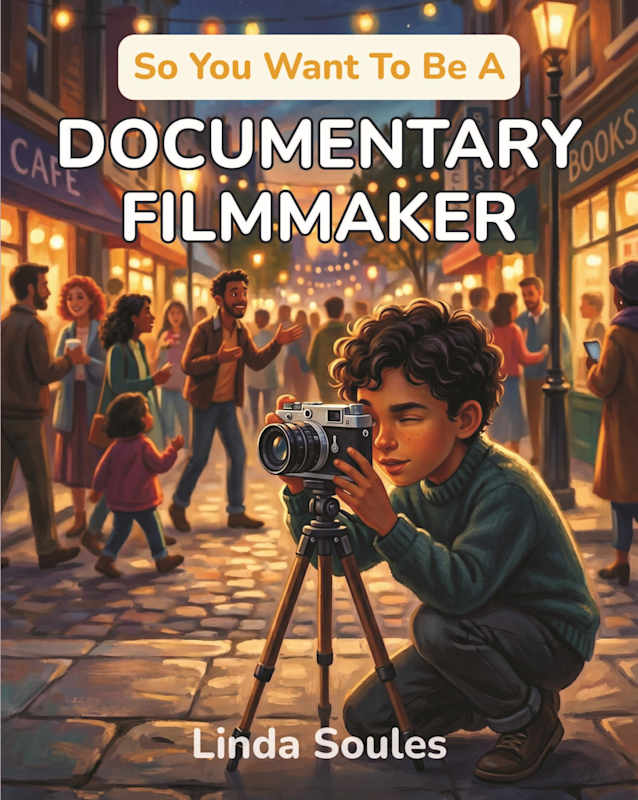
So You Want To Be A Documentary Filmmaker (So You Want To Be A...)
About
Every great documentary begins with someone who noticed a story everyone else walked past.
So You Want To Be A Documentary Filmmaker is an illustrated career guide for kids who love true stories, video making, and asking questions. Written for ages 10 to 14 and enjoyed by curious readers 8 and up, it takes young readers behind the camera to show how real documentaries are researched, filmed, edited, and shared with the world.
Kids learn what documentary filmmakers actually do, day to day. They see how a filmmaker earns the trust of the people on screen, why sound matters as much as the picture, and how a great interview question can unlock a story. They also learn how editors turn a hundred hours of footage into a ninety-minute film. A lively “day in the life” follows a filmmaker on a shoot, from a dawn gear check to a family dog who won’t get off her feet and an interview interrupted by her own gurgling stomach. Honest chapters explain the hardest parts of the job too, including tight budgets, long waits, and the responsibility of telling real people’s stories fairly.
Along the way, readers meet filmmakers who changed how the world sees itself. There are the Lumière brothers, who held one of the first public movie screenings in 1895, and Barbara Kopple, who kept filming through a dangerous coal miners’ strike and won two Academy Awards. There is Alanis Obomsawin, who has spent more than fifty years helping Indigenous communities tell their own stories, and David Attenborough, who was once burped at by a mountain gorilla and did his best to burp back.
Packed with fun facts kids will want to share, the book reveals why sound crews call a fuzzy microphone cover a “dead cat.” It shows how wildlife teams hid a camera inside fake elephant dung, why one famous director boiled and ate his own shoe, and how coconut shells become galloping hooves in nature films.
This is also a smart introduction to media literacy. Young readers discover how editing choices can change the meaning of a scene and how documentaries differ from reality TV. They also learn which questions to ask about any video they see online, which is a skill that matters for every kid growing up with a camera in their pocket.
Practical, hands-on sections help aspiring filmmakers start right away, whether they use a phone, a tablet, or a borrowed camera. The book includes simple filming and editing challenges, interview tips, a glossary of filmmaking terms, recommended books and films, and youth film festivals and student documentary competitions to enter. An inspiring author’s note encourages kids to record a conversation with a grandparent or older neighbor, which may become the most important film their family owns.
So You Want To Be A Documentary Filmmaker is ideal for young YouTubers and future film students, classroom career units, STEAM and media literacy lessons, homeschool families, school libraries, and any child who loves stories, people, and making videos. It makes a thoughtful gift for birthdays and holidays, and for any kid who has ever said, “I want to make movies.”
Part of the So You Want To Be A… series of career exploration books for kids, which meets young readers eye to eye with honest, fascinating, and beautifully illustrated looks at real jobs.
Praise for this book
"Sometimes the best careers begin with curiosity about the people and stories all around us. In So You Want to Be a Documentary Filmmaker, Linda Soules introduces young readers to a profession that involves much more than pointing a camera and pressing record. Documentary filmmakers search for true stories, spend time getting to know their subjects, conduct interviews, gather footage, and shape what they discover through editing. Soules explains where these professionals work, the equipment they use, those who help create a film, and the qualities needed to succeed, including patience, careful listening, and honesty. Readers also learn about the challenges and rewards of the career, what a typical day might look like, and ways kids can begin practicing these skills now. Famous people in the profession from different backgrounds and eras are introduced, along with interesting facts about real documentaries. Could noticing the experiences of others that sometimes get overlooked be the gig for you?
I’ve reviewed several books in this series by Linda Soules, and she always does such a great job of making different careers interesting and easy to understand. I loved So You Want to Be a Documentary Filmmaker and learned a lot myself, especially about how much research, patience, editing, and responsibility go into this profession. Soules’ writing is informative without feeling like a textbook, and the real examples add plenty of personality. I’d love to share this with my students because it could lead to conversations about asking good questions, listening carefully, and finding stories in everyday life. Children could even interview a classmate or make a short video about something important to them. The colorful illustrations make many of the ideas even easier to understand. I especially appreciated seeing both males and females represented. Dorothea Lange said, “The camera is an instrument that teaches people how to see without a camera.” That captures what I took away from this book because Soules shows kids that being a documentary filmmaker starts with paying attention to what’s happening in the world around them. Anyone with a curious nature who enjoys cameras, movies, or discovering more about unusual jobs will find plenty here. This is a book that belongs in homes, classrooms, and libraries."
"Do you enjoy people? Listening to their stories? Documenting them in written and visual form? Well, perhaps a career as a documentary filmmaker is the right fit for you. In Linda Soules’ So You Want To Be A Documentary Filmmaker, you’ll learn about the process, the training, some interesting documentary stories, and some of the historical figures who made their names as documentary filmmakers. It’s not an easy job. You have to be a good listener, one who knows the right questions to ask, and how to make even the most reserved and quiet person willing to listen to you and answer your questions.
Linda Soules’ children’s book, So You Want To Be A Documentary Filmmaker, is another great addition to the 'So You Want To Be…' series. Basically, it’s an illustrated career guide that takes young readers into the world of producing documentary films. The book leads young people through the career, allowing them to see what filmmakers do on a day-to-day basis, including a ‘day in the life’ look that follows a documentary filmmaker on a shoot. There are also notes on some of the most difficult things in this career, including tight budgets, long waits, and strict editing expectations. The language is simple enough for this age group, and the colorful illustrations add another dimension to the presentation. I love how this series includes several glossaries at the end to further spark young people’s interest. There’s a section on how a documentary filmmaker helps people, a list of some of their most important qualities, some tips on what you might not expect to need in this career, like clear writing skills, a look at some of the historic figures who made their name in documentary filmmaking, and so much more. Like the other books in this series, this is an informative and entertaining read."
"Until a few years ago, using a camera was hard, but now everyone can have one. Since cameras are now available on various electronic devices, children are often intrigued by the idea of filming. To help them put this interest to good use, So You Want To Be A Documentary Filmmaker by Linda Soules teaches young readers about the subject and encourages them to become good documentary filmmakers. She notes that telling true stories can be a little more complicated than it seems. The difference is that while a typical movie involves shooting several takes of a scene, a documentary captures real life. That’s why, in this case, you can start by filming simple everyday moments, interviewing people, or simply having conversations. The joy comes from doing it enthusiastically and learning from the experience.
I loved how Linda Soules approaches the topic because she speaks clearly and directly. Even when she mentions technical aspects, she uses accessible language, for example, when describing related fields of study, such as communication or journalism. She also mentions that documentary filmmakers need to be patient and organized because telling a good story takes time, while emphasizing the importance of being ethical. She explains that you shouldn’t edit footage with bad intentions or betray the trust of those who collaborate on the project. I also loved the illustrations because they’re inspiring and show a wide variety of examples of how to create a documentary. So You Want To Be A Documentary Filmmaker will teach children that this profession requires hard work and effort, but the reward of sharing the truth is invaluable."
"So You Want to Be a Documentary Filmmaker by Linda Soules is a fascinating children’s book that invites young readers into the world of real-life storytelling. I loved how the book approaches documentary filmmaking as both an exciting career and a meaningful way to understand people. Soules has a wonderfully engaging way of explaining what documentary filmmakers do, from discovering interesting subjects to capturing moments that deserve to be remembered. The conversational writing makes you feel as though an experienced filmmaker is sharing everything they’ve learned over the years. There’s a genuine sense of curiosity running through the pages, encouraging children to look more closely at the world around them and recognize how many extraordinary stories are hiding in ordinary places.
One of my favorite things about this book is how thoroughly it explores the filmmaking process. Readers learn about cameras, microphones, interviews, editing, and the many decisions that go into creating a documentary. I especially enjoyed the sections describing a typical filming day and the unexpected challenges filmmakers encounter. The explanations are detailed and approachable, with entertaining examples that make technical information easy to understand. Soules also introduces fascinating figures from documentary history, including pioneering filmmakers whose work helped shape the profession. These real-life stories bring an additional layer of excitement to the book. I appreciated how naturally the author connects the practical skills of filmmaking with qualities like patience, curiosity, careful listening, and respect for others.
The illustrations are another reason I enjoyed this picture book so much. They’re colorful, expressive, and filled with inviting details that bring the filmmaking world to life. The warm lighting and richly illustrated environments give the pages a cozy, almost cinematic quality. One particularly charming illustration shows a filmmaker interviewing an older woman in her living room, capturing the personal connection that makes documentary storytelling so special. Other scenes take readers to dramatic coastlines, snowy landscapes, bustling streets, and behind-the-scenes editing spaces. I loved seeing the variety of people represented throughout the artwork, along with the cameras, recording equipment, and other filmmaking tools. The illustrations complement the informative text beautifully, making the different stages of filmmaking feel tangible and exciting.
I appreciated the book’s thoughtful message about the importance of paying attention to other people. Soules presents documentary filmmaking as a way to preserve memories, share overlooked experiences, and help audiences understand lives different from their own. I loved that the book also gives children practical ideas for getting started, including using a phone to record a short film, practicing interviews, and studying documentaries with a curious eye. There’s something genuinely inspiring about showing young readers that storytelling begins with noticing what’s happening around them. So You Want to Be a Documentary Filmmaker is an absorbing, informative, and heartfelt introduction to a creative profession. I’d happily recommend it to curious young readers, especially those who love movies, asking questions, and discovering the stories behind everyday life."
"Linda Soules treats documentary filmmaking as a habit of attention. She writes for the child who notices the person standing alone and wants the stories hidden in ordinary days. A documentary, she keeps saying, is a record and a made thing. You choose what to film, what to leave out, and how to arrange it, and you never fake the life you found.
The book's promise is plain: this really happened, and it is shown as truthfully as possible. A film is made twice. First you show up until people trust you, hay and a head-butting goat included. In the edit, a hundred hours may become ninety minutes. Beside soup, the same blank face looks hungry. Beside a toy, it looks tender. Editing order creates the feeling. In Nanook of the North, shaping turns into staged hunts and a half-igloo. Reality television picks a cast for conflict and steers people toward drama. The sample shoot day stays ordinary: a stomach gurgle in the headphones stops the interview.
Soules writes the way a good interviewer listens. The jokes are quick: a microphone in a fuzzy cover called a dead cat, Werner Herzog boiling a shoe. Barbara Kopple stays on a Kentucky picket line through threats and gunfire. A gorilla tugs at David Attenborough's shoes. The book stays with you because the dull work remains, the emails and the grant forms, and because she remembers the people who have to live with the film.
Readers from about ten on get the hard bargain of the work: you may wait years, you may be wrong about who the hero is, and a camera changes the person it points at. A curious kid can use this. So can the adult reading beside them. It is worth handing over."