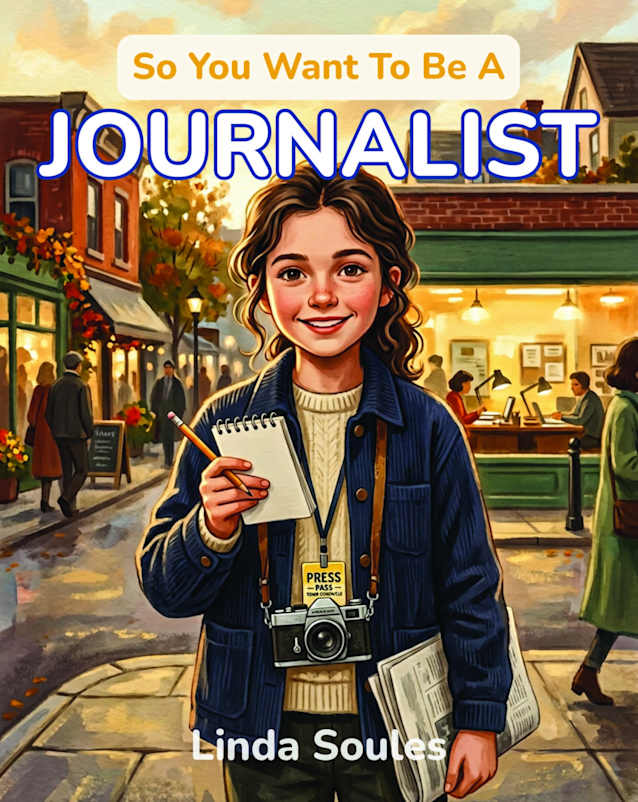
So You Want To Be A Journalist (So You Want To Be A...)
About
WINNER of the Literary Titan Gold Book Award
Somewhere right now, a reporter is knocking on a door no one wants to open. Somewhere else, another is reading the 400th page of a court document, looking for the one sentence that doesn’t add up.
This is what journalism actually looks like. Not the bright lights and the breaking-news graphics — but the slow, stubborn work of finding out what is true and telling everyone else before anyone else does. Journalists ask the questions powerful people would rather no one asked. They write the stories that change laws, free the wrongly convicted, and sit beside families on the hardest day of their lives to get the truth right.
This vivid, thoughtfully illustrated guide for curious readers ages 10–14 (and welcoming to readers 8 and up) takes young people inside one of the most demanding and consequential professions in the modern world. They’ll learn the difference between a beat reporter and an investigative journalist, why one source is never enough, and how a single Freedom of Information request can crack open a story hiding in plain sight. They’ll discover the daily rhythm of a working newsroom — the morning pitch meeting, the afternoon interviews, the editor who sends a draft back three times, and the deadline that does not move.
Readers will follow journalists into the field: the city-hall reporter watching a budget vote, the foreign correspondent filing from a place most people couldn’t find on a map, the science reporter at the edge of a launchpad, and the sportswriter in the press box — where cheering is strictly forbidden. They’ll learn how reporters protect their sources, verify what they’re told, and decide what belongs in print and what doesn’t. They’ll also confront the hardest parts of the job — the difficult interviews, the threats that sometimes come with a byline, and the responsibility of getting it right when people are reading every word.
Along the way, readers meet real journalists who changed history — Ida B. Wells, Nellie Bly, Edward R. Murrow, and Gordon Parks — and uncover surprising true stories: news once delivered by carrier pigeon, the most famous wrong headline ever printed, and the secret Watergate source known only as “Deep Throat.”
From small-town weeklies to international news desks, journalists do the patient work of keeping a free society informed. This book introduces young readers to the people who choose that work — and asks whether the curiosity, persistence, and clear-eyed honesty it requires might already live in them.
Praise for this book
"A journalist is someone who seeks the truth and shares it with the world. They ask questions that no one else dares to ask. That’s why it’s such an admirable profession. Now children can learn everything they need to know about it in So You Want To Be A Journalist. Linda Soules explains, in an engaging way, what this job entails, where it takes place, and what tools are needed to do the job effectively. She then goes into more detail, highlighting the benefits of being a journalist, such as satisfying curiosity and having direct access to information. She also illustrates a typical workday, so children can get a clear idea of what the profession is like.
I found Linda Soules’ writing style inspiring. She explains what journalism is in a way that’s realistic and accessible to children. For example, there’s a section on subjects you might not expect to use, like math, in which she explains that understanding statistics, scientific studies, and percentages is necessary, so it’s helpful to learn about the subject. She also mentions what a child can do to prepare right now, such as reading the news, practicing clear writing, and taking an interest in the news in their own community. In addition, she shares interesting points, such as fun facts and information about famous journalists throughout history. I also loved the illustrations because they’re detailed and highlight the key points of each explanation, reinforcing the ideas. So You Want To Be A Journalist will teach children to think critically and provide them with the basics for entering the world of research."
"So You Want To Be A Journalist by Linda Soules is an engaging and informative introduction to the demanding work behind every headline. Written for curious readers ages 10–14, the book moves beyond the glamour of television news to show journalism as a profession built on patience, courage, and persistence. Soules explains how reporters search for reliable information, ask difficult questions, verify facts, and communicate the truth clearly. By emphasizing that journalism can change laws, protect communities, and give a voice to people who might otherwise go unheard, the book presents the profession as both admirable and essential.
One of the book’s greatest strengths is its clear explanation of what journalists actually do. Readers learn about different careers, including beat reporters, investigative journalists, foreign correspondents, science reporters, and sportswriters. Soules also describes the daily rhythm of a newsroom, from the morning news scan and pitch meeting to interviews, fact-checking, revisions, and an unmovable deadline. Practical details about notebooks, recorders, public documents, source protection, and Freedom of Information requests give children a realistic understanding of the tools and responsibilities involved. The book is honest about the difficult parts of journalism while still conveying the excitement of uncovering an important story.
Soules’ writing is accessible, inspiring, and well suited to young readers with short attention spans. She explains unexpected skills journalists need, such as understanding statistics, scientific studies, percentages, and community issues. The historical profiles of Ida B. Wells, Nellie Bly, Edward R. Murrow, and Gordon Parks show how determined reporters have helped change the world. Fun sidebars about carrier pigeons, the mistaken “Dewey Defeats Truman” headline, and Watergate’s secret source add humor and variety. The detailed, colorful illustrations reinforce the text and help readers imagine everything from a busy newsroom to a reporter covering city hall.
So You Want To Be A Journalist encourages children to ask whether something is true rather than simply accepting what they hear. It promotes accuracy, fairness, curiosity, and unbiased reporting while showing the importance of both local journalism and major international news organizations. Young readers are also given practical ways to begin preparing now, including reading the news, practicing clear writing, following community events, and asking thoughtful questions. This is an excellent resource for school libraries, home bookshelves, and middle school writing classes. It offers a complete and honest look at journalism while inspiring future writers and researchers to approach the world with courage, grit, and a commitment to the truth."
"Linda Soules's So You Want to Be a Journalist is a clear-eyed career guide for ten- to twelve-year-olds who question what they hear. It strips away headline glamour and shows reporting as verified, patient, necessary work. For parents, that honesty is the point.
This guide explains how journalists serve the public: ask hard questions, verify every claim, and write what communities need to know. Coverage spans the ethics code, FOIA requests, beats and bylines, and tools from spiral notebooks to audio recorders. A day-in-the-life section runs from overnight story tips to a filed byline after fact-checking with an editor. Profiles of Ida B. Wells, Nellie Bly, Edward R. Murrow, and Gordon Parks show reporting changing real communities. Closing pages cover school newspapers, interviewing a neighbor with careful notes, and the Five W's every young reporter should know.
Soules writes clearly without watering down the work. She gives real weight to reporters buying their own latte, the newsroom rule that even your mother's word needs checking, and the Chicago Tribune headline that declared Truman the loser before the votes were counted. In the So You Want To Be A series, illustrations of newsroom desks and field reporters draw children in and make dense sections easier to follow. Parents and teachers should read alongside them, turning each page into a conversation about beats, bylines, and the weight of putting your name on a story.
Hand this to the kid who fact-checks group-chat claims before bed. The guide respects that instinct and shows where patient, plain reporting can lead."
"So You Want To Be A Journalist by Linda Soules is a clear, sincere, and quietly inspiring nonfiction guide for young readers who are naturally curious about the world around them. It does not present journalism as something glamorous or easy. Instead, it shows the profession as patient, stubborn, ethical work built on listening closely, checking carefully, and caring enough to keep asking questions.
This is an illustrated career guide rather than a traditional story. The book walks readers through what journalists do, where they work, who they work with, and why the profession matters. It explains reporting as a process of gathering information, interviewing people, reading records, confirming facts, writing clearly, and publishing stories that help the public understand what is happening.
The book also introduces important tools like notebooks, phones, recorders, and public documents, while exploring the emotional and practical sides of the job. Readers learn about newsroom teamwork, local reporting, famous journalists, journalism vocabulary, and simple ways they can begin practicing these skills in their own communities.
What I liked most about this book is that it understands journalism as a public service, not just a job about writing. The heart of the book is truth: how to find it, how to protect it, and how to share it responsibly. Soules gives young readers a strong sense that asking questions is not rude or annoying when it is done with care. It can be one of the most important things a person does.
The book is especially strong when it talks about local journalism. I appreciated how it shows that the 'small' stories in a town can matter just as much as the big national headlines. A school board meeting, a city budget, a road problem, or a local official’s decision can deeply affect people’s daily lives. That message gives the book a grounded and meaningful quality.
The sections on ethics are also important. The book makes it clear that journalists should not invent quotes, accept hidden favors, or publish carelessly. It teaches that trust is not automatic; it is earned through accuracy, fairness, and patience. That is a valuable lesson for young readers, especially in a world where information moves quickly and not all of it is reliable.
The illustrations give the book a warm community feel, from newsroom scenes to interviews, homes, cafés, and town meetings. They help make the profession feel approachable without making it look too easy. The historical examples are also well chosen, showing how journalism can expose injustice, witness history, and change public understanding.
Overall, So You Want To Be A Journalist is a strong, timely entry in the series, with a message that feels both practical and important."
"This is a great resource for preteens or older teens who are interested in journalism. The book is easy to follow and written in a way that holds younger readers' short attention spans. It navigates the ins and outs of what journalism is or isn't, why it is important and how it is useful to our communities. This could also be a useful book assignment for a middle school creative writing class to help get kids excited about writing and reporting."
"I read this book and also asked my daughter to read it. We both gave it 5 Stars. The book explains what journalists do in a way that is easy to understand, while encouraging readers to ask questions, think critically, and appreciate the importance of accurate reporting. The writing is clear and age-appropriate, and the examples help young readers connect with the material."
"So I have a degree in journalism and I really think this would have been great to experience this book in middle school. It would've helped me focus on the type of journalism I wanted to do sooner."
"This is the 2nd book of this series I've read. I wish these were available when I was growing up. They are easy to read and full of so much detail. You get a day in the life of a journalist.as well as sources at the end to take the next step."
"I love how this book promotes the idea that journalists must be accurate and unbiased. I also enjoyed how it showed the nonfiction aspect of every day life and how not every story is about glamour. This book also promotes small town journalism and its importance over big news media and I do agree that it’s important."
"At one point in my life, I want to be a journalist, reading this reminded me why! This was a really nice and informative book! I just love this book series! I get books and I’m always eager to share with my children but I end up loving them too! Thank you! 😊"
"As a first-grade teacher, I love finding books that introduce children to careers in a way that sparks curiosity without feeling overwhelming. So You Want to Be a Journalist by Linda Soules does exactly that. It gives young readers a thoughtful look at what journalists do and why their work matters, all in a way that's easy to understand and engaging for kids.
What I appreciated most was how the book encourages students to ask questions, pay attention to the world around them, and understand the importance of telling the truth. Those are lessons that go far beyond journalism and are valuable in every classroom. It naturally opens the door to meaningful conversations about writing, listening, critical thinking, and being responsible with information.
My students enjoyed learning about a career that many of them hadn't really considered before, and it inspired some wonderful discussions about how stories are discovered and shared. It's the kind of book that makes children realize there are so many exciting ways they can use their talents as they grow.
This would be a wonderful addition to any classroom, school library, or home collection for young readers who love writing, asking questions, or simply learning about the world. Linda Soules has created another engaging and educational resource that helps children dream a little bigger while showing them the value of curiosity and communication."
"This is a very informative book for children about what a career in journalism would be like. The sentences flowed very nicely and it was an easy read that kept me interested the whole time. I especially liked the part where the author compared journalists to young kids because they always ask why. In this book you will learn the good and the bad of this job, the daily life, as well as information on famous journalists. I would recommend to any young person interested in the field."
"This was a wonderful book to read with my kids. We really enjoyed learning about what journalists actually do and how much of their work is centered on curiosity, research, asking thoughtful questions, and making sure the facts are right. I especially appreciated how the book explains the importance of honesty, ethics, and serving the community in a way that's easy for children to understand. The colorful illustrations kept everyone engaged, and the real-world examples sparked some great conversations about critical thinking and why trustworthy news matters. Overall, this is an excellent book for curious kids who love asking 'why?' and want to better understand the important role journalists play in our everyday lives."
"This was an engaging and inspiring read. It does a wonderful job of showing the dedication, curiosity, and integrity behind journalism while making it easy for younger readers to understand. The real-life stories and historical examples kept it interesting from start to finish. It was a great read for the young ones in the family and sparked some thoughtful conversations. I would definitely recommend it to curious young readers."
"So You Want to Be a Journalist by Linda Soules is an accessible introduction to the exciting, demanding, and ever-changing world of journalism. Rather than presenting journalism as a glamorous profession filled only with headline-making stories, the book offers a realistic look at what it takes to become a successful reporter, writer, editor, or media professional. It is especially valuable for students, aspiring journalists, and anyone curious about how news is gathered, verified, written, and presented to the public.
One of the book's greatest strengths is its straightforward writing style. Linda Soules explains journalism concepts in a way that is easy for beginners to understand while still providing meaningful insights into the profession. Readers are introduced to the fundamental principles of journalism, including accuracy, fairness, objectivity, ethics, interviewing techniques, research methods, and news writing. These topics are presented logically, making the book suitable for readers with little or no prior knowledge.
The author emphasizes that journalism is much more than simply writing articles. A journalist must be curious, persistent, observant, and willing to verify facts before publishing information. Soules explains that credibility is a journalist's most valuable asset and demonstrates why accuracy and ethical reporting remain essential even in today's fast-paced digital media environment.
The book also explores the many different career paths available within journalism. Readers learn about newspaper reporting, magazine writing, broadcast journalism, digital media, investigative journalism, feature writing, photojournalism, and other specialized fields. This broad overview helps aspiring journalists understand that the profession offers diverse opportunities beyond traditional newspapers.
Another notable aspect of the book is its practical advice on developing journalistic skills. Soules encourages readers to practice writing regularly, build strong interviewing abilities, stay informed about current events, and cultivate critical thinking. She also highlights the importance of meeting deadlines, communicating clearly, and adapting to technological changes that continue to reshape modern newsrooms.
The discussion of ethics is particularly valuable. In an era where misinformation spreads rapidly through social media, the author reminds readers that responsible journalism depends on verifying sources, presenting balanced viewpoints, respecting privacy, and distinguishing facts from opinions. These timeless principles give the book lasting relevance despite changes in media technology.
The writing remains engaging throughout, avoiding unnecessary jargon while maintaining a professional tone. Real-world examples and practical guidance help readers connect theory with everyday journalistic practice. Instead of overwhelming beginners with technical language, the author focuses on building a solid foundation that readers can later expand through education and experience.
Although the book serves as an excellent introduction, experienced journalists may find some sections relatively basic. Readers seeking advanced investigative techniques, multimedia production, or in-depth discussions of data journalism may need additional resources. However, these limitations do not diminish the book's value as an introductory guide."
"Linda Soules does such an incredible job with this career series for kids. This book, which explores what a career in journalism entails, is presented in such a creative way. Of course, she covers the basics of the profession, but she also dives much deeper into the human side of journalism.
The graphics, the breakdown of a typical schedule, the historical facts, and the glossary are all great additions to the book. It’s perfect for middle-grade readers who are interested in becoming professional journalists one day or who simply want to learn more about the field."
"I was so happy to receive another reader's copy of Soules' amazing "So You Want to Be..." career-driven series for kids and in another field that I know very well. Similar to her "So You Want to Be a Teacher" book, I was so happy to see Soules take some extra time to explain the First Amendment to kids to help them understand it and how they also have the rights of freedom of speech, expression, and press to remember as they get older. I also enjoy how the graphics really depict what I experienced in my high school journalism course for three years in how we plan, interview, and write our stories and news. It made me feel like Soules stepped right into our newsroom or even a newsroom of a popular news station. One thing that I would love to see in Soules' book is actually some feedback and stories for current-day journalists that the kids would remember, or even a set of activities towards the back of the book to encourage kids to begin their journalism practice over the summer, especially for a curious kid who wants to know about everything and has something to do. I also appreciated as an African American woman in this field that Soules took the time to recognize the contributions of Ida B. Wells to the profession, as sometimes journalism forgets about the importance of her news writing and research into the field, & that really warmed my heart to see. A perfect touch to the end of the book is the fantastic vocabulary words of journalists that kids could learn and practice, as well as a list of her resources of things to do and journalists to learn more about, etc. This was a fantastic manual for our little future journalists, and I wish I had a book like this as a kid when I was interested in journalism and writing. Wonderful book overall!"
"Solid and easy to digest, very accessible for anyone who wants to take a peek at the life of a journalist. Though the author puts these in the 10-14 age category, this could be fine for younger but more mature kids still in elementary school or even uncertain high school seniors trying to look at their options."
"This book is the perfect gift for any young person who mentions interest in the journalism field. It is packed with advice, terminology, a day in the life, hard things to consider, important qualities of a good journalist and so much more. I loved reading it with my story telling daughter."
"As with the other books in this series, this book introduces young reader to another career, journalism. I thought it was great at showing what journalism actually looks like as well as the different types of reporters. There was a lot of emphasis on integrity which is integral in this field. It tells the good, bad and ugly of the job, but my favorite part is what you can do to prepare now; it begins with curiosity."
"Whoever wrote this book was very passionate about journalism. I loved that it talked about how journalism is protected by the constitution, and how there are ethics in journalism as well. This book was really great and in-depth. It presented everything to consider."
"Such a great series! This is perfect for the writers, storytellers and those with a passion for knowing."
"My daughter is reading through this whole series, and this is one that really stood out. Like all the books in the series, it is very thoughtfully written and includes all sorts of things you wouldn't have thought of. Even ways to prepare for your future career now. Keep it up! These books are awesome."
"It really warms my heart to see someone that is trying to spread a positive message to our youth and future youth. Education is so important, more than most know and it will only help improve ones life. I think us as adults should do everything we can to push hobbies, push ideas, and push thought into our children. Help give them a sense of wonder, a sense of purpose and a sense of passion. The journalist edition was very informative and quite fun to be honest. It had some interesting facts I never knew of and honestly it showed journalism to me in a different light. Not a journalist myself, however it is something I support and agree with. I would say this book is not only for children but for any age of someone is interested in the topic. The illustrations that go along with it are quirky and overall it was a good read. This would make a nice addition to a personal library or a good place to start on your child’s bedside table."
"This is just the right book for children who wants to become a Journalist. It explains and gives examples for everything they need to know. Learn about how to research, make phone calls, examine and compare the interviews and different responses. You must get it right because everyone is depending on you for the facts, the right answers or just the missing puzzle. You can find out about what is required to be a journalist, the qualifications and the determination you need to succeed. You'll find out the tools they use, the places they work, their daily routine, the most challenging part of the job, the most rewarding part of the job and so much more. Start your career as a journalist today, grab your notebook and start your interviews. Just turn the pages and you will find out how."
"I love that this a quick, straightforward, and honest look at a job that for so long I had been told was a path I should consider pursuing as a writer. I never took it into consideration because I did not care for rules or restrictions as I called Grammar and English hahaha!
Yet, now that I am older and I am slowly working through different classes for my creative writing degree, I am becoming more appreciative of the jobs that I had never thought were a possibility. Journalism being one of them.
I will be so honest I feel called out in this book. It may not change my career trajectory because there are some skills that I was not born with and have not been able to be taught (math- God bless the hearts of all my teachers and professors they tried), however, there may be more to this area now with easy access to blogs and site for articles. I think that maybe there is something there.
Either way this book also is so good for someone to read who is thinking of this and really would like to know more. It doesn't share everything but its a good starting point.
Very well written!"
"This book is a great educational book to give someone wanting to be a journalist an idea of what they do. What is like to be a journalist and what a day in the life consists of. It goes into detail of where a journalist works and how to get the stories the public wants here. This book also has fun facts and people in history who were famous journalists. A great guide to help people start who have the desire to become a journalist."
"I continue to try to wrap my mind around how much research the author puts into each one of the books. To then expertly lay it out in a detailed format that is simplistic enough for young readers to understand and for their parents to be able to explain it to them. Each new book I read feels like an adventure, and this is what will pull young readers in. Soules has figured out how to develop a love for reading."
"This is the second book I have read by this author and it is as informative as the first. As a former journalist I found nothing to argue with and a lot that brought back memories. The author does not mince words...when pursued as a career (not just a job), it is demanding, it can be hard and it is incredibly rewarding. As the author suggests, the best part of the job is satisfying curiosity. The 'big' stories hinted at are rare; the careful reporting of routine matters is just as important. The author offers valuable advice on early steps...every experience, every new word learned, every question that makes you work for an answer broadens your field."
"Journalists live for the unknown. They ask plenty of questions, review lots of documents, and interview many people. They ask the hard questions no one else wants to ask.
The best part about Journalism is that the US Constitution's 1st Amendment, freedom of speech, protects you.
Working as a journalist requires hard work and lots of hours. You might be in the field in your hometown or as a foreign correspondent.
What I like about this book is the fact that it covers all aspects of the job. I especially like the 'Day in the Life' where it details just what you'll be doing.
The artwork is just superb too."
"Great series as always. I super love this book. Wish I had it as a kid. I wanted to be a journalist."
"Great book to explain a possible career option to kids. It does a great job providing information on the different locations a journalist may work, what tools they need for the job, and what a day in the job may look like. The pictures do a great job of helping to support the text for better understanding. Great story to share during career day lessons!"
"An absolute educational experience to delve into the world of journalism! As readers we are learning how courageous journalists are to uncover and report the truth. Journalist truth is so vital for society because it provides the transparency of events."
"Love these books. This gives an in depth look into what it takes to be a journalist and how it works as a career. One thing I wish journalists remembered is their zeal for report facts. Right down the middle, unbiased. Great read."
"“So You Want To Be A Journalist” is an interesting quick read that dives into the basics of becoming a journalist. Although geared towards kids, it can still be read by adults who are curious about what being a journalist entails. The pictures are eye catching, and the way the career path is detailed is easy to understand.
Reading this book, one understands that the job of a journalist is complicated but steady and careful, as one must search for the truth, and also be able willing to tell the story even if it makes certain people mad.
The book also gives the names and story of several famous journalists, so as to inspire someone to further research the job of a journalist. I especially enjoyed the story of Nellie Bly, who feigned illness so she could check herself into an insane asylum to report on the inside conditions. This shows how journalists must be creative and honest, no matter what.
The lingo of a journalist is also shared within the book, acquainting the reader with terms used in the industry, so as to provide education ahead of someone’s decision to become a journalist. One example is the word lede, which is the first line to bring in a reader, and it is spelled differently so as to differentiate itself from lead, the material used to publish papers. I found this interesting.
I like that the book provides the definition of journalism terms, describes the character of someone considering this role, the duties of such a person, and also gives examples of some real life journalists. I think this book provides ample explanation that will prove useful to anyone seeking the role of becoming a journalist."
"Excellent writing and source of knowledge. I learned a lot about the day to day tasks of a journalists. The book mentions vaguely about the current atmosphere surrounding ethical journalism and I think that was smart. It’s enough to make people question it without becoming political. Good job with this one."
"This book is very relevant in our current times. The author explains in very specific details how a reporter is protected, how the news is for everyone, and with AI, The Most Important Qualities of the Journalists, is especially well written. Within the Fun Facts, I really appreciated the quick review of the 5Ws, the same five I teach my own students which makes this book very practical."
"I really enjoyed this book because it doesn’t make journalism sound like some glamorous job where reporters simply show up with a microphone and report breaking news. Instead, it shows kids what really happens behind the scenes and honestly, I found that much more interesting while reading for my son. It also teaches about finding and verifying the truth. It explains the difference between a beat reporter and an investigative journalist, why journalists need more than one source, how Freedom of Information requests can uncover information, and even how reporters protect their sources. Those are things I probably wouldn’t have thought much about before reading this."
"So You Want To Be A Journalist by Linda Soules is a solid pick for kids curious about news careers. It walks through what journalists actually do day-to-day, including a surprising section on why math matters for understanding statistics and studies. I liked the tips for things kids can start doing now, like reading the news and practicing clear writing, plus the fun facts about famous journalists sprinkled throughout. The illustrations do a nice job reinforcing the key points. A clear, respectful, age-appropriate look at the profession — recommended for readers around 10-14."
"This book details every aspect of becoming a journalist. Even down to explaining why a journalist should never even accept a coffee from anyone they are speaking to regarding a story or investigation. If anyone interested in becoming a journalist then this informative book is definitely a good source to read."
"The colorful pictures show exactly how exciting a busy newsroom can be. The book is fun and fast to read. It's a great choice for school libraries and home bookshelves, especially for kids who love asking lots of questions."
"This book is a great read. It contains facts about what you will need to become a journalist. It is easy to read as well as interesting for someone who has no interest in becoming a journalist. I found the history of journalism very interesting, how it started with pigeons, and the famous journalists. The writing draws you into the book and is setup to keep you reading."
"This is a great book for any aspiring young journalist! It doesn’t sugar coat anything, and is entirely honest about the pros and cons of journalism. I wish I had something like this in my arsenal before I started journalism school."
"Very beautiful book for kids and teenagers. It's a very good book with picture illustration and language of this book is very easy to understand for beginners and any age group. Beautifully depicting life and work of true journalists their research, challenges in work, their ability to see each and every incident with different perspective. It's a complete guide to understand what actually a journalism is. Bought for my niece and she loved it."
"This is a good non-fiction guide that explains the main points of media literacy, truth finding and reporting for young readers.
This is written for children ages 8–14, and young writers interested in non-fiction storytelling.
With short histories of real journalists like Nellie Bly and Gordon Parks and others, this book gives examples for kids to research and become inspired. It also follows a reporter's daily tasks to give the reader an idea of a normal day for one.
The author show that journalism is about learning how to ask the right questions and the truth in stories that help your community. I recommend."
"This is a great book for kids who are curious about what being a journalist is all about. It explains in plain, easy to understand language what a journalist is, what they do,, what tools they use to do their job efficiently, the best part of being a journalist, the hardest part, and the most surprising things about the job. It goes on to explain what an average day in the life of a journalist might look like, who you might work with, how being a journalist helps people, some of the most important qualities a person would need to be a journalist, and things you might not expect to need. The book covers a few famous journalists in history, such as Nellie Bly and Edward R. Murrow. There are questions at the end of the book to ponder to determine whether the reader might make a good journalist, as well as a glossary of journalist words. I personally think it’s a great book for kids interested in learning more about being a journalist. The information is fun and thought provoking. I highly recommend."
"Does a great job of explaining the role of a Journalist including co-workers, a day in the life of a journalist, and other aspects. Would be a great asset to a classroom to prepare students for workforce readiness."
"Another great book in the series So You Want To Be A.... This book tells about what a journalist does and how. And also tells us about freedom of press being protected in the constitution and explains what that means, and why. Very cool book for kids interested in journalism."
"Short but chock full of information! As an educator, I feel the pictures, shorter length and tone would all engage young readers. I found the statistics around local newspaper closures sobering, especially given this quote: 'Communities without local reporters have been shown, over and over, to have higher levels of corruption, lower voter turnout, and a public that does not know what is happening to it.' The author managed to use that as a way to highlight the importance of journalism. I appreciated the piece- although geared for children- didn’t sugarcoat the career but gave a realistic view. Overall it’s a great book for kids interested in journalism."
"This book was really well written and really informative. It gave a great insight into the day to day life of a journalist and an overview of the history of journalism. This book would be a fantastic read for any one that is looking at becoming a journalist (even I considered changing career) to give them a better understanding of what the job entails. Would definitely read again."
"An interesting, insightful and easy to understand foray into the role of a journalist. Just the right length and level of detail for its target audience. I learnt a few things and it’s made me wish I’d considered journalism as a career choice!"
"Really good read, I read this with my teenage son who is interested in journalism, easy to understand with fun facts and lots of history! Very informative and has just made him more certain it's something that he would love to do! Definitely read if journalism interests you for more information on the role and history."
"Fantastic, clear entry point into journalism, even for non-media backgrounds! As someone with a science background who typically writes research reports, I found the book- So You Want to Be a Journalist, to be an engaging and informative read. It provides a very clear picture of what day-to-day life actually looks like if you decide to pursue journalism. The author shares excellent practical tips on how journalists hunt for leads, filter information, and structure questions to build a strong story. If you're a complete beginner or simply curious about how news gets made, this book gives you an interesting and eye opening roadmap."
"This was a nice little read, very informational. It's a great read for a teenager that's getting close to looking for a career, maybe in journalism. Even outside of looking for a career, I know I learned quite a bit about journalism that I didn't know before."
"I wish I had access to books like this one when I was a kid. The language is simple but not boring and monotone. Going through the 'day in the life of a journalist' is probably the most important part of the book as it shows many details that a kid wouldn’t think about. This is a great resource for kids that are thinking about what they want to be when they grow up."
"I honestly found this book to be quite interesting, despite the fact that I do not exactly want to be a journalist when older. Because I do, however, want to complete a few research projects of my own, I found this book to hold some valuable information and reminders that I could still apply to a career path in sociology. I would also argue that this book, even for someone who may not particularly care for journalism, would be an important read, especially for younger kids, particularly the pre-teen to early teen ages. I do not want to share all the important details of the book, however, I will say that one of the aspects I particularly enjoyed from this book, was that it does indeed show how much work and dedication goes into journalism, and how some people (particularly the sources) may even be risking their jobs, all so that the population receives the truth. All in all, I would agree with the book that journalists and journalism are often overlooked, and how especially now with social media and how easy it is to spread false information, journalism is more important than ever."
"I love this series for kids! This one on journalism as a career warmed my heart as this was my career aspiration as a young person. The writing has always been great. I absolutely love the illustrations in this one more for sentimental reasons but they are excellent in the whole series as well. Looking forward to exploring more careers with the children in my life through this author's work."
"This book is a great introduction to journalism, especially for children and young people who are thinking about becoming journalists. It covers many aspects of the profession in an informative and objective way. I particularly enjoyed the sections about the challenges and dangers journalists can face. I would definitely recommend this book to any young person interested in journalism. 5 stars :)"
"Fantastic, clear entry point into journalism, even for non-media backgrounds! As someone with a science background who typically writes research reports, I found the book- So You Want to Be a Journalist, to be an engaging and informative read. It provides a very clear picture of what day-to-day life actually looks like if you decide to pursue journalism. The author shares excellent practical tips on how journalists hunt for leads, filter information, and structure questions to build a strong story. If you're a complete beginner or simply curious about how news gets made, this book gives you an interesting and eye opening roadmap."
"I wish I had access to books like this one when I was a kid. The language is simple but not boring and monotone. Going through the 'day in the life of a journalist' is probably the most important part of the book as it shows many details that a kid wouldn’t think about. This is a great resource for kids that are thinking about what they want to be when they grow up."