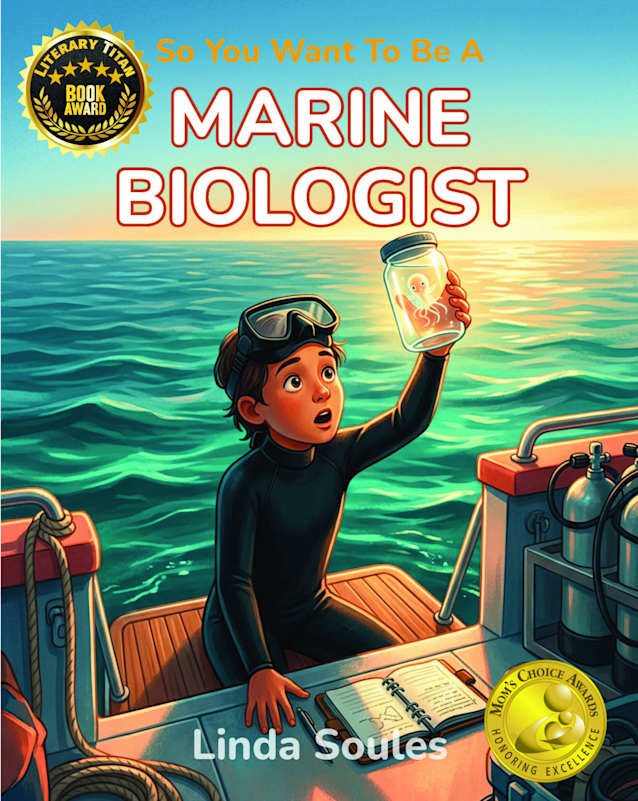
So You Want To Be A Marine Biologist (So You Want To Be A...)
About
RECIPIENT of the Mom's Choice Award® Gold — Honoring Excellence
WINNER — 2026 Purple Dragonfly Book Award (1st Place): Animals/Pets · Green Books/Environmental · STEM
WINNER — 2026 NYC Big Book Awards, Educational Series (Pre-Teen Nonfiction)
WINNER — 2026 PenCraft Seasonal Book Award, Best Children's Book (Preteen)
WINNER of the Literary Titan Gold Book Award
Seventy-one percent of this planet is ocean. Most of it has never been seen by human eyes. What lives down there, how it survives, how it connects to everything above the surface including you — those are not small questions. They are the questions that have driven scientists into the water for generations. And they are still not fully answered.
So You Want To Be A Marine Biologist takes young readers ages 10–14 inside one of the most adventurous and most rigorous professions on earth — not the documentary version, but the real one. The years of study that come before the first research dive. The specific discipline of observing life in an environment that was not built for human bodies. The team of scientists, divers, data analysts, and conservationists working together to understand a world that covers more of this planet than all its land combined. The expedition that yields exactly what you hoped — and the one that changes your entire hypothesis.
This is a book about what marine biologists actually do: the ecosystems they map and monitor, the species they catalog and protect, the research vessels they live and work on for weeks at a time, and the precise, patient observation they bring to creatures that operate on schedules and terms entirely their own. It’s also a book about what the work costs, what it reveals, and why the people who do it say the ocean never gives up all its secrets — and that is exactly why they keep going back.
Inside, young readers will discover:
- What a real marine biologist’s work looks like — from laboratory research to open-water fieldwork
- The science of ocean ecosystems and the astonishing diversity of life they sustain
- The physical demands and intellectual rigor the profession requires — and how marine biologists meet them
- The urgent role marine biology plays in understanding and protecting a planet under pressure
- What young people can do right now to discover if this might be their calling
Honest, specific, and genuinely illuminating, So You Want To Be A Marine Biologist doesn’t talk down to young readers — it brings them all the way in. Because the child who wants to know what this work is really like deserves a real answer.
For readers who feel the pull toward something deep and vast and not yet fully known. For the kid who stands at the edge of the water and feels something shift.
The ocean covers most of this world. And most of it is still waiting to be understood. Maybe you are the one who will.
Ages 10–14 · Nonfiction · Careers & Professions · Illustrated
Praise for this book
"Did you know that almost every living thing on Earth traces its roots to life in the ocean? In Linda Soules's So You Want To Be A Marine Biologist, many interesting facts will astound you and make you want to look deeper beneath the water's surface. There's a lot to be seen underwater. There are sea creatures that live and breathe deep beneath the water's surface. And many wonderful and inspiring plants grow on the ocean floor. But that's not all. The ocean covers seventy percent of Earth's surface, provides us with oxygen to breathe, controls the weather, and feeds us. What more could you ask for? Considering the ocean's importance, it is essential to take care of it, which we're not doing very well. Pollution is threatening life in the ocean. But there is hope. Marine biologists study the ocean and find ways to rejuvenate what might otherwise become extinct before it's too late. Would you like to be a marine biologist and make a difference to ocean life?
In Linda Soules's So You Want To Be A Marine Biologist, young readers will learn about the ocean as well as those dedicated, highly trained scientists, marine biologists, who study and work to preserve a precious part of our lives and well-being. This is a thoroughly detailed book that will inspire young readers to consider this career path, or at least, to interest and educate them on the importance of the ocean and what lives within. The illustrations are superb and add another dimension to the research material. The book is well organized and presented in a manner that will interest young readers. The book concludes with interesting tidbits, like important qualities of a marine biologist, information on some famous marine biologists, some fun facts, and a list of things you can do now to prepare yourself for this potential career path. A fascinating and informative read."
"So You Want to Be A Marine Biologist is the kind of children's nonfiction book that immediately pulls young readers in and makes them want to know more. It's officially written for ages 10-14, but honestly, I can see it working for curious younger kids, older teens thinking seriously about careers, and even adults who just love learning cool things about the ocean.
What makes this book stand out is that it doesn't just say, 'Marine biologists study the ocean.' It actually shows what the job feels like. Readers get a real look at the work behind the wonder: early dive briefings, research vessels, lab work, data analysis, coral bleaching, ocean conservation, and the patience it takes to study animals and ecosystems that don't operate on human schedules.
The book does a great job balancing excitement with honesty. Yes, marine biology sounds adventurous and fascinating, but the book also talks about the harder parts, like cold water, seasickness, failed hypotheses, grant rejections, long waits for funding, and the physical and mental demands of the job. I appreciated that because it gives kids a fuller picture of the career instead of just presenting the fun, shiny version.
The illustrations are another huge strength. They are colorful, vivid, and engaging, with images of ocean life, divers, reefs, deep-sea creatures, and research vessels that make the subject feel big and alive. The visuals make the book especially appealing for younger readers who may not read the whole thing independently yet but will absolutely linger over the pictures and absorb a lot along the way. My favorite scenes were the ones where divers were under the water. Those scenes looked magical.
I also liked how well the book is organized. The short sections, glossary terms, fun facts, 'day in the life' style details, equipment explanations, and next-step suggestions make the information easy to follow. It gives kids practical ways to explore whether marine biology might be something they want to pursue, which is such a smart addition. I keep leaning on the word 'practical' when writing this review, but I think, overall, that's what this book really is: it's practical. Most career books for kids simply explain what a job is. This one goes further.
So You Want To Be A Marine Biologist is a beautifully illustrated, thoughtful, and genuinely inspiring book for any child who loves the ocean, animals, science, or big questions about the world. It's informative without being boring, honest without being discouraging, and exciting without oversimplifying the work. This is definitely a book kids can return to again and again as they grow. Highly recommended for ocean-loving kids, future scientists, and any young reader who has ever stood at the edge of the water and wondered what is out there."
"Linda Soules's 'So You Want to Be a Marine Biologist' serves as an essential, practical primer for middle-grade readers. The book's primary strength is its ability to balance the inherent wonder of the ocean with the rigorous reality of scientific labor.
Soules begins by establishing the high stakes of oceanography: the ocean produces the majority of our oxygen and regulates our climate, yet it remains largely unmapped. She effectively redefines the marine biologist, moving beyond the trope of a simple 'ocean lover' to frame them as a vital scientist tasked with managing Earth's most critical life-support system.
Soules categorizes the field into distinct specialties, ensuring readers understand that 'Marine Biology' is an umbrella term for a network of roles: monitoring biodiversity and bleaching; exploring high-pressure zones using Remotely Operated Vehicles (ROVs); and managing the intersection of human activity and mangroves/seagrass.
A significant portion of the book is dedicated to the instructional 'how-to' of the job. Soules meticulously lists the tools of the trade, categorizing them by their function in data collection.
The text excels in its 'Day in the Life' instructional segment. This section serves as a procedural guide, breaking down the workday into: Briefing: Defining objectives and safety protocols; Observation: Executing transect surveys and fish counts; Documentation: The transition from underwater observation to lab data entry; and Analysis: Understanding how bleaching at a deep-water site dictates future conservation policy.
Soules provides a clear-eyed look at the constraints of the profession. She delineates between the public perception (discovery and adventure) and the professional reality (seasickness, equipment failure, and the constant hunt for grant funding).
Key instructional features including scientific terms (e.g., transect, hydrophone, bleaching) are introduced in context with clear definitions. Standard operating procedures outline the importance of safe diving, careful note-taking, and mechanical problem-solving. Lastly, the concluding chapters shift from the 'what' to the 'how.' Soules provides a roadmap for the aspiring scientist, emphasizing that the path begins long before university.
She provides actionable pathways, a checklist for the reader, turning abstract interest into a series of 'First Steps,' such as keeping a field notebook and practicing snorkeling.
By highlighting icons like Sylvia Earle, Jacques Cousteau and Eugenie Clark, Soules connects the reader to a lineage of explorers who combined scientific discipline with a deep, emotional commitment to the sea.
'So You Want to Be a Marine Biologist' is an empowering STEM resource. It successfully demystifies a complex field, replacing a 'distant dream' with a concrete, actionable career path. It is ideally suited for classroom units on ecosystems or career-focused nonfiction collections, successfully transitioning the reader from a curious observer to an informed aspirant."
"In this illustrated nonfiction children’s career guide, “So You Want To Be A Marine Biologist” by Linda Soules, readers are taken on an amazing adventure learning the intricacies of what it’s like to become a marine biologist. Children and adults alike will learn many interesting facts, not only about the marine environment, but also exactly what it takes to become a marine biologist.
The first thing that truly stuck out to me was how Linda Soules jam-packed this children’s book with so many interesting facts that readers of any age will walk away with knowledge they didn’t have before reading it. As an adult, I learned that the ocean covers more than seventy percent of our planet. That percentage made me stop for a moment to take it in. I truly never put this kind of intense thought into such a dynamic piece of information. Plus, another truly interesting fact I learned is that the ocean environment produces more than half the oxygen we breathe. If these two pieces of information don’t intrigue you, how about another fact that eighty percent of the ocean hasn’t even been explored yet? Those facts would make any reader in awe of just how significant our ocean is in our day-to-day environment.
Another thing I never put much thought to was how involved a marine biologist’s job truly is. They don’t just study the ocean and its inhabitants; they must devote their lives to learning about and supporting such an integral living environment for generations to come. Soules provided detailed information that will allow children to truly see just how involved the life of a marine biologist is in sustaining not only every human being, but also all the ocean’s inhabitants that we depend on for our lives. This informative book will delight readers of all ages because there is so much information for every reader to learn from.
The illustrations were AI-generated by Soules, and she fully disclosed that she worked diligently on trying to make these generated images as unique and specific as possible to help guide her readers along a marine biologist’s journey. The colors and detailed illustrations were treasures provided throughout this nonfiction guide.
Linda Soules is an award-winning author of the So You Want To Be…series, which is a children’s nonfiction series of career-exploring books. This series is continually growing to help inform children of various careers that will be available to them as they get older. This series has won many awards and continues to grow in popularity as each new book is added.
Overall, “So You Want To Be A Marine Biologist” by Linda Soules is one nonfiction career book that will entertain readers of various ages. The information is intriguing to learn, the illustrations are spot-on to the data being offered throughout, and the additional bonuses of Fun Facts, Glossary of Terms, and the Want To Learn More sections perfectly complement the entire guide offered. It comes highly recommended!"
"In So You Want To Be A Marine Biologist, Linda Soules writes for kids who love tide pools but rarely think beyond them. She makes clear that more than eighty percent of the ocean remains unexplored, and marine biologists go looking.
This guide walks through what marine biologists actually do, from counting reef fish and attaching shark trackers to exploring trenches no sunlight reaches. That work pulls them far beyond the shoreline, onto research vessels and intertidal mud flats, and into the water with scuba BCD vests, ROVs, plankton nets, and Secchi disks. Best parts include naming species no one has seen; hardest include seasickness, wet fieldwork, and grant proposals that take years. A ten-day cruise sample tracks transect counts and bleaching reports. My child laughed at the whale pump and snapping shrimp sections; I paused at Sylvia Earle's 7,000 underwater hours.
The book introduces scientific vocabulary naturally, from how species are named to why salt levels shift across ocean zones, and speaks directly to the reader ('Ready to jump in?') without ever dumbing it down. Illustrations track the job from voyage planning and reef slates to late-night lab work beside a porthole on the sea. Within the So You Want To Be A... series, this volume balances ocean wonder with the grunt work few career guides are willing to name.
Hand this to the kid who asked why coral bleaching matters or whether scientists really get seasick. The book answers both, then asks if you can handle cold water and long boat rides. That closing checklist is exactly what a family needs when a tide pool obsession turns serious."
"My 9 year old really enjoyed this book... My son really liked the part where they broke down the schedule hour by hour of a marine biologist's day. Great read for young explorers!"
"All the facts discussed are intriguing and fascinating, enough to ignite curiosity from children."
"I wanted to be a marine biologist when I was a kid and if I had a book like this I might have pursued it!"
"Together, the illustrations and prose create not just a guide to a profession, but an invitation to pay attention, suggesting that noticing the ocean carefully might be the first step toward protecting it."
"The book balances excitement with challenge... marine biology is not just adventurous but demanding, patient, and purposeful work. Together, the illustrations and prose create not just a guide to a profession, but an invitation to pay attention."
"This book is an awesome reference for children that show interest in the field of marine biology. It's the perfect length to keep their attention and has fantastic images to capture how amazing the ocean is...Having a child that has long been obsessed with sharks and has thought about marine biology for years, this book definitely covers a lot of areas that he may not have thought of."
"Realistic and entertaining way to educate children on daily tasks and key objectives of marine biologists."
"I wish I had this book when I was a pre-teen!...This book laid out in an age-appropriate way what a marine biologist ACTUALLY does. The amount of detail was just right. I appreciated that they covered not only what is great about the job but also what is hard and surprising. This gives a much more balanced perspective to folks."
"I really enjoyed this book and it was fun to learn about this career. The illustrations are nice, clear, and well done. They tie together with the text very well. Would definitely recommend and can’t wait to find the other books in the series."
"This children's book is great for the child that is always wanting to be at the ocean. Somone constantly talking about Shark Week and Sea Turtles. It breaks things down in a way that actually makes sense—what the job is really like, what goes into it, and what people don’t usually think about. It has beautiful images that go perfectly with the topic at hand. Short, informative, and straight to the point. Super beginner-friendly, especially if you’re just curious about marine biology or thinking about getting into it."
"This book is great. I loved the story line and how informative it was. The illustrations were phenomenal. It was engaging in all the right ways and something the whole family can enjoy. One book I do not mind reading to my niece."
"What a great series! My son loves these books and this one was no different. Such great information that lays out the good, bad and ugly of the job. He particularly loves the fun facts at the end of the book. Highly recommend checking these out."
"This is a great educational book on the career of a marine biologist. I would say it’s geared towards an elementary aged kid. It reads similar to the 'Who Is' type books that many kids know and love. I liked the layout, including the best parts of the job, hardest parts of the job, surprising parts (the ocean has been explored less thoroughly than the surface of the moon!), A day in the life, and even a glossary at the end of the book for any of the 'big words'. The questions towards the end that encourage kids to ask themself to know if this is a future career for them are great too! All in all, great book and will definitely check out others in this series with my kids."
"This short book is an amazing read. Ages 10-15 i would say is a good age range given the in-depth info it gives. If anyone is thinking about marine biology as a career, I recommend this book....10/10 recommend to let young minds be inspired to love the ocean and understanding what is happening to it."
"Adorable book to share with your kids, esp if they’re showing interest in the ocean or ships or water. Loads of fun information of the ocean, more than we can find our in the galaxy. Shrimp’s loud noises, reef water protection from waves, equipment and data from scientists! Enjoyable read."
"First off, the illustrations are great! They really pull you into the book and help you visualize what you are reading. I loved that the book was short and to the point with great facts throughout. Any age could read this and get the idea of the career this is and if it’s something they might want to do. I’m already debating the switch!"
"Most books that talk about different jobs just explain what they do. This book gives enough details so that you understand what a marine biologist does, the tools used on the job, the importance of their work, and the positives and negatives that go with the job."
"I assume the layout of the entire series is like this and if so, it's a must buy for whatever job a child is interested in."
"This series methodically walks through every aspect of an occupation — from the job responsibilities to the tools being utilized, to the interactive relationships with others in a similar field. We LOVE this entire series!"
"There was so much I didn’t know about sea creatures. This book showed me a ton as well as learning more about what a marine biologist actually does day to day."
"I am currently a marine science student and this book of course caught my eye. This book is an excellent introduction for anyone curious about marine biology as a career. It does a great job explaining what marine biologists actually do, the education required, and the different career paths available in the field.
I especially liked how easy the book was to understand without being overly simplistic. It’s informative, encouraging, and realistic at the same time. The author clearly has a passion for marine science, and that enthusiasm comes through in the writing.
This is a great resource for students, young readers, or anyone considering a future working with marine life and ocean conservation. Highly recommended for aspiring marine biologists!"
"So You Want to Be a Marine Biologist was a gift to my daughter. It is a fun and interesting book for kids who love the ocean and sea animals. The pictures are beautiful, and the book does a great job explaining what marine biologists actually do in a way that is easy to understand and exciting to read."
"Wow- I wish I would have had this type of book when I was younger. It’s such a great insight into the marine biologist profession. The illustrations are multicultural and use vivid colors. This book grasped my attention from the start. It is extremely informative and immersive, to the point where you almost feel like you’re with marine biologists learning about their jobs. I liked that it also includes famous marine biologists, pros and cons, and extra facts. After reading about marine biologists, this book also switches gears from providing information to enabling consideration as to whether this could be a future career or not! It really gets the reader involved."
"So You Want to Be a Marine Biologist is an engaging and informative nonfiction book that introduces readers to the exciting world of marine science. Written by Linda Soules, the book is especially well-suited for upper elementary and middle school readers who are curious about ocean life and science careers.
The author explains what marine biologists do in a clear, kid-friendly way, breaking down complex ideas into understandable sections. Readers learn about studying ocean animals, exploring underwater habitats, and using scientific tools to collect data. The book also highlights the education, skills, and dedication needed to work in this field, helping students understand that being a marine biologist takes curiosity, hard work, and a love of learning.
As a teacher, this and other books in the series would be a great addition to any classroom library."
"An engaging and educational book that makes learning about ocean life and marine science exciting for kids. It explains what marine biologists do in a fun, easy-to-understand way while inspiring curiosity about the ocean and sea animals. The book is filled with interesting facts and encourages young readers to dream big and explore careers in science. A great read for any child who loves the ocean and wants to learn more about protecting marine life. My daughter loved this book because she wants to become a marine biologist."
"This is a fun, informative book for kids that explains what it takes to be a marine biologist. Topics include the best, hardest, and most surprising parts of this job; famous marine biologists; what a day in the life of a marine biologist looks like; qualities needed to be successful at this job; the 'tools of the trade,' and what a marine biologist actually does. Anyone who loves the ocean will enjoy reading this book!"
"Another amazing book in the series. So You Want to Be a Marine Biologist is a fantastic non-fiction account of what it is like to be a marine biologist and the impact this job has on the future of the planet and all living creatures. This book will definitely inspire future biologists by encouraging them to start while they are young exploring all things related to water. Really great book."
"I LOVED the pictures with detail of coral and sea life. There are also fun facts like 80% of the ocean has never been explored. It explains that marine biologists are scientists who study all living things in the ocean. I didn't realize, before reading the book, that they live on research vessels at points. The book also describes their tools of the trade and what a typical day in the life could look like. I love all these So You Want to be a books!"
"This book would be an easy read for young kids who may be interested in what this career can offer. It is a fantastic informative book on realistic expectations about becoming a marine biologist and what the job could entail without sugarcoating. The best and hardest parts of the job sections is a real perspective on what a person in this profession can accomplish. My favorite line from the book is “Are you comfortable with cold water, long rides, and the ocean’s general indifference to your comfort?” because it is such a true statement. Having a bachelor’s degree in marine biology myself, this statement really hit home on how true it is.
The illustrations in this book are eye catching and unique. I saw some species of animals that are not as well known (like dumbo octopus) that made an appearance. There is also sections at the end of the book on how to further explore this career opportunity and other learning topics."
"If your child loves the ocean like mine does then i recommend this book. My child dreams of being a marine biologist and this book is so perfect for them to read. It’s not a hard read and it’s very enjoyable."
"I loved this book and how deeply it explains the life of a marine biologist. I grew up going to the beach and if I would have read this when I was young there would have been a very high chance this would have been my choice."
"This is the book I was missing when I was a curious kid with a love for the ocean! Full of inspiring words and gorgeous, colorful illustrations, this book will not only keep the interest of budding marine biologists, but will also help prepare them for their eventual career path. Every step along the way was explored in detail from what a marine biologist is to an hour by hour example of how they spend each day. As a kid interested in marine biology but not sure what that really meant, this would have been so helpful! The author also outlines different specialties in marine biology (reef ecologist, deep sea biologist, coastal ecologist), opening up further horizons for study. All is not presented through rose colored glasses, however. The author is careful to present both the potential pros and cons so young people can make informed decisions about their future career ideas. I really liked how she wrote about useful attributes for marine biologists to possess, again helping young people decide if it's a good fit for their career. For those interested in continuing down the path of marine biology, the end of the book has many useful suggestions for things to do right now that will help later, such as learning to snorkel, doing a beach clean up, and learning more from the resource list of websites, books, and organizations. All in all, I thought the guide was well written, visually pleasing, and entertainingly informative. While I think the target audience of 10-14 is accurate, even those a bit younger and certainly a bit older will gain much from reading it. I know I certainly did!"
"This book was the perfect way to introduce my kids to the world of marine biology! Beautiful illustrations! It shows kids not only the beauty of the oceans but how to study all the creatures you can find in the water, from a tiny tide pool to the deep ocean!"
"Could not stop reading! So fascinating the ocean! If your kids are curious of science or the ocean or animals in the ocean they will love this book. In very short story you and your kids can learn a lot about things most people don't know about. And it has beautiful pictures! Be a Marine Biologist!"
"So You Think You Want to Be a Marine Biologist is an engaging and informative nonfiction book that gives young readers an honest look at what it takes to pursue a career in marine biology. Rather than focusing only on the excitement of exploring the ocean, the book explains the education, dedication, and teamwork required to become a marine scientist. One of the strengths of this book is its realistic approach. Readers learn that marine biology involves much more than swimming with dolphins or discovering new sea creatures. The author highlights the importance of science classes, research, patience, and careful observation, while also introducing the many professionals who work together to study and protect ocean ecosystems. The book also does an excellent job of connecting science to real-world issues. Topics such as coral reef decline, ocean pollution, and conservation efforts help readers understand why marine biology is an important field today. These discussions encourage young people to think about how they can help protect the environment while inspiring them to explore careers in science.
I especially appreciated that the book includes practical advice for students who are interested in marine biology. It provides age-appropriate suggestions for developing curiosity, building scientific skills, and exploring opportunities that can prepare them for this career. Overall, So You Think You Want to Be a Marine Biologist is an excellent resource for upper elementary and middle school readers, particularly those ages 10–14 who are fascinated by the ocean and STEM careers. It is both educational and motivating, offering an inspiring yet realistic view of marine biology while encouraging readers to become lifelong learners and environmental stewards."
"Does the ocean fascinate you? Do you think you want to be a marine biologist? This book is a great read to prepare you for a career being a scientist of the water and every living thing in it. A very realistic overview of a typical day or adventure. Most live on a research vessel for long periods of time in order to collect data and study new organisms. If you discover a new plant, species, fish etc., you get to name it, record it, write it into the permanent scientific record. Marine biologists help people by doing the research. This book provides the most important qualities needed for this profession along with things you might not expect to need. Learn how to start to prepare for a career now."
"This book discusses the position of a marine biologist along with describing the ocean and its vastness. It includes the importance of scientists and the dire situation our ocean and planet are currently facing. Using awesome illustrations we can actually see the ocean, its living things, and how humans interact in it. It continues with an accurate description of this occupation with both the fun and unpleasantness that comes with it. Readers learn the why, who, what, where, when, and how of ocean exploration and scientific discovery, necessary tools and equipment, a realistic daily schedule, and working conditions. The text describes both the seriousness and excitement of this life. I appreciated the included glossary, famous marine biologists, questions a scientist can ask, and how someone can get started. I even learned something new from the fun facts section! This book is tailored to a 10-12 year old audience but I enjoyed it as an adult with a masters degree in biology."
"I know I sound like a broken record with this series. I get it. #sorrynotsorry here is another 5 star review - because Linda Soules keeps absolutely smashing it out of the park with these books.
When I was growing up in Florida I definitely had thoughts of being a marine biologist. Chemistry scared me away from a career in medicine or science, but the core principles of the profession are still ones I find fascinating and worthy of sharing with young people. This entry in the series does an amazing job of it, per usual. GORGEOUS illustrations. And such valid points about what it takes to be successful in the field."
"This book is fantastic!! Beautifully written. Love how informative it is. Breaks down the different types of marine biology jobs and what they do. Tells you all about the different technologies used in the field and even has super fun facts towards the end. Really easy to read and understand. Highly recommend."
"Another great book in this series. Full of information. My kids loved reading through this one and the pictures are nice too."
"Very much like the author's other entries in this series, this book takes a very interesting occupation and puts it into clear view for a young audience. While the tools of the trade, history around the career path, and methodology are important--the author always has a knack for putting the role into greater context for the reader. Being a marine biologist isn't just a cool profession, but one of many roles that helps center the importance of being better stewards for our natural world."
"So You Want to Be a Marine Biologist is an interesting and inspiring book about the work of marine biologists. It explains the education, challenges, and rewards of the career in a way that is easy to understand. The real-life stories make the book engaging and show why protecting the ocean is so important. I would recommend this book to anyone who enjoys science or wants to learn more about marine biology."
"Going into this book I thought it was just going to be a few words on a page with pictures for children but it was so much more than that. There are colorful pictures but it's also jam packed with information on Marine Biology, sea animals and life. It was a good read for me as an adult but I'll be working into a science unit for my homeschooled child this upcoming school year. If you have a child or you yourself are interested in Marine Biology, I highly recommend."
"An amazing introduction to a young child's curiosity about the ocean and the possibilities of it being their workplace! Easy to read and understand for kids 10+. Interesting facts of what it is to be a Marine Biologist, the importance of their work, the hardships they face, and a list of other books to read to learn even more about this career field. There are several other books in the 'So You Want To Be A...' series. Definitely check them out when your child says, 'I want to be a (fill in occupation) when I grow up!' and help them along with their journey to a fulfilling work life!"
"I think that most kids go through a point in their life where they dream of being a marine biologist. I know I was definitely one of them! This book does a wonderful job of showing what that dream could actually look like! It's fun, educational, and full of lots of interesting facts that make marine biology exciting without being overwhelming. This is a great read for curious kids who love sea life and who have big dreams!"
"This book packs a lot of descriptive information in a short book. Reading about all the different jobs a marine biologist does and how important each task was fascinating. I would read this book over and over again just to look at the illustrations."
"It discusses the good, the bad, and the unexpected for this field of work. I like that it covers details that will set real life expectations, allowing the reader to understand some of the requirements this job has."
"A fun and informative read for anyone curious about marine biology. It gives an honest look at what the career is really like, balancing the excitement of working with marine life with the realities of the job. Easy to read, engaging, and especially helpful for students or anyone considering the field. Definitely worth reading!"
"This was so cute for my son. After a fun visit to the Aquarium he was interested in being a Biologist and I found this book to be perfect for him."
"This is a fun and informative book that introduces young readers to the exciting world of ocean science and marine life. It does a great job of showing what marine biologists do, the discoveries they make, and how they help protect our oceans. The engaging writing and colorful illustrations make learning about sea creatures and ocean exploration enjoyable. A great choice for curious kids who dream of working with animals and discovering the mysteries beneath the waves! 🌊🐬"
"Love this book! Written at a level kids can understand, but gives so much information! There are sections on what marine biologist actually do, where they work, tools they use, the pros and cons of the job, and the most important qualities of a marine biologist, amongst other important and fun information. My kids (8 and 11) are super excited to read the other books in the series now since this was so informative but written for kids to understand."
"Great introduction to marine biology for any ocean loving kids. It shows the fun stuff and the hard stuff, plus gives you ways to get started helping now. Illustrations are stunning and go perfectly with the context. Highly recommend this book and this series!"
"Inspiring ideas about exploring the ocean are just the introduction you need to consider being a marine biologist. Beautiful illustrations fill this book making you want to read more. I love how the author shares tools of the trade, best parts of the job and hardest parts of the job. Finally, the book highlights some famous marine biologists and shares steps you can take right now to get started in this career."
"Such a good book! My niece is into everything related to the ocean and loved reading this book! I thought the information was great and easy to understand and the pictures were perfect! Great book!"
"This was fascinating!! There is just something about the ocean and all of the unexplored areas that attracts so many of us humans. Any child who has loved visiting the beach, river, lake, or creek, will love reading this book.
The life of a marine biologist is very exciting. The author does a great job of explaining a daily routine and just how important to our world’s survival a marine biologist’s research and discoveries truly are! The illustrations on each page add to the appeal of this book.
As with the other books in this series, this would make a great addition to an elementary classroom library!"
"Very good and informative book. I used it in my homeschool as part of science lesson."
"So You Want To Be A Marine Biologist is an engaging nonfiction guide that gives young readers a realistic look at what a career in marine biology actually involves. What stood out most to me is that the book moves beyond the exciting image of ocean exploration and shows the patience, preparation, and scientific discipline behind the work.
One of the strongest parts of the book is the explanation of what marine biologists do before they ever reach the exciting moments people usually associate with the field. The focus on years of science learning, careful observation, and research preparation helps show that studying the ocean is not just about diving with sea animals—it is about collecting information, asking questions, and understanding complex ecosystems.
I especially liked the sections about mapping coral reefs and monitoring ocean environments, because they show how scientists study the ocean as a connected system rather than looking at individual creatures separately. The book highlights how every species plays a role and how researchers use detailed observations to understand relationships between organisms.
Another valuable part is the discussion of life aboard a research vessel, where young readers get a sense of the teamwork and commitment required for marine science. The book explains that marine biology often involves collaboration between divers, scientists, conservationists, and data specialists, showing that discoveries are usually the result of many people working together.
The conservation sections also add important depth. The book addresses challenges like disappearing coral reefs and pollution while also showing that marine scientists are actively working on solutions. I appreciated that it presents environmental problems honestly while still encouraging curiosity and action instead of making the future seem hopeless.
What stood out overall is how the book treats young readers as capable future scientists. It does not oversimplify the career, but it also makes the path feel possible by showing the skills, habits, and curiosity that can start developing early.
Overall, So You Want To Be A Marine Biologist is an informative and inspiring introduction to marine science, combining career guidance, ocean discovery, and conservation awareness for young readers interested in exploring the world beneath the waves."
"So You Want to be a Marine Biologist is a must read book for all young aspiring Marine Biologists. It provides a detailed breakdown of the life of a Biologists right down to their daily schedule. This book does a great job of not only providing the reader with just the pros of this career, but it also describes the hardships and obstacles that a Biologist may face like applying for grants, facing down uncooperative weather, and having the determination to never give up. The graphics are vibrant, which really draws the reader in. I would definitely recommend this book for any young reader who aspires to become a Marine Biologist or even just an avid lover of all things of the ocean!"
"My elementary age kiddos really loved this one. The illustrations are amazing, the information feeds their little brains. Great series."
"This isn't just for little kids, in fact I would say it's great for older kids. My daughter is 14 and her dream is to be a marine biologist so I had to get this book."
"Loved this! My daughter wants to be a marine biologist and this book is perfect. So much wonderful details!"
"I love these cute little stories. They hold so much information and are perfect for kids as part of career day. They can read them, discuss what all it takes and decide if it is something they would like to learn more about. This book had some amazing information about marine biologist what all that means to do for work. Where they spend most of their time and much more. I loved it. Another great book for this fun series."
"So You Think You Want to Be a Marine Biologist is an engaging nonfiction book that gives young readers a realistic look at careers in marine biology. Instead of focusing only on ocean adventures, it explains the education, hard work, and teamwork needed to become a marine scientist. The book highlights important topics like ocean pollution, coral reef decline, and conservation, helping readers understand why marine biology matters. It offers practical advice for students interested in science by encouraging curiosity, research skills, and environmental responsibility.
The illustrations in this book were amazing. It gives vivid colors and clear visuals to help the reader stay engaged with the information.
This is an excellent resource for readers ages 10-14. It would even be beneficial to older readers as well who are just starting out and wanting to learn more about this field. It is informative and inspiring, showing that marine biology is a rewarding career that requires dedication and a passion for protecting the environment."
"Great book for kids who are interested in the ocean, its inhabitants, and keeping them clean and livable. I love the illustrations as well."
"It's a fantastic book. It's also an eye-opener. If your children are interested in being marine biologist you should definitely support them.
We forget just how important the ocean is and our daily life. To work is hard and long hours but it's very rewarding. Soules outlines what a person needs to do to train to become a marine biologist. Check out the glossary toward the end. This book pretty well explains everything you need to know and it's a very good read. I encourage you to pick it up for your kids and read it too."
"My autistic son loves marine life and we watch it constantly on the discovery channel. When I found So You Want To Be A Marine Biologist, I knew he would love it. I didn't know I would too. It breaks down all the tasks of a marine biologists and their schedule. The illustrations are so detailed that they could tell a story on their own. The section titled 'How We Help People,' explained what marine biologists mean to the public and how it reaches into every day life. It was so relatable and easy to understand. This is a daily read in our house. I love how it encourages young readers to discuss and learn more about the ocean and how marine biologists affect everyone and every thing."
"I love this series of career exploration books! The ones I feel are the best are those that explain jobs children don't necessarily know much about and most likely don't know anyone with that career. The illustrations are colorful and really add to the text. As an adult, I even learned a lot about this career and how it involves jobs that are not necessarily always in the water! I recommend."
"Another great book in this series! What I enjoyed the most was learning about the vast unknown of the deep ocean, and how scientists are discovering new things regularly, and continue to do so. The fun facts are awesome!"
"Finding a new bed time story is always fun! It’s nice to find something that interest the kids but also teach them something new. This book gave lots of fun facts about what a marine biologist is, life on the ocean, under the ocean, and things kids can do to help the ocean. My daughter went to sleep thinking one day she could become a marine biologist."
"This was such an interesting book to read with my kids. We loved learning what marine biologists actually do, from studying ocean animals and coral reefs to diving, collecting samples, using underwater technology, and working aboard research vessels. I especially appreciated how the book balances the excitement of exploring the ocean with the real science, teamwork, patience, and hard work behind each discovery. The colorful illustrations kept everyone engaged, and the fascinating facts sparked plenty of conversations about ocean life and why protecting our oceans matters. Overall, this is a wonderful book for curious kids who love animals, science, and exploring the mysteries of the ocean."
"Wonderful educational book from the book illustrations to the cool facts about marine biology. I can’t wait to learn more facts from the other ebooks in this series."
"This is a great book to dive into if your child is interested in marine life. This book breaks down and explains all that a marine biologist really does, how their work leads them all over the oceans, and where ever their trackers on species may lead them, their job isn’t just in a lab, or one specific spot, its world wide!
The book goes on to explain the different tools used in the trade; subs equipment, ROVs, underwater cameras, plankton nets, and other miscellaneous tools. It tells of how the traveling and the new discoveries are the best parts of the job and tells of how the weather and expense of ships and what not can be the hardest part of the job.
You learn about the amazing fact that the ocean isn’t nearly as researched as many people believe. They go on to explain what a day in the life of a marine biologist can be (ok I can’t give you everything otherwise why would you read the book?!). It speaks a lot about how being a marine biologist is really a job that requires team work, that you don’t do it all alone.
It gives you an inside look at how marine biologists help people and goes on to explain the important qualities a person needs to be successful in this field. Overall it is a very helpful and informative book!"
"I'm working my way through this series fairly quickly. It's remarkable to me how consistent these books are. This particular title - though all the books are designed for 8-14-year-old kids - even taught me (at 57!) a few things about Marine Biology that I did not know!"
"Excellent - Again! I love these types of books! This is a wonderful book for adults that have children and for both of them to learn about the different types of things you can grow up and be! This book is great for a ocean lover! And fish lover. It gives you the education on Marine life and so much more."
"The book does a wonderful job of showing the many sides of marine biology. Young readers are introduced to coral reef research, ocean ecosystem monitoring, species identification, laboratory studies, open-water fieldwork, and the unique challenges of conducting research aboard ships. I especially appreciated the emphasis on patience, observation, teamwork, and scientific curiosity. These qualities are just as important as the exciting technology and exploration often associated with ocean science.
Another particularly strong aspect is the discussion of conservation. The book helps young readers understand that marine biology isn't simply about discovering fascinating creatures; it is also about understanding the threats facing ocean ecosystems and finding ways to protect them. Topics such as coral reef decline and pollution give the career a sense of urgency and purpose without overwhelming the intended audience.
I also appreciated how the book treats children as capable learners. It doesn't sugarcoat the physical, academic, or practical demands of the profession, yet it maintains an encouraging tone throughout. The suggestions for things kids can do now to explore marine science make the career feel accessible rather than like a distant dream.
The glossary, fun facts, and additional resources—including books, websites, and citizen-science opportunities—are excellent additions for readers who want to continue exploring after finishing the book."
"I really enjoyed the way this book makes marine biology interesting and approachable. One detail that especially caught my attention was the explanation of the 'whale pump' and how whales can play an important role in the health of ocean ecosystems. I also found the discussion of the mantis shrimp fascinating, especially its unusual abilities.
These specific examples helped make the subject feel much more engaging than a simple overview of marine biology careers. The book does a nice job of combining interesting marine-life facts with information that can inspire readers who are curious about working in the field.
A fun and informative read for anyone interested in ocean life and the many possibilities within marine biology."
"An informative book for any child (or grown-up) interested in learning if marine biology is a possible future job. It explains what marine biology is, what a marine biologist does, what a day in the life of a marine biologist looks like and what the best parts of the job are and what the hardest parts are. Very thorough and interesting read. Also, provides a list of other resources if interested in learning more."
"So you want to be a Marine Biologist written by Linda Soules is a lovely book that influences children who have an interest in Marine Biology, and their interest in the ocean and its hidden gems. The book defines exactly what a Marine Biologist does and the science behind the career path. Those interested will learn about climate change and the effects it has on the ocean and how Marine Biologists can help the ocean population. Lovely animation depicting what is expected is a nice touch to this career guide."
"So You Want To Be A Marine Biologist by Linda Soules is an excellent introduction to marine biology for young readers who love the ocean and are curious about what it would actually be like to turn that interest into a career. What I appreciated most is that the book doesn't present marine biology as simply swimming with fascinating animals. It shows the science, patience, teamwork, and persistence behind the adventure.
One of my favorite sections was the 'Day in the Life' discussion. The book takes readers through the work involved in a typical research day, including briefings, underwater observation, documentation, and analyzing data afterward. I liked this because it shows that being a marine biologist involves much more than being in the water. Careful observations and accurate records are just as important as the exciting fieldwork.
The explanation of coral bleaching was another particularly interesting part. Instead of treating climate change and damaged reefs as distant environmental issues, the book connects them directly to the work scientists do to monitor ecosystems and understand what is happening beneath the surface. It helped make the conservation side of marine biology feel concrete and important.
I also enjoyed learning about the tools of the trade, including equipment used for collecting observations and studying underwater environments. The book introduces scientific vocabulary such as transect, hydrophone, and bleaching while explaining the concepts clearly enough for young readers to follow.
What makes the book especially useful is its honesty about the less glamorous parts of the profession. It discusses challenges such as seasickness, equipment problems, failed hypotheses, and the difficulty of obtaining research funding. I appreciated that balance because a child considering this career should understand that loving the ocean is only the beginning; becoming a marine biologist also requires patience, education, problem-solving, and dedication.
The sections featuring famous marine biologists such as Sylvia Earle, Jacques Cousteau, and Eugenie Clark add another inspiring element. Seeing real scientists who have contributed to our understanding of the ocean gives young readers examples of where curiosity and persistence can lead.
I especially liked the practical ending. Rather than simply telling children to 'follow their dreams,' the book gives them things they can actually start doing now, such as keeping a field notebook and practicing snorkeling.
Overall, this is a well-organized and informative career guide that treats young readers as capable learners. It combines fascinating ocean science with a realistic picture of the work involved and gives aspiring marine biologists concrete ways to start exploring the field.
A wonderful choice for ocean-loving kids, future scientists, and any young reader who has ever looked beneath the waves and wondered what is down there."
"This book about Marine Biologist will teach the readers so many interesting facts about the ocean and the life forms that live there. I thoroughly enjoyed reading it!"
"Fantastic book about becoming a marine biologist. Gives great detail and not just a general overview. Breaks it down to what a biologist does and where, what is needed to do the job, what is hard about it and what to love about the job. Plus fun facts and a glossary. The illustrations are wonderful too."
"While I read this book out of curiosity, I learned way more than I anticipated. From the glossary, the 'day in a life', and the pros and cons of being a Marine Biologist. It was all very interesting, and I was surprisingly impressed by the book. I will absolutely be giving my kids a copy of this, and others in the 'So you want to be a' series."
"So You Want To Be A Marine Biologist was surprising in the detail of how they work, learn and all the skills required to do the job. The outlined basics in this book would help any student know what they need to get started. Also, the book went into the Marine Life while giving details of importance of maintaining a healthy Coral Reef and Ocean in general. The importance of giving a Healthy Life to the Ocean and Marine Life, in turn gives the Planet and Humans benefits as well. Excellent Read for any older child interested in Marine Biology."
"This was such a neat read!! I am actually allergic to the ocean, which has created a long-distance relationship between me and the ocean. This allowed me to explore more than I ever could in real life. I am also fascinated with the whole 'So You Want To Be A...' series. Wonderful work!! Thank you."
"This book is so helpful so for a child or teen trying to decide what to do with their career. It deep dives into the good, bad, and tedious parts of the profession. The book even includes and day in the life and personality traits that are important for the job."
"This series of books never misses! Great for littles who love the ocean!"
"A beautiful and engaging introduction to marine biology! 🌊🐠 This book does a great job showing kids that being a marine biologist is about so much more than studying ocean animals. it’s about science, exploration, conservation, teamwork, and curiosity. The illustrations are gorgeous, and the fun facts and activities make the information easy to enjoy. A great choice for any young reader who loves the ocean, animals, or science!"
"This is a well written, engaging book for anyone considering being a marine biologist. It gives details about what a marine biologist does, what a day looks like for them and has some fantastic pictures."
"The book is informative. On a level for young people to understand and enjoy. The definitions at the back of the book help explain some of the questions young people may have. The pictures are very interesting and colorful. The pictures also help explain the story for young readers."
"An informative and engaging look at the life of a marine biologist, this beautifully captivating book takes readers on the journey of what this career path really entails. I appreciated the honesty and balance this book provides readers explaining the excitement that comes with marine biology but also sharing the difficulties that one would face in this field. This book engages readers with the beautiful illustrations, and short, easy to understand sections that show the important concepts of marine biology.
I appreciated the tips for youth who are interested in pursuing this career path - ways to get engaged young that can help make a difference, but also introduce youth to the field right from their own homes. The author did a wonderful job also providing additional resources for those interested in learning more."
"This book was easy to read and packed full of information. Not only did it contain a ton of information, but it also had illustrations which made the reading interesting. I like that it had useful definitions in a glossary at the back of the book. I thought it was a nice, easy read 🤷♀️"
"Book has beautiful colorful descriptive pictures. Whether your nine or ninety its sparks an interest for any age reader. It informs the reader about the different parts of being a MARINE BIOLOGIST, from a Reef-Ecologist investigating a Coral Reef in warm water tropics to a Deep-Sea Biologist working from a research vessel in the middle of an ocean to a Coastal Ecologist working in intertidal zones. It describes the tools of trade, explains how the importance whale poop is to the environment. Speaks about the different type of shrimp, and it tells which shrimp has a clicking sound that is louder than a gun shot. So if you or your grandchildren have a desire to learn about what the life of a MARINE BIOLOGIST is about this beginners guide will hold you and your child captive from beginning to story's end."
"This is an excellent book for children and teens thinking about a career as a Marine Biologist. It explains how the day to day job of the Marine Biologist is, including the times of day certain tasks take place. There are interesting facts about exploring the Ocean Floor, including that the Moon has been explored more than 30% of the Ocean Floor on Earth. There are also tips on how research is funded including applying for grants. Very interesting read, would recommend."
"It's a lovely and straightforward book about the life of someone with a career in marine biology. I find it very informative in raising awareness to how the role of a marine biologist is important as they are involved in looking after wildlife in the ocean."
"We loved this book! It’s inspiring but also honest about what marine biologists really do — not just swimming with dolphins, but the lab work, research, and conservation too. Easy to read, educational, and award-winning for a reason. Highly recommend for any child dreaming of working with the ocean."
"This was really a great book! I thought it was very informative and easy to understand. It explained what marine biologists do and gave helpful information about what it takes to become one.
I liked that the book wasn’t confusing or overly complicated. The information was explained in a way that made it easy to follow and learn from. I think it would be especially helpful for someone who is interested in marine biology and wants to learn more about the career.
Overall, I really enjoyed the book and would recommend it to anyone who wants to become a marine biologist. It gives you a good idea of what the job is like and what you can expect if you decide to pursue it"
"This book is amazing. The author lets the reader know the in and outs of being a marine biologist. It is a great read for young children."
"This is a great book for kids who are interested in the ocean and fish. It gives a very comprehensive view of the job of a Marine Biologist and what is entailed in the position. It also has great graphics that kids can see what some of the duties are and explains that if you love water how you can help the planet with this job. In addition, it explains what they kids can do now to start helping the oceans and get started on the way to becoming great marine biologists."
"This is a very well put together book that helps young readers understand just how exceptional the ocean is as well as how important the work of a marine biologist is, from descriptions of the vastness of the ocean, a day in the life, and even introductions to marine biologists who they may have never heard of before. This book also provides fun fact about marine life (especially whale poop)."
"So You Want To Be A Marine Biologist by Linda Soules is such a fun and informative read for ocean-loving kids. It breaks down what marine biologists really does, the school subjects you need, and how to get started all in a way kids actually understand. My 10-year-old finished it and immediately wanted to visit an aquarium. Highly recommend for ages 8-14. I see where my 10 year old started having great interest in this and I'm impressed."
"This was such an informative book. It really went in depth about marine biology. It was lengthy with the wording but was packed with a ton of information. Kids that are super into science and reading will absolutely devour this one! And the illustrations are beautiful to say the least. If you have a child who loves ocean life and animals, this one's for them!"
"It is filled with beautiful illustrations that show what a scientist goes through, how they work, and some of the things they do in their day to day on the sea. Not only that, they show the beauty of the sea and the creatures that live in it. Enough to grab younger minds and have them wanting more.
This book goes into some details the average adult would not know on the topic of the ocean, while keeping it within the level of understanding of younger teens. Between that and the illustrations to get those even younger interested it is a good introduction to what might grip children into at least preserving the oceans, if not going into a career of marine biology themselves."
"As someone with a degree in Marine Biology & Sustainable Aquaculture, I went into this book already knowing that marine biology is SO much more than 'getting to swim with dolphins all day,' and I really appreciated that this book actually showed that side of the field.
What I liked most was how it explored the different paths you can take within marine biology. The parts about field research, studying marine ecosystems, using equipment to collect data, and conservation really stood out to me. I especially loved the emphasis on how much we still have to learn about our oceans and how important marine scientists are when it comes to understanding and protecting them.
I also appreciated that it included some of the less glamorous realities of the job. Marine biology can mean long days in the field, difficult conditions, and a LOT of work behind the scenes before you ever get to the exciting discovery. That honestly made the book more enjoyable for me because it didn’t romanticize the career, it showed why the work is worth it.
This would be such a great book for a kid who is constantly asking questions about sharks, coral reefs, sea turtles, or basically anything that lives in the ocean. It does a great job of taking that childhood curiosity and showing that it can actually turn into a career.
Would I recommend it? Absolutely. And honestly, reading it made me wish I could go back and give my younger self this book before deciding what I wanted to do with my life. 🐚🌊"
"I really enjoyed So You Want to Be a Marine Biologist. My favorite part was the 'What a Marine Biologist Actually Does' section. I liked learning that marine biologists don’t just work in laboratories—they can actually get into the water to study animals in their natural environment. The example of scientists attaching tracking devices to sharks to follow where they travel really stood out to me because it showed how hands-on and adventurous this career can be.
I also loved the beautiful underwater illustrations, especially the scenes showing divers surrounded by colorful coral reefs and schools of fish. The book makes marine biology feel exciting while also showing how important this work is for understanding and protecting the ocean.
This is a great book for children who love marine animals, science, diving, or simply want to learn what it would actually be like to become a marine biologist.
A fun, informative, and inspiring read! 🌊🦈🔬"
"So You Want to Be a Marine Biologist by Linda Soules really caught my attention because I enjoyed learning what marine biologists actually do. My favorite part was the “Day in the Life” section about diving because it helped me imagine what it would be like to explore the ocean as part of the job. I was also surprised by the whale-pump fact, and it stuck with me because I never knew whales could have such an important role in the ocean ecosystem. I would recommend this book to anyone who loves sea animals and wants to learn more about what it is like to work in the world of marine biology."
"So You Want to Be a Marine Biologist offers an engaging introduction to the field of marine biology and the experiences that come with exploring life beneath the waves. The cover’s focus on hands-on observation, including collecting and studying marine specimens, immediately creates a sense of curiosity and adventure. I appreciated the apparent emphasis on discovery, fieldwork, and learning about ocean ecosystems. The book looks particularly suitable for young readers who are considering careers in marine science or simply enjoy exploring the natural world. Overall, it provides an inviting starting point for anyone curious about marine biology, ocean exploration, and scientific discovery."
"I honestly enjoyed this book more than I expected. The section about the 'whale pump' surprised me because I never realized whales play such an important role in keeping ocean ecosystems healthy, and it was one of those facts that stuck with me long after I finished reading. What I liked most was how the book balanced the excitement of discovering new species with the reality of the hard work involved, making marine biology feel both inspiring and real."
"I think So You Want to Be a Marine Biologist is a great book for anyone who loves the ocean or is interested in science. It is informative without being difficult to understand, and it gives a realistic picture of what marine biologists actually do. Most importantly, it shows that working with the ocean can be challenging, but it can also be exciting and meaningful. I would recommend this book to young readers who dream of discovering more about the underwater world and helping protect it.📚❤️✅"