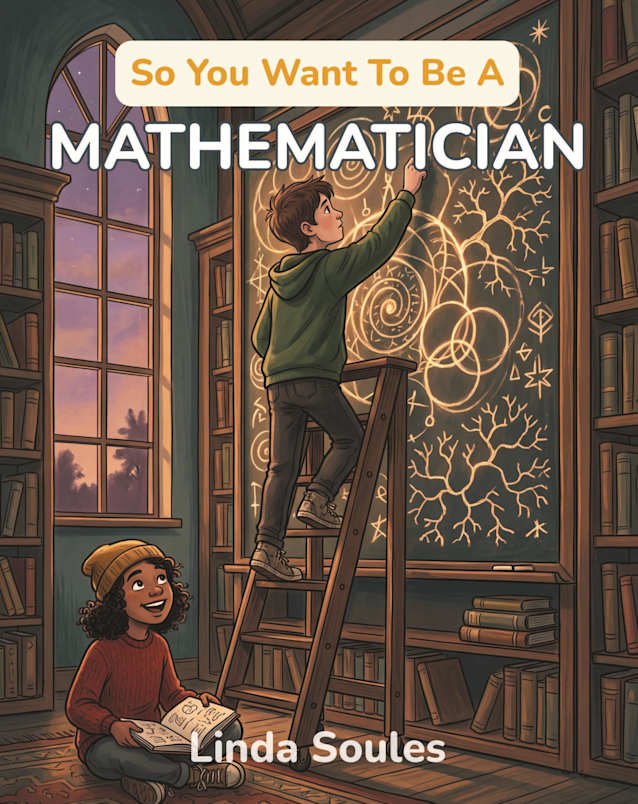
So You Want To Be A Mathematician (So You Want To Be A...)
About
From the So You Want To Be A… Series — 2026 Purple Dragonfly Book Awards, Grand Prize Winner
Right now, somewhere in New York City, two people have exactly the same number of hairs on their heads. Nobody has counted. With one simple idea, a mathematician can prove it.
Mathematics is far bigger than times tables and worksheets. It is the hunt for hidden patterns, the thrill of solving puzzles that stumped people for centuries, and the joy of proving something true forever. So You Want To Be A Mathematician invites curious kids into that world with fascinating true stories, laugh-out-loud moments, and hands-on math activities they can try at the kitchen table.
Young readers will discover why sunflower seeds grow in Fibonacci spirals, why cicadas count in prime numbers, and why a pattern that works four times in a row can suddenly break. They’ll learn how one mathematician carved a formula into a Dublin bridge, and how another paid off a math prize with a live goose on national television. Along the way they’ll meet famous mathematicians whose stories inspire, including Emmy Noether, Srinivasa Ramanujan, Katherine Johnson, Maryam Mirzakhani, Zu Chongzhi and June Huh. Several of them were once told they weren’t good at math.
This career-exploration book also gives an honest, age-appropriate look at the real job. Readers learn what mathematicians actually do, the difference between pure and applied math, where mathematicians work and how much they earn. They see the path through school and college, and the best and hardest parts of a life spent solving problems. They find out how math keeps medicines safe, guides Coast Guard rescues, protects online payments, powers GPS and even brought the snow in Frozen to life.
Kids don’t just read about math. They do it. They can make a Möbius strip, test the unsolved Collatz conjecture, discover the magic number 6174, prove Homer Simpson wrong, and play Sprouts, a game invented by famous mathematicians. The book closes with a kid-friendly glossary, a heartfelt author’s note and a resource guide to the best math books, websites, competitions and museums for young learners.
Written for ages 10 to 14 and accessible to readers 8 and up, this illustrated STEM book is perfect for:
Curious kids who love puzzles, logic, codes, patterns and asking “why?”
Reluctant math students who need to see that being stuck is part of the adventure
Parents, teachers and homeschool families looking for engaging math enrichment, STEM career education and a great read-aloud
Gift-givers searching for a meaningful book for a budding scientist, engineer, coder or mathematician
Part of the acclaimed So You Want To Be A… series of career books for kids, which treats young readers as intellectual equals and shows the real wonder of every profession.
For every kid who has ever seen a pattern where everyone else saw randomness.
Praise for this book
"So You Want to Be a Mathematician by Linda Soules is an inspiring children’s book that explores what mathematics is and the career paths available to aspiring mathematicians. It encourages children to move beyond the classroom, explore the world, discover patterns, solve puzzles, and search for logical proof. It explains basic mathematical concepts such as prime numbers, the Pigeonhole Principle, and the Fibonacci sequence. It debunks myths about mathematics, such as the idea that you must be a genius to be good at it, and instead highlights qualities that matter more in learning the subject, such as persistence and curiosity. Soules suggests practical experiments that children can try. Young readers will learn about various branches of math and possible ways to apply mathematics. They will be inspired by the mathematicians featured, who include Emmy Noether and Katherine Johnson.
Linda Soules’ work offers a refreshing definition and exploration of mathematics. I liked how it moves beyond the classroom curriculum to show how the subject can be applied in the real world. It brings abstract concepts to life through engaging illustrations and thought-provoking exercises. By dismantling common math misconceptions, it assures young learners that they can be mathematicians even though they may not consider themselves geniuses. Readers will enjoy the historical stories, such as a story about the Irish mathematician William Rowan Hamilton, who carved a formula into a Dublin stone bridge during a walk. Young readers will learn that there is a humorous side to mathematics and will be encouraged by remarkable mathematicians who overcame great obstacles to grow in their field, such as Indian mathematician Srinivasa Ramanujan, who taught himself advanced mathematics. So You Want to Be a Mathematician is an important work that welcomes readers into the world of math and debunks the idea that mathematics is only for some. Highly recommended for young learners."
"Linda Soules’s So You Want to Be a Mathematician is a children’s book that treats curiosity as the beginning of a possible career. It introduces mathematics through patterns, questions, and the pleasure of figuring something out, then connects those interests to the work mathematicians actually do. The voice is friendly and direct, with enough humor to make the subject feel approachable. I especially liked how it takes young readers seriously. It assumes they’re capable of following an interesting idea, even when that idea takes a little patience. That confidence gives the book much of its appeal and makes its encouragement feel earned.
There’s plenty to explore here, from different branches of mathematics and possible workplaces to the habits that help people tackle difficult problems. Historical examples sit alongside everyday situations, giving the subject both a human history and a practical presence. Soules pays attention to collaboration, imagination, clear writing, and the willingness to check your own reasoning. Those details make the career feel more fully drawn. The sections about frustration and persistence are especially valuable because they give the enthusiasm some weight. Readers get a sense that enjoying mathematics can include uncertainty, slow progress, and the satisfaction of staying with a question.
The illustrations give this picture book a welcoming atmosphere. Golden light, earthy greens, and rich browns fill libraries, kitchens, gardens, and workspaces, while expressive faces bring warmth to scenes of thinking and discovery. Children and adults appear together often, and the range of people pictured helps support the book’s invitation to many kinds of readers. I liked the visual attention to ordinary objects, natural patterns, and inviting rooms. It makes mathematical curiosity feel at home in daily life. The pictures offer plenty to linger over and give the information a personable setting.
The amount of text and the vocabulary make this a substantial read, especially for older children who enjoy asking how things work. Some pages introduce several ideas close together, so reading a section at a time would give those ideas room to settle. It’s also well suited to sharing with an adult who welcomes questions and doesn’t mind pausing to investigate one. The activities, glossary, and suggestions for further exploration give that conversation somewhere to go. What I found most appealing is the book’s interest in the person behind the mathematics: someone who notices, wonders, tries, and keeps learning. It’s an engaging introduction to a profession, with an encouraging view of the curiosity children already bring to the world."
"Linda Soules makes her case in So You Want to Be a Mathematician with a claim that sounds like a magic trick: two people in New York have the same number of hairs on their heads, and nobody has to count. Mathematics, she shows, is not worksheets and times tables, but the hunt for patterns and the pleasure of proving why they hold.
What follows reads less like a career guide and more like a tour through a working mathematician's head. Soules covers college paths and salaries, but the pages come alive in the stories: a formula carved into a Dublin bridge, a café notebook that ended in an unusual prize, a boy in a library who spent thirty years chasing one sentence in a margin. She is honest about the hard parts too: the dead ends and the proofs that collapse. Portraits of Emmy Noether, Srinivasa Ramanujan, Katherine Johnson, and June Huh carry the message that curiosity matters more than being the fastest in the room.
Soules writes the way a good teacher speaks, in short, warm sentences that never talk down. Her jokes land, from the annoyed pigeon to the ice cream line that tests its server's limits. Best of all, the book keeps handing the pencil to the reader. You count pinecone spirals, cut a Möbius strip, and test a pattern that looks certain before it surprises you. Reading it feels like being invited into a game rather than handed homework.
Instead of just describing the job, the book hands kids a real unsolved problem and lets them work on it before bedtime. Curious readers from ten to fourteen will get the most from it, though parents will learn a lot too. It belongs on any shelf where a child has ever asked, 'But why?'"