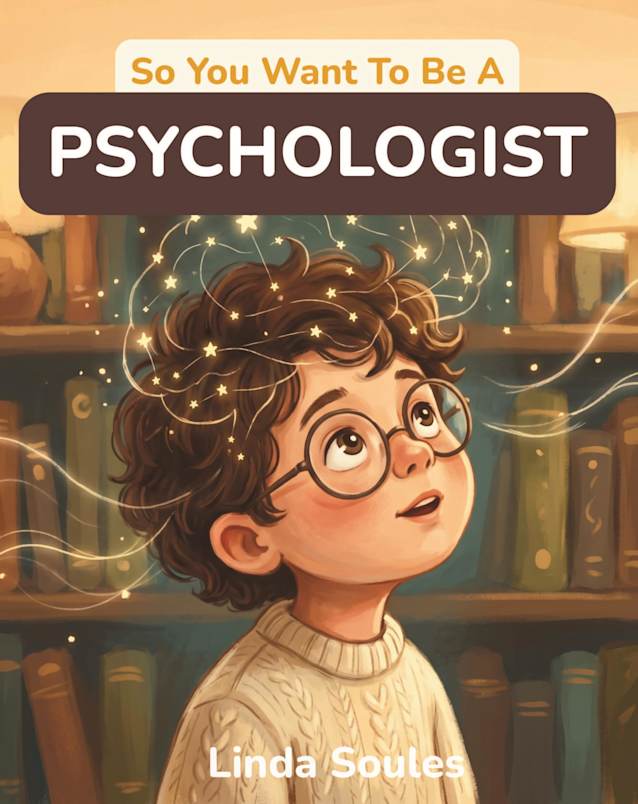
So You Want To Be A Psychologist (So You Want To Be A...)
About
WINNER of the Literary Titan Gold Book Award
The human mind is the most fascinating puzzle there is — and this is the book for the kid who can’t stop asking why.
Why does your loudest friend clam up the second a teacher calls her name? Why can you remember a silly song from years ago but not what you ate for lunch? Why do people yawn the instant they see someone else do it? If questions like these tug at you, you might already be a little bit of a psychologist.
So You Want To Be A Psychologist is a smart, warm, beautifully illustrated introduction to the real science of the mind — not the myth. It won’t pretend psychology is mind-reading, or just couches and “how does that make you feel?” Instead, it shows young readers what psychologists actually do: ask a careful question about how people think, feel, learn, and behave, then go find the honest answer with evidence.
Part scientist, part detective, a psychologist studies everything from memory and fear to how babies learn, how juries decide, how athletes stay calm, and how one class of kids learns to read faster than the class next door. This book takes readers behind the scenes of it all — and treats them as the curious, capable future professionals they might become.
Inside this book, curious readers will discover:
- What psychologists really do all day — from running experiments to helping real families
- The surprising places psychology hides: schools, hospitals, courtrooms, sports fields, video games, even car dashboards and crosswalks
- True stories of trailblazing psychologists, including Jean Piaget, Mary Ainsworth, Kenneth and Mamie Clark, and Martha Bernal
- Jaw-dropping fun facts: why you can’t tickle yourself, how rats laugh, the famous “invisible gorilla” experiment, and the marshmallow test
- An honest look at the hard parts — the patience, the uncertainty, and the courage it takes to be wrong and say so
- A day in the life, a kid-friendly glossary, and simple experiments to try right now
Honest about the challenges and glowing with the wonder of the work, this is a career book that respects a child’s intelligence — and a conversation-starter parents and teachers will love reading alongside them.
Perfect for: curious and gifted readers ages 10–14 (and a wonderful read-aloud from age 8); fans of STEM and brain-science books; kids fascinated by human behavior, feelings, and how the mind works; and anyone who loves nonfiction that reads like an invitation, not a lecture.
From the award-winning So You Want To Be A… series — honest, inspiring career guides built on one big idea: every grown-up job started as a kid’s curiosity.
Which mind will they set out to understand? Add So You Want To Be A Psychologist to your cart today.
Praise for this book
"Do you ever wonder why people think what they think? Why do they do things that often make no sense at all? In Linda Soules’ So You Want To Be A Psychologist, you will discover a lot of interesting facts about people who study the minds of others. Do you know what these people are called? Psychologists. And their work is part scientific thinking, a vivid curiosity about how the mind works, and a genuine care for the person they’re studying. That requires a lot of inventiveness and a considerable amount of both precision and patience. It also requires years of study, not just of potential patients, but academically as well. But if you’re interested in the mind, perhaps this job is the right fit for you.
Linda Soules’ children’s book, So You Want To Be A Psychologist, is a fascinating read whether you have an inclination to study the science of the mind, or you just want to further understand it for personal reasons. Like the other books in the “So You Want to Be” series, this book won’t disappoint. There’s a lot of interesting information packed into this beautifully illustrated book. As well as the basic facts behind the science, the author presents real-life stories of psychologists who have made a major contribution to the study of the human mind. These stories include psychologists like Jean Piaget, Mary Ainsworth, Kenneth and Mamie Clark, and Martha Bernal. I found it interesting that the author presents the work of a psychologist as being one who is part scientist and part detective. Once again, the author has presented a comprehensive, educational, but also entertaining read."
"Linda Soules’ So You Want To Be A Psychologist is an engaging introduction to the science of human thought and behavior. Written for children who are always asking 'why,' the book explains that psychology is not mind-reading or simply talking to patients on a couch. Psychologists are part scientists and part detectives: they ask careful questions, observe people, conduct experiments, and use evidence to understand how humans think, feel, learn, remember, and make decisions.
I love how this book has a way of making complicated ideas clear without talking down to young readers. Soules uses familiar questions, surprising facts, and hands-on activities to bring psychology to life. Readers can try the Stroop effect, test whether yawning is contagious, and experience the floating-finger illusion without needing special equipment. The book also challenges popular myths, such as the claim that people use only ten percent of their brains or that venting anger always makes them feel better. These examples encourage children to question extraordinary claims and search for reliable evidence.
The book also shows how widely psychology is used beyond counseling offices. Psychologists work in schools, hospitals, courtrooms, sports facilities, laboratories, video-game companies, and even in the design of cars and crosswalks. Inspiring accounts of influential psychologists, including Jean Piaget, Mary Ainsworth, Kenneth and Mamie Clark, Martha Bernal, and Ivan Pavlov, demonstrate how psychological research has changed both science and society. A day-in-the-life section, glossary, career information, and suggestions for further study help readers understand the education, patience, precision, creativity, and compassion required to enter the profession.
So You Want To Be A Psychologist is an informative, entertaining, and beautifully illustrated career guide that respects children’s intelligence. It honestly discusses both the excitement and the challenges of psychological research while encouraging curiosity, critical thinking, and empathy. The book is especially well suited for readers ages ten to fourteen, although younger children and adults can also enjoy reading it together. It would be a valuable addition to classrooms, school libraries, homeschool collections, and family bookshelves, particularly for any child fascinated by the human mind and determined to discover why people behave the way they do."
"Curious about the responsibilities of a psychologist and how the average person could use these skills in daily life, I read So You Want To Be A Psychologist: A Kids' Guide to Psychology… from cover to cover. I concluded that even though adults and children will treasure this book for a lifetime. The quality illustrations invite a warm feeling of curling up by a fire place with a cup of hot cocoa. I love how a day in the life of a psychologist is etched out like a log in the schedule. It paints a positive experience with loving a career revolving around people watching and analyzing the way the world works.
I love how it is informative about where psychologists work outside of counseling. The author touches the career and influence of scientist, Ivan Pavlov. I never would have imagined the bit about math being apart of this insightful detail. I have studied psychology, analyzed people and loved testing the field with my own experiments.
The grammar and punctuation is appropriate and well written for the age group that the author targets, however I highly recommend it to dreamers, home schoolers, librarians and book collectors. The research around this field is easily explained so that is does not scare away the average joe with college like terms. Those who seek wisdom and knowledge about how society runs smoothly should add this book to their library."
"Not only are the pictures captivating and detailed, the book has fun facts and also information about the pioneers in the field. There is so much information broken down into categories that makes it very easy to follow. Definitely recommend for small readers and even up to those age groups deciding their future career path!"
"I have read several of these books. I seem to learn something new about each profession that I didn't know was a thing. These books are written in a way that kids AND adults can really understand. They also take a deep dive into each profession. Love these books!"
"Amazing. So much great information for a teen trying to decide what path to take in school. I was very impressed with the detail."
"I love that this book included more of what psychologists do and gave other examples besides therapy. This book also explained the difference between the types of psychologists and about psychiatrists and cleared up any misconceptions."
"Good overview of what it takes to become a psychologist. Aimed towards children around 10. In depth information about education, as well positives and negatives of the job."
"This book (along with Linda Soules' other published Kids' Guides) create such a helpful M-A-S-T-E-R-P-I-E-C-E that's suitable for any CURIOUS CHILD."
"A well written explanation of the work of Psychologist. It explains how they study the mind and behavior to help people understand themselves better. A read for all ages."
"So You Want To Be A Psychologist is an exceptional book that introduces young readers to the fascinating world of psychology in an engaging, thoughtful, and age-appropriate way. Rather than relying on common stereotypes about psychologists, this book explains the real science behind understanding how people think, feel, learn, and behave.
What impressed me most was how much respect the author shows for young readers. Complex ideas are explained clearly without talking down to the audience, making this an excellent choice for curious kids who love asking "why?" The book explores a wide variety of topics—from memory and emotions to learning, decision-making, and human behavior—while demonstrating how psychologists use observation, research, and evidence to answer important questions.
The real-life stories of influential psychologists add depth and inspiration, showing how their discoveries have shaped our understanding of the human mind. I also appreciated the inclusion of fun experiments, surprising facts, and everyday examples that help readers connect psychological concepts to their own lives. Learning why people can't tickle themselves, how the invisible gorilla experiment fooled so many participants, or how psychology influences schools, sports, hospitals, and even road safety makes the subject come alive.
The illustrations and accessible writing keep the material engaging from beginning to end, while the honest discussion of the challenges psychologists face reinforces that science is built on curiosity, patience, and a willingness to keep learning.
This book would be an outstanding addition to classrooms, school libraries, homeschool collections, or any family bookshelf. It's perfect for children ages 10–14 who are interested in science, human behavior, or future careers, but it's also enjoyable for adults reading alongside them.
Overall, this is an informative, inspiring, and wonderfully written guide that encourages curiosity, critical thinking, and empathy. It leaves readers with a greater appreciation for the complexity of the human mind and the important work psychologists do every day. Highly recommended!"
"This is another great So You Want To Be A book! I like that it differentiates between psychologists, psychiatrists, counselors, and family therapists. It gives great information about schooling needed as well as job opportunities. It also talked about the different places psychologists can work such as schools, hospitals, courtrooms, private offices, etc. The best parts, hardest parts, and surprises about the job gave interesting information, and the illustrations were great! I received a free copy and loved it!"
"So You Want to Be a Psychologist is a great starting guide for kids curious about human behavior. By mixing science with empathy and problem-solving, Soules gives young readers a simple roadmap to understand why people act the way they do."
"This was such an interesting read! It's easy to stereotype a career based off one general piece of information, but reading this made it clear what a misconception that can be. Psychologists can work in so many places; schools, Healthcare settings, sports, military, etc. The 'Try this on your own brain' section was very cool and had me really questioning how complex the mind can be!! Definitely recommend this book!"
"I read this because my daughter is actually in college studying to be a psychologist. It was sort of neat to see the field explained this way. I'd suggest this for kids around 5th grade age and up. It tells a good bit of background about the traits you would need to become one as well as where you can use your skill set (not just for therapy)."
"This author continues to delight me with this series. I want to read the entire series! As a healthcare professional, I found this book particularly interesting and thorough. It is as informative as it is entertaining. Children of all ages can enjoy this series. The pictures are an added bonus. This author has done fantastic work."
"A fun and educational introduction to psychology for kids! This book makes learning about the human mind, emotions, and behavior easy to understand while inspiring curiosity, empathy, and a love for discovering why people think and act the way they do."
"I actually bought this for a teacher (for her classroom library) for children who were seeing psychologists. It’s great information for children who are interested in psychology as a career but it’s also helpful for kids who are trying to understand who they have an appointment with. It’s obvious what a dentist does when you see one, but a child may not know what psychologists do.
It turns out, this is a great book to explain what psychologists do. Older kids can read it themselves and younger kids can be read to.
Solid information, good role models, and a list of further resources in the back."
"The character here is the reader. And this book gets them. It’s for the 11year old who notices that their loudest friend goes silent when the teacher calls on her. It’s for the kid who remembers every lyric to a song from 3rd grade but can’t remember what was for lunch. It’s for the one who has 47 'but why?' questions before breakfast.
Instead of patting them on the head and saying 'you’re so smart,' this book hands them the tools of a psychologist and says: 'Okay, let’s test it.' That shift matters. The reader becomes part scientist, part detective. One page you’re learning why you can’t tickle yourself. The next you’re behind the scenes of the 'invisible gorilla' experiment, or reading about Kenneth and Mamie Clark and how their work changed schools. Suddenly psychology isn’t just couches and 'how does that make you feel.' It’s in courtrooms, on sports fields, in video games, even in how crosswalks are designed.
What I love most is the honesty. It doesn’t pretend this work is all fun facts and aha moments. It talks about patience. About being wrong and having to say so. About running experiments that fail. That respect is huge kids know when you’re sugarcoating. Here, they’re invited into the hard parts too, and it makes the wonder feel earned.
My niece read this in two days and immediately started running her own 'marshmallow test' on her little brother. She’s now telling everyone that rats laugh. She feels capable. She feels seen."
"I purchased this for my 11 year old niece who's already decided her career. She's adamant about it so I got her this. Of course, I read it first. It's really good, especially if you want to be a psychologist. It explores the human mind for the young reader in a way a teacher can't. It's worth the money and my niece loves it. She carries it everywhere she goes."
"Children often wonder what they want to be when they grow up, and this book is a great resource to explore that. It gives definitions, scenarios, and realistic expectations of what this career entails. My favorite part about this book is the writing because it is almost conversational. It felt as if someone was teaching me instead of me researching the topic on my own. There were also a lot of fun facts, like the horse that was believed to be able to count. I enjoyed learning about psychologists I had not heard of before like Kenneth Clark and Martha Bernal. I think this book offers the reader enough information to be fascinated but leaves them wanting more in case it ends up being the career choice."
"So You Want To Be A Psychologist is an exceptional book that introduces young readers to the fascinating world of psychology in an engaging, thoughtful, and age-appropriate way. Rather than relying on common stereotypes about psychologists, this book explains the real science behind understanding how people think, feel, learn, and behave.
What impressed me most was how much respect the author shows for young readers. Complex ideas are explained clearly without talking down to the audience, making this an excellent choice for curious kids who love asking 'why?' The book explores a wide variety of topics—from memory and emotions to learning, decision-making, and human behavior—while demonstrating how psychologists use observation, research, and evidence to answer important questions.
The real-life stories of influential psychologists add depth and inspiration, showing how their discoveries have shaped our understanding of the human mind. I also appreciated the inclusion of fun experiments, surprising facts, and everyday examples that help readers connect psychological concepts to their own lives. Learning why people can't tickle themselves, how the invisible gorilla experiment fooled so many participants, or how psychology influences schools, sports, hospitals, and even road safety makes the subject come alive.
The illustrations and accessible writing keep the material engaging from beginning to end, while the honest discussion of the challenges psychologists face reinforces that science is built on curiosity, patience, and a willingness to keep learning.
This book would be an outstanding addition to classrooms, school libraries, homeschool collections, or any family bookshelf. It's perfect for children ages 10–14 who are interested in science, human behavior, or future careers, but it's also enjoyable for adults reading alongside them.
Overall, this is an informative, inspiring, and wonderfully written guide that encourages curiosity, critical thinking, and empathy. It leaves readers with a greater appreciation for the complexity of the human mind and the important work psychologists do every day. Highly recommended!"
"Curious about the responsibilities of a psychologist and how the average person could use these skills in daily life, I read So You Want To Be A Psychologist: A Kids' Guide to Psychology… from cover to cover. I concluded that even though adults and children will treasure this book for a lifetime. The quality illustrations invite a warm feeling of curling up by a fire place with a cup of hot cocoa. I love how a day in the life of a psychologist is etched out like a log in the schedule. It paints a positive experience with loving a career revolving around people watching and analyzing the way the world works.
I love how it is informative about where psychologists work outside of counseling. The author touches the career and influence of scientist, Ivan Pavlov. I never would have imagined the bit about math being apart of this insightful detail. I have studied psychology, analyzed people and loved testing the field with my own experiments.
The grammar and punctuation is appropriate and well written for the age group that the author targets, however I highly recommend it to dreamers, home schoolers, librarians and book collectors. The research around this field is easily explained so that is does not scare away the average joe with college like terms. Those who seek wisdom and knowledge about how society runs smoothly should add this book to their library."
"This is awesome. I love seeing these kinds of books for young kids who want to explore the mind. It's a tricky thing, but interesting."
"This is a good book for any children who are thinking about becoming a psychologist when they grow up. This would also be great for kids who ask a lot of questions about why people may do certain things and gives them an idea for their career in the future. I like how this book goes over what a psychologist is and what they do. This book also gives an idea of what tools a psychologist uses, who they work with, and the highs and lows of the job!"
"I found this book extremely insightful and full of helpful and interesting information for those interested in psychology. I personally fell in love with psychology in high school and ended up becoming a counselor, so this book is something I would have LOVED as a teen. It provides historical facts, important terminology, characteristics needed in the field, and fun little mind tricks. I especially found the part about not being able to tickle yourself very interesting. I highly recommend this book to any child or adult interested in psychology."
"My daughter cannot get enough of these books. This was a career she didn't know much about, and now she is fascinated. The book is thoughtfully written and full of information kids can utilize in their future career plans. My kiddo wants to read every book in the series. Well done."
"This book is adorable! The illustrations are super cute, made with vibrant colors that draw the eyes in. The story is easy to follow as well as informative - but in a way a child can understand and process. I love that it focused on the curiosity of some children and their desire to know why people behave the way they do. Even more important, it explains in detail what a psychologist actually does - but in a way they can comprehend and follow. It also explains where a psychologists might work and the important tools they use during their daily roles. Even breaking down what a day in the life of a psychologists might look like, what they might do, and the others they work with.
Most importantly it highlights the crucial work psychologists do, how they advocate and help others, skills and qualities they generally possess, and even pays tribute to some of the greats within the field; including Piaget and Ainsworth. Not just that but it offers a list of things they can do at their age to prepare for their future in this role, as well as a list of blow your mind favorites to try, and even a glossary of relevant terminology."
"This interesting book explains to kids exactly what it takes to be a psychologist! Topics kids can learn about from this book include what a day in the life of a psychologist looks like, what qualities are needed (including a few you might not expect to need), the best and hardest parts of the job, famous psychologists in history, fun facts, and so much more. Anyone interested in learning more about how the brain works and how psychologists study the mind will enjoy this book!"
"This book explains the ins and outs of what being a psychologist is and what is involved in becoming and being one. Very good read for anyone who is interested in this career!"
"I work as both a therapist and a children's dance teacher. I don't talk very often about my work when at the other, but the questions of 'what is that' has been raised by my students and occasionally their parents. I liked how this book broke down the career into simple and digestible non-clinical terms that would be appropriate for me to use when explaining what I do.
I really like how it talks about the difficult parts of the work. It's very easy for children to see only the glamorous side of a job, especially if it's their 'dream job' and this gave a nice humanistic touch."
"So You Want To Be A Psychologist by Linda Soules is an engaging and accessible educational guide that introduces young readers to the fascinating science of the human mind and behavior. Soules breaks down complex psychological concepts, scientific research methods, and the diverse paths within the profession into clear, age-appropriate explanations. Rather than just offering a basic job description, the book explores why people think, feel, and act the way they do, helping children understand how curiosity and empathy drive real psychological work. Richly detailed and thoughtfully structured, it serves as an inspiring and informative starting point for any young reader curious about human nature and the professionals who study it."
"The book opens with a simple, sneaky-effective hook: a string of 'why does that happen' questions (why your loudest friend goes quiet when a teacher calls on her, why yawns are contagious) that most readers will find themselves genuinely pulled into before they realize they're being taught anything. From there it lays out the premise plainly: psychology is the science of the mind, built on the same rules as any other science, evidence, experiments, and a willingness to be wrong. No mystery plot, no ticking clock, just an honest pitch for why this particular kind of curiosity is worth a career.
Since this is nonfiction, there's no cast of invented characters, but Soules populates the book with real psychologists who function almost like a supporting cast, and she picks a good, varied bunch. Jean Piaget shows up watching his own kids play with blocks to figure out how children's logic develops in stages. Mary Ainsworth gets a lovely, quietly moving section on attachment and the idea that 'feeling safe is what makes being brave possible.' Kenneth Clark and Mamie Phipps Clark are covered for their research on segregation that became part of the evidence in Brown v. Board of Education, and Martha Bernal, the first Latina to earn a psychology doctorate in the U.S., rounds it out with a story about persistence in a field that didn't always want her there. These profiles do the work that side characters usually do in fiction, they give the abstract stuff a human face.
The real tension in the book isn't clan politics or missing ships, obviously, it's the gap between what feels true about people and what's actually true, and Soules leans into that hard. There's a genuinely fun section debunking things 'everybody knows' (venting anger doesn't calm you down, you don't use ten percent of your brain), and a recurring bit about Clever Hans, the horse that seemed to do math but was really just reading human faces, that she uses as a through-line for the whole scientific-skepticism theme. The pacing holds up well for a career-guide book, it alternates text-heavy sections on ethics and methodology with lighter 'fun facts' and hands-on experiments kids can try on themselves (the Stroop color test, the floating-finger illusion), so it never sits still long enough to get dry.
Where this one stands out in the series is that it doesn't oversell the job. Soules is upfront that psychology means years of slow, uncertain work and a lot of 'we don't know that yet,' which is a more honest pitch than most career books bother to make, and it actually lands better for it. Kids who are the 'why do people do that' type, the ones who ask a follow-up question after the first answer, are the obvious audience, but the book works just as well for a parent or teacher looking for something to read alongside them. It's not flashy, but it's sincere, well-researched, and quietly convincing."
"This book gave great information about what a psychologist does. Goes through each step clearly and methodically. Easy for a child to understand and read easily. The language is clear and precise. Great book."
"This was so fun to read! I’ve personally always been interested in psychology so I really enjoyed it. The illustrations are beautiful. I wish I had the so you want to be series growing up."
"I genuinely love these books. They are full of information but in a child friendly way."
"This is an informative introduction to psychology that explains not only what psychologists do, but also where they work, the tools they use, and both the rewarding and challenging aspects of the profession. I especially liked how the book combines colorful illustrations with real-world examples, fun facts and simple activities that encourage readers to think like scientists. Overall, this is an excellent career-exploration resource for children who are interested in people, behavior, science, or understanding how the mind works."
"This book like so many in this series, is highly practical and helpful in describing what psychology actually 'is' and what it looks like to work in such a field. This book gives good background into what a psychologist does: studying the human mind and figuring out applications for their discoveries. It went into depth and detail about the schooling needed, the hard hours, the emotional weight, and the fact that psychology isn't just sitting in a quiet room asking How do you feel about that?' I was surprised by the amount of deeper delving into the career. It was unexpected but well done. An excellent view for a youngster truly thinking about this occupation when they grow up."
"I found this book to be very thorough in explaining what Psychology is and what a Psychologist does. Most people probably assume that a Psychologist only works out of their office, helping individuals deal with issues in their lives. This book opens up the world of possibilities that exist when someone devotes their life to being a Psychologist. It introduces the possibility of working in such fields as sports coaching, behavioral science and design of everyday products that we all use, as well as other fields. This book also touches on the history of Psychology and introduces us to some of the work done that has helped change the way we think about things.
Overall, this is a well written book which is informative about working as a Psychologist. The book is aimed at children 10 to 14, which in my opinion is a good age range, although I think younger readers may need assistance with understanding some of the information. As someone with a Bachelors degree in Psychology, I wish I had had a source like this available to guide me in my career choices."
"If you are leaning towards a degree in this field, it’s definitely the book to grab! I was always curious about psychology but now I’m more interested in it! Definitely recommend this for kids as well as it has some engaging content."
"There is a lot of useful information in this book, and as an educational assistant I will definitely be going back to look at this information and sharing it with my colleagues. This book is useful for kids to understand what a psychologist is and what they do, how they can help families but they do it in a way that kids will understand. Would recommend this to anyone who has a child that sees a psychologist or what’s to know more about it."
"So You Want To Be A Psychologist is a great book for young minds trying to navigate the 'What do I want to be when I grow up?' This book not only gives examples of famous Psychologists such as; Jean Piaget, who transformed how children’s minds were understood, Pavlov’s dogs experiment, teaching us about conditioning. So You Want To Be A Psychologist, shows you that Psychologists are NOT psychiatrists who can’t prescribe medication. Psychologists are so much more than that, with a vast field of job possibilities. They are not just limited to hospitals or private clinics. Psychologists are everywhere: they are in schools, in courts, on sports teams, even the military. The list is endless. If you have a budding Psychologist in your family, purchase this book for them or even yourself. It is worth the read!"
"So You Want to Be a Psychologist gave me a better understanding of what psychologists actually do. I liked that the book showed that psychology is more than just sitting and talking with people. Psychologists can work in schools, hospitals, sports, businesses, courts, and research. One part I found interesting was the example of Clever Hans the horse. It showed how important it is for psychologists to look closely at evidence instead of just believing what they see. I also found the information about becoming a psychologist interesting because it showed how much education and training is involved. The book explains the difference between a PhD and a PsyD and also talks about the importance of privacy, informed consent, and being honest when working with people. Overall, I think this is a good book about psychologist."
"I read this book to get a better understanding of what might go into someone wanting to be a psychologist. This book was so good to help give you an idea of why you might want this career and also what you might not expect but still need. I really liked this book."
"Other customers should know this is a very kid friendly book. If a child will continue reading it after the first 10 pages, his curiosity surely has been piqued. Gauge the child's interest. It is easy to understand and relatable. The fact that different nationalities are quoted helps children be able to see themselves as Psychologists. Activities are very helpful, such as yawning, and seeing colors as words or the colors themselves. I also enjoyed the pictures."
"Very informative book. It includes history, biology, experiments, well known people in this field and the branches of this field you can go into. Enjoyed the book!"
"This a well written book in a well written series. The language is in layman’s terms, easy enough for the age range to understand. There are real world examples in each section requiring examples. One of the surprising elements is that it was not written in “male default” language. The art is well done, a cutesie-type of artistry that is warm and conveys the topic at hand. I enjoyed seeing a glossary of “big word” terms as well as resources a young reader can search out. A small read but an enjoyable one."
"I really loved So You Want To Be A Psychologist by Linda Soules. It's written like a conversation, not a textbook. The best parts are the real scenes she uses to explain the mind, like Clever Hans, the horse in Germany who seemed to do arithmetic by tapping his hoof but was actually reading people's faces, and the basketball gorilla experiment where half the viewers miss the gorilla because they're busy counting passes. My favorite is A Day in the Life. At 9 AM she does an assessment with a 9year old girl who struggles with reading, sitting at a low table with puzzles so the child feels safe while she observes. It's warm, honest, and inspiring."
"I enjoy how this book gives readers a better understanding of what it takes to become a psychologist. It’s a helpful and informative guide for anyone interested in the field, especially those who are just starting to explore their career options. I like that it encourages readers to think about the journey ahead and what to expect along the way. Overall, I think it’s a great starting point for anyone considering a career in psychology!"
"This was my first 'So You Want To Be A...' book and I was quite impressed. I expected there to be a rundown of what it was like to be a psychologist and there was. The author discussed just what exactly psychology was, explained the scientific aspects (i.e. testing and research) of being a psychologist, and even described what a typical day might look like. I really liked the fact that the author included a section that essentially detailed the bright spots of the job and also included a section that explained the hardest parts of the job. I think the biggest surprise for me with the book was that the author included a decent amount of history regarding psychology, including details about famed psychologists Again, I expected the book to mostly focus on what to expect from the job so that was a nice surprise. I am definitely interested in reading more from this series and introducing my kids to it."
"This is an excellent introduction to what it means to be a psychologist for kids, age 10-14. It’s well written with a friendly conversational tone. It has great illustrations and includes things like, ‘a day in the life of’ and has extra resources at the end for kids who want to learn more. I would highly recommend this as a great resource for parents or teachers wanting to introduce kids to what it means to be a psychologist!"