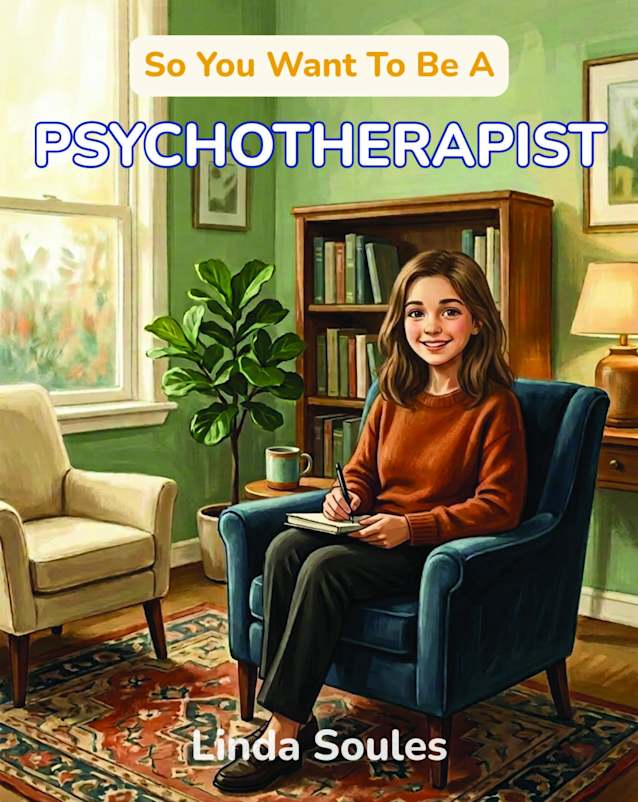
So You Want To Be A Psychotherapist (So You Want To Be A...)
About
WINNER of the Literary Titan Gold Book Award
Imagine a job where your most powerful tool isn’t a scalpel, a computer, or a fire truck — it’s the way you listen.
So You Want To Be A Psychotherapist invites curious kids into one of the strangest, most surprising careers there is: the work of helping people heal through careful, honest conversation. No talking down. No sugarcoating. This is a career book that treats young readers as intellectual equals — honest about the small private victories and the hard parts of a life spent in a small room with two chairs.
Inside, readers discover:
- What a psychotherapist actually does all day — and why listening, not advice-giving, is the real skill
- Where therapists work — from cozy offices to schools, hospitals, video calls, and even barns full of horses
- The tools of the trade — the two chairs, the tissue box, the fifty-minute hour, and the “doorknob moment” every therapist knows
- The best parts of the job and the hardest, told with rare honesty
- A real day in the life, from morning tea to the moment the work stays at the office
- Trailblazers who changed the field — Carl Rogers, Mamie Phipps Clark, Virginia Satir, Marsha Linehan, Anna Freud, and Derald Wing Sue
- The qualities that matter most — deep listening, emotional steadiness, curiosity, and self-awareness
- Fun facts, a “Could This Be Your Job?” quiz, a kid-friendly glossary, and where to learn more
Part of the acclaimed So You Want To Be A… series, this richly illustrated introduction to psychology, empathy, and mental health is written for ages 10–14, yet lingers happily with younger readers and sparks real conversations for the whole family. It’s the perfect gift for the empathetic child — the one their friends come to, the one who holds a silence a beat longer than everyone else.
Somewhere out there, a person you haven’t met yet is having a hard week. One day there will be two chairs in a room, and one of them could be yours.
The chair will be waiting.
Praise for this book
"So You Want To Be A Psychotherapist by Linda Soules is another excellent addition to the So You Want To Be series. Two chairs in a quiet room; that’s what it takes for lives to start changing. Imagine a job that doesn’t revolve around vehicles, tools, or computers but around how you listen to others. This book invites young readers to delve into a career where understanding, empathy, and listening skills are the most important tools. It explains what a psychotherapist does, what it takes to be one, and why it’s such an important job, especially in today’s fast-paced, high-powered, busy lives. Readers will learn what tools they use, what a day in the life of a psychotherapist looks like, and the challenges and rewards that come with the job. They’ll meet famous psychotherapists who shaped the job, and they’ll learn the qualities needed to decide if it’s what they want to do with their lives.
Linda Soules’s series just keeps getting better, and So You Want To Be A Psychotherapist is an excellent addition. This wonderfully illustrated book introduces young readers (and older ones) to the work of a psychotherapist, explaining every part of the job in simple, straightforward language. It may not sound like the most exciting of careers for a child, but rather than just a job description, this book treats the subject the same way a therapist treats their clients – with respect, patience, and a deep dive beneath the surface. The book moves smoothly from one topic to the next and includes fun facts, a quiz for readers to take, and a helpful glossary at the end. It’s an honest book; it doesn’t sugarcoat the challenges of the job, the cost involved in getting there, the hard work, the potential for burnout, and other challenges, but it does so in a way that doesn’t discourage readers. If your child is the one their friends turn to, the one who listens quietly without judging or shouting, this could be the career path for them. One day, they’ll meet that person having a hard time, and that’s when the room with two chairs will be open and waiting."
"So You Want To Be A Psychotherapist by Linda Soules is another excellent addition to the So You Want To Be A… series. Rather than focusing on vehicles, technology, or specialized equipment, this career guide introduces children to a profession in which the most powerful tool is the ability to listen. Soules explains how psychotherapists help people understand their emotions and heal through careful, honest conversation. Written for readers ages ten to fourteen, the book treats children as thoughtful equals while presenting mental health and therapy in a warm, approachable, and respectful way.
The book offers a thorough look at what psychotherapists actually do, where they work, and what a typical day might involve. Young readers learn about the familiar two chairs, the tissue box, the fifty-minute hour, and the surprising “doorknob moment,” when a client reveals something important just as a session is ending. Soules also explores settings beyond the traditional office, including schools, hospitals, video appointments, and barns where therapists work alongside horses. Fun facts, practical listening exercises, a self-assessment quiz, and a kid-friendly glossary make the material informative and engaging.
One of the book’s greatest strengths is its honesty. Soules doesn’t sugarcoat the educational requirements, licensing process, ethical responsibilities, emotional strain, or risk of burnout that can accompany this career. At the same time, these challenges are presented without discouraging readers. The book emphasizes the importance of empathy, curiosity, emotional steadiness, self-awareness, and self-care. It also introduces influential figures such as Carl Rogers, Mamie Phipps Clark, Virginia Satir, Marsha Linehan, Anna Freud, and Derald Wing Sue, showing how different people and ideas have helped shape the profession.
The warm, inviting illustrations and straightforward language make So You Want To Be A Psychotherapist accessible to younger readers while offering valuable insights for teenagers, parents, and adults. It’s especially well suited to the child whose friends naturally turn to them, the quiet listener who offers patience rather than judgment. The book may also reassure young people who feel nervous about attending therapy by showing that psychotherapists are caring professionals trained to listen and help. Realistic, encouraging, and deeply compassionate, this career guide invites readers to consider whether one of those two chairs in a quiet room might someday be theirs."
"Linda Soules shows ages 10 to 12 that a psychotherapist’s main instrument is careful attention in a quiet space with two chairs, not a machine or a couch. Parents reading along will find that framing useful at home as well.
The book walks through the whole shape of the work: what a session sounds like, confidentiality and the boundaries that protect the hour, and the many roads in, from counselors and social workers to psychologists and psychiatrists. It explains approaches like CBT and EMDR, clinical notes, supervision, and play tools such as sand trays and puppets for children who cannot yet name a feeling. There are profiles of figures like Carl Rogers, Mamie Phipps Clark, and Marsha Linehan, a day-in-the-life walkthrough, a glossary, and a closing self-check. The school counselor pages stand out for families: knocking on that door needs only something on your mind, not a full crisis.
Soules' voice stays plain and close, more conversation than lecture, built from small office facts that stick: the hallway white noise machine, the tissue box left within reach, the fifty-minute session. Illustrations give young readers a visual hold on the setting while adults pause to talk. In the So You Want To Be A series, this title treats mental health care as ordinary, not strange or shameful.
The book's strength lies in treating a school counselor's office and a psychiatrist's with equal narrative weight, which quietly corrects the assumption that therapy is only for crisis.
Give it to the kid who already holds a silence longer than friends expect, and keep it nearby for the adult who wants steady language for those talks."
"This illustrated career guide explains what psychotherapists do, where they work, who they work with, and why their role matters. It walks readers through therapy rooms, schools, hospitals, community centers, group settings, online sessions, and child-centered spaces.
The book also explores the basic tools of the profession, from therapeutic approaches and clinical notes to supervision, confidentiality, and the quiet structure of a therapy session. Readers are introduced to famous figures in the field, important vocabulary, practical ways to begin building listening skills, and the emotional qualities needed for this kind of work.
What stands out most about this book is its softness, but not in a weak way. It understands that psychotherapy is not dramatic on the outside. Most of the work happens in ordinary rooms, between two people, through conversations that may look simple but are actually full of care, attention, and skill.
I liked how the book avoids making therapists seem like magical problem-solvers. Instead, it presents them as steady companions who help people notice patterns, name difficult feelings, and find their own way forward. That approach feels respectful both to therapists and to the people who seek help.
The emotional honesty is one of the book’s strongest qualities. It does not hide the hard parts: slow progress, heavy stories, burnout, silence, and the need for therapists to take care of themselves too. At the same time, it shows why the work matters. A person sleeping better, speaking more clearly, or feeling less alone may not look like a grand victory from the outside, but the book understands how enormous those changes can be.
The illustrations match the tone beautifully. The rooms feel calm, warm, and safe, with soft colors and peaceful details that make the subject approachable for young readers. I also appreciated the sections on cultural humility and self-awareness, because they add depth and remind readers that therapy is not only about knowing techniques, but about respecting the full person sitting across from you.
Overall, So You Want To Be A Psychotherapist is a warm, thoughtful entry in the series, and one of the more emotionally grounded ones."
"This is a great educational book for anyone wondering what it would be like to be a Psychotherapist ! I would say it’s geared towards an elementary aged kid. It reads similar to the 'Who Is' type books that many kids know and love. I liked the layout, including the best parts of the job, hardest parts of the job (you can’t do the healing for someone), surprising parts, A day in the life, fun facts (a therapy hour is 50 minutes, not 60), and even a glossary at the end of the book for any of the “Psychotherapist words”. The questions towards the end that encourage kids to ask themself to know if this is a future career for them are great too! All in all, great book. This is one of many books in the series we have read and we will definitely continue to check out others in this series out too."
"This book is geared towards kids, but it is also great for adults. I even learned a lot and it really kept my attention. The pictures were warm and inviting. Every topic was explained in a way that not just informed, but kept my attention. It covered a lot of really good information. I think my favorite part was the importance of a psychotherapist taking care of themselves also, so they can properly take care of clients in the way they deserve. It even introduced important psychotherapist that made meaningful contributions to the field."
"What a great series! This book provides an overview of the career, walks the reader through a typical workday and identifies the pros and cons of the career. It is well written and will appeal to those seeking a career as well as parents seeking to help students identify opportunities."
"This book is very well written and explains in easy to follow and understandable language on what a psychotherapist does. I would definitely recommend this book to older elementary students and older!"
"As someone who wanted to be a psychotherapist when I was younger I would have loved this book. It can also be useful to explain therapy to a child."
"I have enjoyed reading all of these books. Do you want to be a psychotherapist is such an interesting and informative book. I felt this one in particular had a more mature read. I enjoyed reading about the history of some famous psychotherapists like Sigmund Freud and his daughter, Anna Freud work with children."
"This book shows you just how important a psychotherapist actually is. It presents opportunities for career placement that the general public never even knows about. This book also lists many fun facts about how therapy works on the mind."
"As someone interested in pursuing a career in counseling, I found this book both informative and inspiring. It gave me a better understanding of what the profession involves and reinforced why I'm passionate about helping others. It's an easy read with valuable insights for anyone considering this career path."
"This is a great children’s book. This is an awesome way to introduce different career to your child and have them explore different options for their future. The illustrations in this book are top notch and really give the sense of the career and all has required in that career. The book is geared towards children, so the language is easy to follow, simple, and the points and themes are very clear. I highly recommend this book for any parent who would like to educate their child beyond standard educational topics.
The book goes in a detail about the characteristics a person possesses to be a good psychologist, which I think is an interesting take on the subject. The book is not dry or factual. It instead focuses on their personality traits and characteristics that a person as which would make them a good psychologist and why. This is an interesting take, and one that I’ve not seen before in a children’s book. As such, this is a refreshing take on a children’s book and has a certain level of maturity that I think is good for children to experience while reading and learning."
"What I think I love most about this book is that it provides both the good and the bad about the job. It clearly tells you what's needed to be good at therapy. It highlights the listening skills, the confidentiality, and the need to not always speak during a session. It talks about how draining the job can be, but also how rewarding. This is an excellent introductory book for any kiddo who is considering exploration of this field of work."
"One of the moments that stayed with me was the discussion of the two chairs exercise, along with the worry stone and the memorable doorknob moment, because these examples showed how small, practical techniques can uncover emotions and help clients move forward instead of just talking about their problems. Those specific moments made the book feel authentic and gave me a clearer picture of what psychotherapy looks like in real practice rather than just in theory. This book is for anyone interested in becoming a therapist because it shows that effective therapy is built on empathy, observation and simple techniques that can make a lasting difference."
"I picked this up for my niece because she has been asking a lot of questions about mental health careers, and it surprised me in a good way. Instead of making therapy sound easy, it explains why careful listening, emotional steadiness, and trust matter so much. The little details about a therapist's day and the stories behind the profession made it feel real, and it started a thoughtful conversation between us afterward."
"I thought this book was super cute! This was an awesome way to describe what therapy is to kids and what a career would look like in this. I think this book could also be useful for teens and adults who are wondering about the career."
"So You Want To Be A Psychotherapist introduces kids to the world of mental health and talk therapy. Instead of focusing on jobs that use big machines or gadgets, this book shines a light on a career where listening is the main tool. Soules breaks down therapy in a simple, positive way—showing kids how caring about others can turn into a great job."
"Reading through this one was very special to me because while studying psychology in college, this was exactly what I wanted to do. I love listening to people and being able to help them through what they are feeling, by letting them talk and then giving them advice if that is what they want, or just being there to listen. I am not in the profession at this point, but I have friends who have told me that talking to me has really helped them, and that is really rewarding."
"This series is such an informative and interesting way to explore career paths. So much fun to read through. A great way to get more knowledge and insight about becoming a psychotherapist."
"This is a great book for a young reader who is either interested in the field of psychotherapy or just wants to learn more about the subject for personal reasons. I would even recommend it for a young person who is going to therapy themselves, as it simplifies the purpose of therapy while also giving important details on how and why therapy works. This book does a great job of not dumbing down the topic while maintaining an appropriate viewpoint of a younger reader. I highly recommend this book and I'm looking forward to reading more from this series."
"This is an excellent introduction to what it’s like to be a psychotherapist. From the basics of listening, a typical 'day in the life,' terminology, this book is a great peak at what a career as a psychotherapist would be like. The illustrations in this book are very good and convey the common setting and atmosphere you would experience. Overall a lot of good information presented in a clear and engaging manner."
"As a licensed mental health counselor, this book was a really great preview of what this career includes on a day-to-day basis, but also over the span of a career. The language is perfect for readers 10-14, but is also appropriate for children on either side of that age range due to the illustrations and level of detail that is included. I enjoyed reading this book because it gave an accurate depiction of what it means to be a psychotherapist: you work over time to make yourself unnecessary!"
"This is an excellent book that not only reads very well for the intended age-range (10-14), but it also is beautifully illustrated. The author does a fantastic job going into detail what a therapist does. Anyone young person thinking of going into that field will have a clear idea on what the job entails. I also feel it will help a young person understand what a therapist does if they see a therapist. I definitely want to check out the other books in her series."
"I would highly recommend this book for young readers who are curious about pursuing a career as a psychotherapist. It provides a clear and informative foundation for understanding what to expect from this profession and the important role psychotherapists play in the lives of their clients.
In my opinion, becoming a successful psychotherapist requires genuine compassion and empathy for others, a willingness to listen without judgment, and a sincere commitment to the well-being of each client. This book offers young readers a helpful introduction to these qualities and to the rewarding work of helping others."
"What an encouraging guide! I think that this is a very encouraging and factual book on the life of a psychotherapist. The writing is age appropriate. The graphics are clear and heartwarming. I hope more children consider this field. It is a field perfect for a compassionate person."
"A really cute and informative book for kids/teens that are interested in the field!! This would've been perfect for when I was younger and curious about this career. It's kid friendly while being informative and not childish. The pictures are also a nice touch. I like that it explains and uses actual terminology without making it overly difficult to understand."
"As a mom, I really like the way this book introduces kids to a career they may not know much about. It explains what a psychotherapist actually does and, more importantly, shows that the job is about listening and understanding people rather than simply giving advice.
I loved the little details, like learning about the 'fifty-minute hour,' the famous people who helped shape the field, and even the different places therapists can work. It also doesn’t pretend the career is always easy, which I appreciated.
The quiz, fun facts, the images and glossary help keep younger readers interested while giving them plenty to think about. I could see this sparking some really good conversations between parents and kids, especially for a child who is naturally curious about people and why they think and feel the way they do."
"An incredibly insightful piece of reading. I found myself reflecting on how demanding this profession truly is. Active listening which requires an immense amount of concentration, and paired with the analytical writing skills which are needed for documentation, it must be deeply draining for every therapist. It makes perfect sense why the therapists need their own support systems and therapy to process it all. A great feeling when the patient is starting to progress achieving the mission of the therapist."
"This book was a great read for a child wanting to understand the work of a psychotherapist.
It had clear, easy to understand language and was written in a way that is easy for a child to resonate with.
I also, as an adult learnt a few things too. Like the difference between a psychiatrist and psychotherapist, I always just thought they were the different name for the same profession.
I really liked the illustrations too.
I'd recommend this to children and adults who want an easy to understand guide of what is needed to become a psychotherapist"
"'Therapy comes in more forms than just talking. It turns out that brushing a giant, gentle, hay-smelling animal can calm a scared person faster than any clever thing a grown-up could ever say. Sometimes the best therapist has hooves.'
This is an incredibly thorough guide to Psychotherapy for kids. I read this cover to cover and will admit to feeling quite moved at some of the phrasing used.
So You Want To Be A Psychotherapist combines a depth of information on the career with beautifully gentle illustrations.
Listing details of the most influential psychotherapist, and including the etymology of the name itself - this guide leaves nothing out.
I am pleased it also talks about the importance of support and therapy for the therapist themselves.
'Imagine a job where your most powerful tool is not a scalpel a computer or a firetruck - but the way you listen.'
A superb text.
Invaluable and recommended."
"Being a good listener is more than being a good friend. Driving into the book So You Want To Be A Psychotherapist helps children understand that listening can be more than just being a good friend but can actually be a very important career choice and incredibly helpful to many people. This book helps a child understand what it means to be a psychotherapist, including the benefits and difficulties of the job. It helps a child understand the huge importance of this career in society. I believe it’s an incredibly useful book to help young minds understand that mental health is very important and that professionals that help handle mental health are incredibly special people."
"I picked up 'So You Want To Be A Psychotherapist' because I've always been curious about what actually happens inside a therapy session, and this book explained it in a way that finally made sense to me. First, I loved how it broke down what a psychotherapist really does. It is not just talking about feelings. It is a whole skill of listening closely, noticing patterns, and helping someone find their own answers instead of just handing them one. For example, I found it fascinating that some therapists keep a smooth worry stone in the room so a person's hand has something steady to hold while their mouth finds the hard words. Also, I never knew about the doorknob moment, which is when a client talks about small things the whole session and then, right as they are leaving, finally says the most important sentence of the day. In addition, the book explained how therapists use a sand tray with tiny figures so kids can build what happened instead of having to say it out loud, which really showed me how creative this work can be. Even Sigmund Freud's dog Jofi got a mention, since she would settle close to calm patients and then walk to the door the moment the fifty minute hour was up, almost like she had her own internal clock. Furthermore, what stuck with me most was the idea that the relationship between the therapist and the client is what actually heals people, more than any fancy technique. That completely changed how I think about therapy. I also liked learning about people like Carl Rogers and Marsha Linehan, since it showed me that this field was built by real people who cared enough to change how we treat the mind.
Overall, this book made me think seriously about what it takes to help people for a living, since it takes patience, curiosity, and the willingness to sit with someone through hard things without trying to fix it for them. It gave me a much clearer picture of the training path, the day to day work, and even the hard parts, like carrying other people's pain without letting it wear you down. In conclusion, if you are a kid, or honestly even a teen, who likes listening to your friends and wondering what makes people tick, this book will speak directly to you. It is written warmly and respectfully, and it does not talk down to younger readers. It left me wanting to learn more about psychology and maybe even explore this as a future path. Highly recommend for curious minds who dream about understanding people and helping them heal."
"As a licensed marriage and family therapist, I wanted to read this book to see how it presents to children who might be interested in the helping profession. I appreciated the emphasis on not giving the answers but being there to help guide the clients in finding out the answers or way to healing. I enjoyed the different aspects discussed, and also the information about professionals in the field who have done amazing works to further the mental health world. Overall, a great overview of what therapists do and what it takes to become 1. Would recommend for children (or anyone really) who is considering the idea of being a therapist."
"This book goes beyond to reassure people that the subject of Psychotherapist is no longer taboo. Seeking and receiving help for mind is akin to getting help for the body. Insightful!"
"Psychotherapy is a very interesting profession. What I knew about it was mostly from reading about Sigmund Freud and fiction novels. This book was the first one that enlightened me what psychotherapists actually do. Being a good listener, having patience and a positive mind, and guarding client’s confidentiality are key things of becoming a psychotherapist. It’s not easy as it sounds. I loved learning that psychotherapists help anyone who needs someone to share their problem and help them find a way out of it or be able to process the emotions and thoughts.
If you are someone who likes listening to a friend vent her problems without judging her, but giving her a new perspective, this profession is for you. You learn that therapists also need to take care of their mental health so they can be fully present for their clients. Towards the end of the book you read what a day in a life of a psychotherapist looks like. This is one of those careers where you want to help people instead of focusing on money. I enjoyed reading the overall different aspects of this profession which gives one a clear picture of what it is all about. Great book for young readers. It’s easy to understand and well-structured. Illustrations are one of the best things about this book. They keep you engaged. For specific terminology related to psychotherapy, there is a glossary at the end of the book."
"Wow .... I honestly could not put this book down. I am always the type of person to help others before I help myself. Not only did this book teach me that I need to take care of myself before I am any good for anyone else. But it also explained what it would be like to be in that field. Alot of useful information. I would recommend this book to anyone not just to someone who wants to be a psychotherapist but to also so you can learn about yourself and how you can help others when they need someone to talk to."
"I found this book interesting to read. Before reading it, I never thought about how many small things therapists notice when talking with clients. I especially remember the example of placing the tissue box closer to the client instead of handing them one. It seems like a small thing, but it can make someone feel more comfortable. This book helped me understand that being a psychotherapist needs patience, empathy, good listening, and understanding. Overall, I really liked this book and would definitely recommend it."
"I quite enjoyed this little read. I wanted to read it more for helping me find ways to talk to my kids or help them talk to me or anyone else they feel safe with as I know in this day and age, with the way technology is and how things have changed, it isn’t always easy to feel heard or express certain emotions.
This read gave me some very helpful insights on ways professionals help kids to open up with different options, such as drawing, or even playing in sand and creating an image for you. I definitely got some great ideas because I know talking doesn’t always work, or is not always a good fit."
"If you have a teen that is interested in being a psychotherapist, this is a great book that will guide him or her into considering this career. The author is transparent about what is involved in being a therapist: educational expectations, license qualifications, ethical responsibilities, and personal characteristics to be an effective therapist. While being honest about the profession, the author also portrays being a therapist in a realistic way.
If you have a teen who may need to see a psychotherapist, this is a perfect book for someone who may be nervous about talking about their mental health. The author touches on how therapists are empathic, self-aware, strong communicators, and constantly seeking to expand their knowledge. I found this book to portray the career field very well.
I would recommend So You Want to be a Psychotherapist because it leaves readers with realistic expectations while pushing them to ask themselves if they have what it takes to be join this profession."
"I like that it doesn’t sugarcoat the profession. Even if a child doesn't end up becoming a therapist, the book teaches incredible lessons on deep listening, empathy, and emotional wellness that any kid can use. This book is really good for older teens, family and would be good fit for schools. I feel like the book is powerful for kids who are interested in becoming a therapist."
"This is an outstanding explanation, for youth, about what is involved in being a therapist. The author presented education, listening, safety for a client, and the importance of a good therapist being willing to see a therapist along the journey of the job. Recommended for middle and high school students."
"I never thought so much information could be packed into a compact book. This book covers every angle for someone considering the field of psychotherapy. It’s also an excellent guide for someone who is unsure about beginning therapy and what therapy could go for them. This book should be in school nurses’ offices too."
"A throughly informative and genuinely enjoyable insight into such a misunderstood profession. I love how there is an element of honesty whilst keeping the book light and child friendly. It challenges assumptions people might already have around psychotherapists and the day in the life segment was especially informative. Something that stands out about this book is the way it makes the job feel achievable and accessible by everyone, which is perfect as it is aimed towards children. Overall such an amazing guide to this job and perfect for children trying to find the career best suited to them."
"A clear eyed, honest and engaging guide for young readers about what it takes to become a Psychotherapist. In line with the author’s aim to ‘write something closer to a conversation than a career guide’, this book feels like a warm, unpatronising, informed conversation between an adult expert and a young curious reader. It highlights the qualities needed (and not needed) in the profession, and provides useful examples of possible scenarios by way of illustration and example. It’s practical approach clearly outlines what the profession entails and what to expect in working practice - a day on the life of, the best parts of the job, the hardest parts of the job etc. as well as providing useful links for further reading and exploration. The illustrations are charmingly almost retro - comforting but clear. Overall, an excellent, really warm, informative and useful guide for young people wanting to dip their toes into this field of work."
"This book explores what is needed to be a Psychotherapist in such a child/young adult friendly way. Parents could read this with their child when looking into job opportunities for when they leave school or college. It answers a lot of questions about what the career involves, about the type of person you need to be and what skills and qualities you need to have. There is even an example 'day in the life' section to see what a working day could look like. It is written very informally and suitable for the age of reader it is aimed at, with lovely pictures to enhance your reading experience. It was even quite informative from an adult point of view for people who may be interested in a career change. I also like that this series covers another 196 careers, all located at the back of the book."
"This was a really sweet and informative book for older kids to learn about the profession of Psychotherapist. It was developmentally appropriate and very thoroughly explored even the day-to-day, which I think is helpful for kids to get a realistic idea of what it's like to be a Psychotherapist. I really appreciated the mention of diverse people in the field who contributed to what the field is today, not just the ones we frequently hear about. Get this book if you have a child who is empathetic and is curious about what a career might look like in the helping profession!"
"This was a really on point book. At first, I thought it was just for little kids, but I realized it’s for a young adult or teen. As a therapist myself, it really captures what’s involved in supporting someone in a therapy session. Talking about chipping away at past shame around going to a therapist and normalizing the practice of talking about your feelings. I liked how they talked about some of the historical figures around therapy and who helped shape current psychotherapy. I thought it was really great that the author talked about developing the skills, like practising listening, taking three deep breaths after someone finishes, talking before commenting, as well as the glossary and additional books to read to learn more about it. Explaining how therapy is about sitting with the silence, being patient through the slow change, and that it is not a fast paced job, but a career that focusses on listening and being present with others going through different challenges in their life. What I thought would be a juvenile book, actually proved to be a very important book in the 'what do I wanna do when I grow up' theme! Definitely something to put on your kids shelves and have them read!"
"This book provides an extensive amount of information in ways that are easily managed and understood. While this book is clearly meant for older children, the pictures and headings make it easy for anyone to get an idea if becoming a psychotherapist is right for them. I'm 30, studying psychology right now, and this book solidified some choices for me!"