So You Want To Be A Robot Builder (Robotics Engineer) (So You Want To Be A...)
About
WINNER — 2026 Purple Dragonfly Book Award (1st Place), STEM
RECIPIENT of the Mom's Choice Award® Gold — Honoring Excellence
FINALIST — 2026 Literary Global Children's Book Awards (Educational and Nonfiction Categories)
GOLD WINNER — 2026 Readers' Choice Book Awards (Ages 8-12 Category)
The robot doesn’t work. You have checked the code three times. You have tested every connection. You have run the simulation until you know it by heart. And still — it doesn’t work. So you start again. Not because you have to. Because the problem is still unsolved, and an unsolved problem is the most interesting thing in the world.
So You Want To Be A Robot Builder takes young readers ages 10–14 inside one of the most inventive and most rigorously technical professions of our time — not the science fiction version, but the real one. The years of iteration that happen before a single robot does what it was designed to do reliably, repeatedly, and in the real world. The specific discipline of building something that must think, sense, and move in an environment that does not cooperate. The team of mechanical engineers, software developers, electrical engineers, and AI specialists working in close collaboration so that a machine can do what once only living things could do. The prototype that almost functions — and the breakthrough that finally does.
This is a book about what robotics engineers actually do: the mechanical systems they design to replicate the physics of movement, the code they write to give machines the ability to perceive and respond, the artificial intelligence they integrate to let robots learn from their own experience, and the creative tenacity they bring to problems that have never been solved before because the machines they are building have never existed before. It’s also a book about what the work costs, what it demands, and why the people who do it say they are not just building robots — they are building the future.
Inside, young readers will discover:
- What a real robotics engineer’s work looks like — from design sketches to field testing in real-world conditions
- The blend of mechanical engineering, computer science, and artificial intelligence that every robot builder must master
- The creative and analytical demands the profession makes — and how engineers learn to meet them together
- The history of robotics and the visionary builders whose machines changed what we believed was possible
- What young people can do right now to discover if this might be their calling
Honest, specific, and genuinely illuminating, So You Want To Be A Robot Builder doesn’t talk down to young readers — it brings them all the way in. Because the child who wants to know what this work is really like deserves a real answer.
For readers who feel the pull toward something that lives at the edge of what technology can do. For the kid who takes things apart to see how they work — and puts them back together better than before.
The robots that will change the world have not been built yet. They are waiting for someone with the curiosity, the patience, and the vision to build them. Maybe that someone is you.
Ages 10–14 · Nonfiction · Careers & Professions · Illustrated
Praise for this book
"I spent decades working as an educator, and I can tell you that good books are harder to come across than one might imagine. Thus, I was quite impressed to see that Linda Soules has done something few middle-school educational books manage to do: treat both engineering and young readers seriously. In So You Want to Be a Robot Builder, the author avoids getting flashy in her presentation and imagery, instead focusing on the field as an intricate blend of mechanical construction, software logic, experimentation, ethics, and human responsibility. More than a book about a 'cool job,' it actually works as a thoughtful guide to how intelligent machines function and why we are building them.
The book’s opening section, 'What If You Were a Robot Builder?' introduces the central thesis: a robot is not simply a machine, but a system with a feedback loop that can 'sense, think, and act.' This continuous loop of perception and response sets robots apart from regular machines. The text introduces the three major parts of a robot: the body, the nervous system, and the brain. The 'body' is described as the mechanical structure and moving parts, the 'nervous system' as the wiring, sensors, and electrical engineering, and the 'brain' as the software and code that allow the robot to make decisions and respond to the world.
The middle chapters are where the book shines. 'What a Robotics Engineer Actually Does' explains that the profession is generally about closing the gap between intention and reality. Engineers may decide to create a robot to perform a specific task, but the machine often behaves unpredictably once placed into the real world. Soules stresses the importance of testing, debugging, and iteration, which gives the book a realism lacking in many technology books aimed at children. The reader learns that robotics engineers spend much of their time observing tiny failures, tracing problems back to sensors, software, or mechanics, and gradually refining systems through repeated trial and error.
One of the book’s strongest sections concerns failure and debugging. Soules explains that robots regularly malfunction, sometimes publicly and spectacularly, and that even tiny sensor discrepancies can trigger larger system failures. The author stresses that debugging robotics is uniquely difficult because the problem may stem from hardware, software, environmental conditions, or the interaction between all three. Particularly effective is the book’s insistence that engineers must take responsibility for these failures: 'the robot is always right.' If something goes wrong, the problem lies in the design, wiring, or code rather than the machine itself.
Perhaps the most interesting section is 'The Most Surprising Thing About This Job.' Here, Soules explains that many things humans do effortlessly, without even thinking, remain extraordinarily difficult for robots. A child picking up toys from a messy floor is contrasted with advanced warehouse robots struggling to grasp irregular objects. The book also shows how insects and animals still outperform many robotic systems in navigation and adaptability, leading engineers to study biology for inspiration.
When all is said and done, So You Want to Be a Robot Builder succeeds because it understands that robotics is not only about machines, but about the people designing them and the values of their creators. This is key. Beneath the explanations of coding, sensors, and engineering lies a larger meditation on patience, responsibility, and problem-solving in an increasingly automated world. Soules does a great job of reminding young readers that technology is not magical, but rather a collaborative process built on experimentation, failure, and persistence. In doing so, the book offers something more meaningful than a simple career guide, encouraging children to see science and engineering not merely as technical disciplines, but as fundamentally human endeavors shaped by curiosity, ethics, and imagination.
'Try again. Fail again. Fail better.' A pretty good writer dropped those lines a long time ago, and Soules has learned that lesson well."
"There's something quietly ambitious about So You Want To Be A Robot Builder (Robotics Engineer). At first glance, it looks like another entry in a career-exploration series—bright illustrations, inviting premise—but it quickly becomes clear that it's aiming for something deeper: not just explaining what a robotics engineer does, but how to think like one.
What stands out isn't the technology itself, but the mindset the book keeps circling back to. It defines a robot in simple but surprisingly durable terms—something that senses, decides, and acts in a continuous loop—and then keeps returning to that idea, layering complexity onto it without ever losing clarity. By the time you reach the later sections, that basic loop has quietly expanded into questions about systems, failure, and even responsibility.
The book is particularly effective when it leans into imperfection. There's a refreshing honesty in how often things go wrong: robots fall, misread the world, behave unpredictably. Instead of smoothing that over, the text treats failure as the actual center of the work. Building something that functions isn't presented as a moment of triumph so much as the result of repeated adjustment—small corrections accumulating over time.
Visually, the book follows the same philosophy. The images aren't just futuristic showcases; they're full of workbenches, half-built machines, tangled wires, and people mid-process. Even the more dramatic applications—surgery, space exploration—are framed as outcomes of careful iteration rather than flashes of genius. It all reinforces the idea that robotics is less about invention in a single moment and more about sustained attention.
There's also an undercurrent here that feels more philosophical than expected. Late in the book, the idea that engineers are embedding decisions—values, even—into machines shifts the conversation. It's no longer just about building something that works, but about thinking
carefully about what that 'working' means in the world.If anything, the book occasionally asks more of its readers than a typical picture book might. It's dense in places, concept-heavy, and not particularly interested in simplifying things just for the sake of ease. But that seems intentional. It trusts that curiosity can handle complexity.
This isn't a book that tries to dazzle with robots. It's a book that slows down long enough to show how they're actually made—and why that process matters."
"So You Want To Be A Robot Builder by Linda Soules is an introductory guide to the world of robotic engineering for kids. The book explains what robots actually are and breaks the field down into the three main areas that make robotics work together: mechanical engineering, electronics, and programming. It walks young readers through how robots sense their environment, make decisions, and perform actions, while also exploring the tools, processes, and teamwork involved in building real robotic systems.
The idea behind a book like So You Want To Be A Robot Builder by Linda Soules is absolutely brilliant. The author explains and breaks down robotics and what it really means to be a robot builder. Soules spends a lot of time describing the everyday reality of being a robotics engineer. She talks about problem-solving, debugging failures, machine learning, and the constant trial and error that comes with designing intelligent machines. Rather than feeling overly technical, the writing is approachable and aimed at beginners or younger readers who are curious about robotics as a career. I feel that there should be more children’s books that give this kind of exposure to various jobs or careers. Equipping children with the knowledge to decide what they want to do in the future in a fun and exciting way. Overall, it reads like a motivating introduction that explains both the creativity and challenges behind building robots. Not only that, but the beautiful illustrations bring to life every explanation and description, making it that much easier for children to grasp."
"Linda Soules's So You Want To Be A Robot Builder respects how curious ten- to twelve-year-olds think. It opens with a clear idea: a robot senses, thinks, and acts. That simple frame makes a complex field feel reachable from the first page.
What kept me reading is how quickly the book moves from big ideas to real work. There is the thrill of a first clumsy movement, the frustration when a demo fails, and the patience it takes to hunt down one bad sensor. It walks through teams, tools, ethics, and jobs in surgery, rescue, and space without feeling like a textbook. The sample workday and practical "start now" tips (kits, Scratch, robot logs) gave us something to try at home. Pioneer profiles and odd facts, like a housefly outperforming advanced robots, kept my attention as a parent too.
Soules writes with direct, conversational warmth. Short sections and vivid examples suit independent readers and parents reading side by side. The sense-think-act refrain gives young readers an anchor they can reuse. The writing stays clear and confident throughout, and the glossary plus further-reading list make it easy to keep exploring after the last page.
If your child takes things apart or keeps asking how machines think, put this on the shelf. It blends honest insight with real encouragement. For ages ten to twelve, and for parents who want a respectful STEM read you can share, this one earns its place."
"So You Want To Be A Robot Builder (Robotics Engineer) by Linda Soules is an engaging and insightful book for young readers curious about the world of robotics. Aimed primarily at ages 10 to 14, but accessible to a broader audience, the book demystifies the field of robotics engineering by breaking down complex concepts into approachable, conversational language.
Soules explores three core domains of robotics: mechanical engineering (the body), electrical engineering (the nervous system), and software (the brain). She emphasizes that a robotics engineer must master all three, as a robot is a holistic system where failure in any part can cause the whole to fail. This interdisciplinary approach is a recurring theme, highlighting the collaborative nature of real-world robotics projects.
Soules also explores the challenges of building machines that sense, think, and act, discussing failure, iteration, and the detective work required to debug complex systems. The book also addresses the ethical responsibilities of robotics engineers, urging readers to consider not just what robots can do, but what they should do, and for whom.
Practical advice is woven throughout, from recommending robotics kits and programming tools, to encouraging hands-on experimentation and participation in robotics clubs. The book also includes fun facts, profiles of famous robotics engineers, and a glossary of key terms, making it both informative and inspiring.
The book is thoughtfully illustrated (with AI-assisted art, as the author transparently notes). It encourages curiosity and resilience, and places human values at the heart of technological progress.
Whether a child is just beginning to tinker or seriously considering a future in robotics, this book is an excellent companion on their journey.
Summary: A standout resource for aspiring engineers, combining technical depth with real-world wisdom."
"These books go into detail about different career paths, or what some would think were just hobbies. It's amazing to know there is so much more to something than meets the eye."
"It's not childish in any way and maintains the attention of the younger crowd, while the writing engages the intended age group very well. I love how the author keeps in mind that children who are interested in these things might have a little bit of an advanced reading level and mindset. Even if they don't, it simulates a conversation with an adult that knows."
"Soules breaks down technical concepts into clear, age-appropriate language without losing the depth needed to truly inform. This balance makes it an excellent classroom addition, especially for encouraging interest in STEM subjects."
"It naturally invites discussion, critical thinking, and even hands-on exploration — something I always look for in educational materials."
"This book gave a perfect, realistic outlook of what it takes to become a robotics engineer. The author takes readers into the lives and workplaces of the profession. I like how the author points out the qualities someone would need to become a robotics engineer, such as integration thinking and physical intuition, and explains them very well for younger readers to understand. In the end, the book offers practical ways for readers to prepare for a career, such as getting a robotics kit or building with whatever they have to develop foundational skills for the profession."
"The book was super informative, well written and organized. It shared all stages of building a robot and all the different people and parts needed to make a successful working robot. The fun facts are great!"
"Wonderful, my kids loved it! My oldest is really into robotics so he enjoyed it tremendously."
"This is a great book about what being a Robotics Engineer is all about. It provides a great overview, a day in the life, definitions of some key concepts in the field, and a nice dose of inspiration for any reader interested in getting into the field. It is part of a series and now I want to read them all!"
"Super fun book for my son who is currently obsessed with robots and dreams of being an inventor."
"This book goes into so much detail about the job of a robotics engineer!...I highly recommend this book to any child interested in robotics!"
"This book is awesome! I love it because it provides information on how to be a robot builder but it's also so encouraging and positive. It teaches perseverance."
"This is a great little book for a young mind interested in future careers or robots. It details what this job entails and highlights some really fun aspects of this job. It is a good series to have for early elementary students or career days at school."
"This book is great! I love the illustrations and...the story itself was fantastic! My nieces and nephews are loving these books and now story time is always great."
"This book goes into great detail to explain what a robotics engineer does, how they do it, the tools of the trade, and what other engineering careers they work with... As an educator, I highly recommend this book when a student is exploring future careers."
"I love this series! One of my favorite statements is, 'The robot is always right.' Even if it messes up, it’s only doing what you programmed it to do. Definitely perseverance is key if you want to be a robot engineer."
"It also doesn't shy away from the hard parts. This book promotes a growth mindset. There is honest talk about things not working, having to troubleshoot, and learning through failure, which is a message we all need!"
"It engages young people in the idea of robotics in a way that feels exciting, but it doesn't water things down... It explains how robots actually work and breaks things into mechanical, electrical, and software pieces in a clear way without being overly simplified."
"It gives kids a real sense of what this kind of work looks like and offers simple, doable ways to get started — building, coding, taking things apart, trying again... It's the kind of thing that could stick with a kid and quietly expand what they think is possible for themselves."
"The explanations of what robotics engineers actually do are clear, and give a realistic sense of the regular work rather than just, 'OHH flashy robot.' Overall, this book is a solid intro to being a robotics engineer, especially for people just starting to explore the field."
"Another fantastic book in this series, and this one hits a little closer to home. Not only does the author explain in clear terms what a robot engineer does, but she also emphasizes the importance of continued learning in the field to be able to use the latest and greatest tools available. Great job, great illustrations, and a wonderful look at what this field is capable of doing."
"I picked up this book thinking it would help kids understand robots, but honestly, I learned a thing or two… including why my son’s robot at last month’s competition kept spinning in confused little circles like it was trying to find the meaning of life. This book breaks down what a robot actually is and what a robotics engineer really does, in a way young readers can grasp without needing a PhD or a troubleshooting hotline. It gives kids a clear picture of the career side of robotics — which is great, because my son has already informed me he plans to “build machines that do my chores,” and frankly, I support this vision. What I loved most is how practical it is. The book explains what kids can start doing now if they want to get into robotics — which would’ve been helpful before my son and I spent three evenings trying to reattach a wheel that kept falling off. The additional reading list is a goldmine too, perfect for young robot enthusiasts who devour information faster than their bots devour batteries. Overall, it’s a fun, informative guide that makes the world of robotics feel exciting, accessible, and just the right amount of chaotic."
"My son has recently expressed interest in robotics so I picked this up for him and WOW. now I want to do it too! This books is super informative about what all goes into programming robots. I had no idea they were so difficult! But the way this book explains it makes total sense. I like how it stresses the fact that robotics also study biology in addition to everything else they need. It makes me really appreciate creation and the natural world a lot more."
"We loved this book! We learned that robots are built using a combination of engineering, programming, and creative problem-solving, which helps them perform tasks that can be difficult or even dangerous for humans. The fact that robots rely on sensors and computer instructions to understand and respond to the world around them was especially interesting. The author also did a great job explaining the different components that make robots work and how science, technology, engineering, and math all play an important role in robotics. Overall, this is a great book for children who are interested in learning more about robots and the exciting process of bringing a machine to life."
"This is the second book in the So You Want To Be A.... collection that I have picked up for my sons' Summer Reading. I love how it breaks down the details of a robot engineer, gives insight into how the work helps so many different people, and of course things to do to start preparing now. I will definitely be grabbing more from the collection to allow my kids to explore future career possibilities."
"I love this series so far. It teaches kids about different trades. This one is about robotics and it reminds me of my husband and his ability to take things apart and put them back together and they work better than before. Teaches kids to be who they are and be curious about things. Talks of hard work and challenges to overcome to reach your dreams."
"I really enjoyed reading this book. It's about different engineers working together to create different types of robots, the true definition of teamwork! It's very well written. I recommend reading this and any of the other 100+ books in the "So you want to be.." series. It's children friendly and has captivating illustrations."
"A fun and engaging book that makes robotics easy for kids to understand. It explains what robotics engineers do in a way that’s exciting, educational, and age-appropriate. The colorful illustrations and simple explanations encourage curiosity, creativity, and problem-solving. A wonderful read for any child interested in robots, engineering, or STEM!"
"Very well written book for kids. I would say between ages 8-12 years old. The pictures are clear and detailed. The book explains what it takes to be a robotics engineer and how robotics work in communities. At the end of the book there is a glossary of bolden words from the story that help children understand vocabulary better. There is also a page dedicated to learning more about robotics from websites and other books."
"Very informational! The illustrations were nicely done and went along well with the information provided. The glossary in the back will also be helpful when children read this book! Especially loved the little random facts."
"Another fun book for my boys! This is the second book I’ve read with them of this kind and it feeds their curious minds. Can’t wait to read the next one."
"Another great book in this series. My kids loved learning about all the work that goes into working with robots. I like that it touched on ethics of robots and when and where it is useful for them."
"This is a fun book that makes robotics feel exciting and approachable. It encourages creativity and problem solving without being overwhelming. I really liked how it breaks things down while still inspiring readers to think bigger and start building. A great choice for any young inventor or STEM enthusiast!"
"If someone is interested at any age in looking into robotics, I think this book is a really good way to start. Because if you can see what you're in for, and it's very descriptive, you really get a good idea of what it's all about. And what it would take. And you can also see the different things it would be used for."
"I love how this book balances the excitement of robotics with a very realistic look at the actual job. Instead of just showing flashy, perfect machines, Linda Soules teaches kids that real engineering takes a lot of patience, testing and fixing mistakes. She also has cool facts about robots in the book. It is the perfect guide for any young tech lover!!"
"This is a great book full of detailed information for young people who are interested in robots. It explained what a robot is and what a robotics engineer does so the kids can really understand what the career side of robots looks like. The information about how to prepare now to prepare now is helpful for kids who really want to get into the robotics field. The list of additional books to read after this is a great resource too."
"So You Want to Be a Robot Builder offers young readers (ages 10–14) a refreshingly honest alternative to science fiction’s polished depictions of robotics. Rather than focusing on futuristic fantasies, the book grounds itself in the gritty, iterative reality of the profession: the failed prototypes, the perplexing bugs that resist debugging, and the quiet thrill of wrestling with an unsolved problem. It walks readers through the full collaborative ecosystem of mechanical engineering, software development, and AI integration, showing how a functional robot emerges from the tension between what a machine should do and what an uncooperative physical world allows it to do.
What makes this guide genuinely illuminating is its respect for its audience’s intelligence. It doesn’t gloss over the costs or demands of the work—the years of iteration, the creative tenacity required—while still conveying why engineers describe their labor as 'building the future.' With concrete explorations of real-world field testing, the history of visionary builders, and practical advice for young people discovering their own aptitudes, the book serves as both a realistic job preview and an invitation. It leaves readers with a provocative, empowering thought: the world-changing robots haven’t been built yet, and they’re waiting for someone with the curiosity and persistence to bring them to life—perhaps you."
"You Want To Be a Robot Builder (Robotics Engineer) is a very readable and visually appealing book. Surprised I expected a simple kid’s STEM book, but the author Linda Soules has written an encouraging book that is easy to read, more like a thoughtful invitation into the mind of an inventor. I appreciated the warm, encouraging voice of the author. At times it reminded me less of a textbook and more of an older mentor sitting beside a workbench saying, 'Keep building.' Especially the section describing how a robot can fail twenty times over one tiny mistake, and how engineers keep searching patiently for the hidden flaw. There’s something deeply human about that idea. This is a must have especially if you want to introduce a hi-tech future to a young reader."
"This is the third book we've read from this author, and I can honestly say they're becoming my son's favorite. He actually gets excited whenever he sees a new one because he knows he's going to learn something interesting.
My 12-year-old was completely into this book. He enjoyed learning how robots are designed, how they solve problems, and the different ways they're used in the real world. My younger son was more interested in the illustrations, which helped keep him engaged.
What I appreciate most about these books is that they make learning fun without feeling like a school textbook. They encourage curiosity and get my boys asking questions long after we've finished reading.
If your child enjoys science, technology, or figuring out how things work, I think this book is definitely worth reading. We'll definitely be looking for more books from this author."
"I just love this series. The information is clear and the illustrations of each job are explanatory and intriguing. Plus there is always extra resources listed in the back of the book for further exploration of the career."
"So You Want To Be A Robot Builder is a great nonfiction text to add to any middle grades classroom. A Mom's Choice Awards Honoring Excellence Recipient and a Literary Global Children's Book Awards Finalist, this book dives into the ins and outs of robotics engineering. The illustrations are detailed and add to the content provided. The illustrations really show the details of different types of robotic elements from applications to design. The book is divided into different sections to help readers understand what is being covered throughout. Sections include: What if you were a robot builder, What a robotics engineer actually does, Where they work, and the Tools of the trade, to name a few. I especially like that the text takes readers through a 'day in the life' of a robotics engineer. This is a realistic insight into the world that robotics engineers may experience throughout their careers. The end of the book has a great glossary with key terms found throughout the text as well as in the trade. I would strongly recommend this nonfiction text for any classroom library, science classroom, coding class, or school/ public library. I also liked that the illustrations showed females in the field in addition to males which helps young girls visualize themselves in this field as well."
"This book is jam packed with a lot of information about robotics and the various other fields of study that are needed to create them."
"The kids and I are really enjoying this So You Want to Be series. My daughter is developing a great interest in robotics this year, so this book popped up at the perfect time. It is giving me some insight into what robotics and robot-making are all about, while also increasing her interest in the subject. Even my son is developing an interest! Looking forward to reading more!"
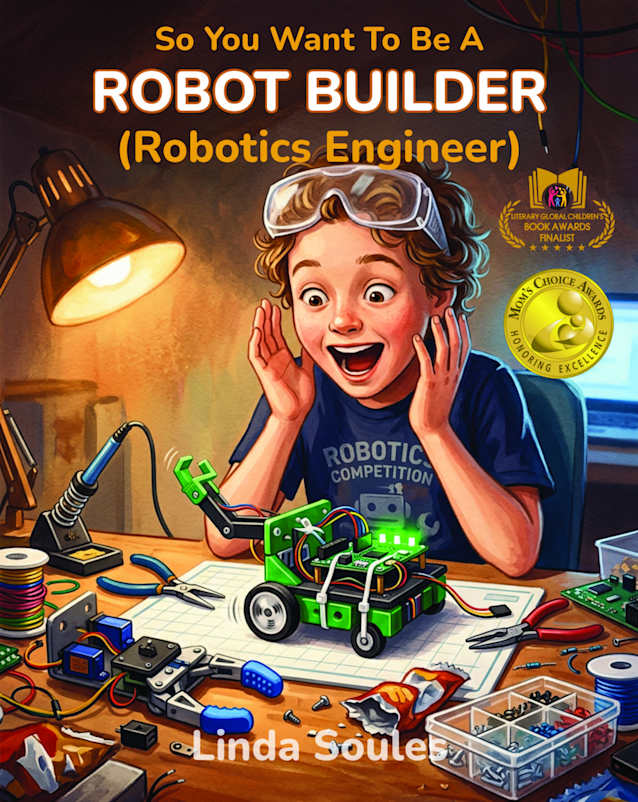
"I picked this up for my niece who’s always taking apart remotes and the cover alone made her gasp. It feels like someone finally wrote about robotics the way kids actually experience it: messy, exciting and totally doable. The illustration with the goggles, scattered parts, and that first working robot captures the I did it! moment perfectly. Linda Soules makes being a robotics engineer sound less like a distant career and more like something you can start building tonight at your kitchen table and that’s the kind of honest encouragement kids need."
"As beautiful and flexible as a robot can be. Without coding and sensors, they are just sculptors. 'A robotics workshop is one of the most multifaceted workspace in engineering.' It involves a lot of electrical and technical works in a space free from distractions. It requires dedication. Most children like to pull things apart to see how they work then trying to put them back together. Parents, they aren't always willfully destroying the things. They sometimes just want to see how it works and if they can make it work better."
"I continue to enjoy books from this series. This book outlines a day in the life of a robotics engineer. It includes expected and unexpected qualities. I love that it outlines who you'd work with as well as provides resources and ideas for future exploration that's age appropriate. The book is easy to read, it's very conversational. The glossary and resource list are thorough."
"Great information. I love the graphics and the tips to get started are incredibly helpful. My kiddo is obsessed with robots but it’s definitely out of my area of expertise so this was a great place to start."
"I love that it outlines who you'd work with as well as provides resources and ideas for future exploration that's age appropriate. The book is easy to read, it's very conversational."
"So You Want To Be A Robot Builder describes the dynamics of becoming someone who creates robots, including the three types of engineering jobs that contribute: Mechanical, Electrical, and Software Engineers. All three parts must work together, and when errors arise, the challenge is one that could fall under either of the three departments and sometimes more than one.
The book explains where robots help society, including surgery, food delivery, and even humans who have lost limbs. It also discusses the importance of paying careful attention to ensure the robots do what they are told to do, and not something that they shouldn’t, so the people making the robots must be extra careful as they consider how the robot can affect human situations.
The book goes on to provide examples that might help a person build a robot themselves with kits. This is helpful in that a person can then get real life experience to see if they wish to pursue this career.
Additionally, the book provides examples of real life robot creators, including Cynthia Breazeal, the creator of Kismet, a robot designed to understand humans. Interesting facts are also shared, including Rover, the robot that went to outer space, where it was expected to last 90 days but ended up lasting 14 years.
It provides very interesting concepts that can give a person the knowledge to decide whether they wish to explore this career path, and this applies to all ages. At the end, it provides definitions, including Feedback Loop, which allows a robot to check its own performance and change as necessary.
I think the book gives a great overview of the life of a robot builder, and contains really colorful pictures so as not to overwhelm the reader with words. I think the artwork adds to the enjoyment of reading, and the book was well thought out with ample research."
"My kid loves building robots. He’s been building some sort of robot since he was 4 (he’s now 7)! I don’t think he realizes that he can make it a job for the future, but this book has kind of helped him see it. He has a robot kit that he likes to build with and after this book, he started giving it a goal (ie, push that ball from here to here, pick up the dog’s bowl and put it away). His solutions are very rudimentary for now, but it’s a step towards maybe having a robotics future. Even if he doesn’t this book has helped him gain some more understanding about engineering than before!"
"I really loved this book! It was about building robots but it felt like life lessons were learned as well! I loved the fun facts ( ie where the term robot came from) I loved that I learned to build a great robot it requires a team, shows that life was meant to be done with others!"
"The format makes it interesting to read, with many illustrations amongst the texts. It's great for children as well because it's not complicated or too technical in the wording. It also includes a glossary to understand terms used in the field of robotics & engineering. Anyone who is curious or wanting to know more about robotics should start with this book."
"I really liked that this book goes beyond just showing kids cool robots. It actually explains what a robotics engineer does and what goes into making a robot work. There is a good mix of mechanical stuff, electronics, programming, testing and even what happens when things don't work the way they're supposed to.
The section about a typical day was probably one of my favorites because it gives a much better idea of what the job is actually like. I also liked that toward the end it gives kids some ideas for things they can start doing now if robotics interests them.
There are a lot of illustrations throughout the book which helps break up the information, especially for younger readers. Some of the topics get a little more technical, but they are explained well enough that kids don't need to already know a lot about robotics to understand it.
Overall I think this would be a good book for a kid who likes robots, building things, coding, or just taking things apart to figure out how they work. It does a nice job of showing that robotics is more than just programming a machine."
"I love how this book opens up more career exposure for children beyond the basic ones that are always talked about, such as firefighter, teacher, doctor, etc. It breaks down real expectations of the career in a child friendly way. Good information. Wish I had books like this available to me as a kid."
"This is a great book for kids exploring what they want to be when they grow up. It gives a lot of detailed information about the job and what it entails. I appreciated how the author made sure to highlight the frustrations, intricacies, and teamwork that goes into being a robot builder."
"I read this with my nephew and he loved learning about Robots. This book is very well written and very detailed... I love how it broke down everything and made it easy to follow along. We will be reading more from this author."
"I think this is a great book for the age group. This would get any kid who is unsure totally into Robotics Engineering. Full of facts, a day in the life, how to get started, and real engineers. With illustrations to match."
"This book had so much information that I learned a lot myself even as an adult! It shows the different types of robots and what they do and why they are built. It gives a great overview of the hardest parts of this job and there is even a section that reviews some of the most surprising things you may not know about the job. I liked that it also reviews what you will need to know to do this job including class areas that you may need to take in school. Great resource to discuss a new career with kids!"
"Wasn't expecting this book to be so interesting. Allowed me to see a little into what types of jobs are required to build a robot. Great for someone not sure what field to study."
"One of my favorite details in So You Want to Be a Robot Builder: Robotics Engineer is the discussion about how a housefly can outperform advanced robots at certain types of movement and navigation. That example genuinely caught my attention because it takes something we normally ignore and turns it into an engineering challenge. It made me think differently about how complicated seemingly simple movements actually are.
The book also does a nice job explaining the basic idea that robots 'sense, think, and act.' I liked how this concept is used as a foundation for understanding the different systems that make a robot work. Instead of presenting robotics as mysterious technology, the book breaks the subject into understandable pieces and shows how mechanical parts, sensors, electronics, and software have to work together.
Another part I enjoyed was the discussion of debugging and failure. The book explains that when a robot doesn't behave as expected, the engineer has to investigate whether the problem comes from the hardware, software, sensors, or even the environment. The idea that 'the robot is always right' was particularly memorable. In other words, if something goes wrong, the engineer needs to look at the design and figure out what needs changing rather than blaming the machine.
I think that is an especially useful lesson for young readers because it presents engineering as a process of experimenting, discovering mistakes, and trying again. The book doesn't make the career sound effortless or purely glamorous.
The illustrations also help make the technical concepts easier to follow, while the conversational writing keeps the material from feeling like a traditional textbook.
Overall, I found this to be a thoughtful introduction to robotics engineering. The housefly example, the sense-think-act explanation, and the emphasis on debugging gave me specific ideas that stayed with me after reading. It should be particularly interesting for kids who are constantly asking how machines work and why they behave the way they do."
"So You Want To Be A Robot Builder (Robotics Engineer) is an interesting book that explains how robots are designed and built. I especially liked the comparison between robots and houseflies because it showed how engineers can learn from the way living things move and sense their surroundings. I also found Kismet, the robot that can interact with people and show emotions, fascinating. This book made robotics seem creative and exciting, and I would recommend it to anyone interested in robots and technology."
"So You Want To Be A Robot Builder is a wonderful book for kids and adults alike.
As the parent of a kid on competitive robotics team this book helped me to understand a lot of aspects I didn't understand before. Brought things to my attention I had no idea of.
The illustrations are great. They are eye catching, match up perfectly to the book and show different kinds of people in the field.
The book is written so that young readers can easily follow along and hold their interest. All while doing a great job of explaining and describing the topics at hand. It breaks down the main type of engineers (mechanical, software, electrical) it takes to create and build robots. But continues to dive even deeper explaining the label work environment. What it's like, each person it takes and how those jobs work.
A wonderful read for the young readers and adults alike!!!"
"Great Book! I got this book because my son is a leader on his highschool robotics team. Often I fail to grasp, fully understand, and retain what his team is actually doing...and it's not because I don't watch or listen. This book was fabulous because it really explains in simple terms what goes into making a robot, the ethics behind it, and how the different people within a robotics team collaborate. The information it gave me was easy to retain - AND I could use it to look up more detailed information knowing that I finally have a full basic background picture to build upon. This was not just a child's book, it could easily be used by teenagers or adults to pursue a career (or like me, just gain a better understanding). Thank you to the group that made these books!"
"Honestly, I really liked this one. It’s fun, easy to follow, and doesn’t make robotics feel like something you have to be a genius to understand. I like that it actually encourages kids to build, experiment, mess things up, and try again. It feels more like something you’d actually want to pick up and play around with instead of a boring textbook. Definitely a good one for kids who like building things, figuring out how stuff works, or are just naturally curious."
"I really enjoyed So You Want to Be a Robot Builder! I liked how the book explains what robots are, what robotics engineers do, and how they build and test robots. It also explains what engineers do when a robot malfunctions and how the robotic system works.
I especially liked learning about a day in the life of a robotics engineer and the different people they work with. The book gives a lot of useful details about robotics and what you should expect if you want to become an engineer. I would recommend this book to anyone interested in robots, engineering, or building things!"
"Geared toward readers ages 9 and up, So You Want to Be a Robot Builder (Robotics Engineer) does an excellent job of introducing young readers to the world of robotics. The book clearly explains what a robot is, what a robotics engineer does, how robots are designed and built, and the skills needed to pursue a career in this field.
I especially appreciated that the book looks at both the ways robots can help humankind and some of the ways they could potentially cause harm. The illustrations are engaging and add to the explanations, helping make the information clear and easy to understand.
My favourite part of the book is the collection of activities for kids to try. These give readers a chance to explore their interest in robotics and get a taste of what it might be like to work in the field someday. Overall, this is an informative, engaging introduction to robotics that encourages young readers to explore whether this might be a career they would enjoy in the future."
"I am just obsessed with these books. They’re so easy to read and a great quick read full of great information! I think these books are a great tool for anyone, although targeted for children, to learn about so many new things. Love, love, love!"
"If you buy most kids' books about engineering, you usually end up with a glossy, dumbed-down rundown of smiling people holding plastic circuit boards, telling you that science is fun with all the depth of a cereal box. Linda Soules’ So You Want To Be A Robot Builder completely flips the script. It treats kids like actual thinkers.
The book kicks off with a brilliant reality check: a robot isn't a shiny Hollywood humanoid with glowing eyes; it is simply a machine that senses, thinks, and acts in a continuous loop. What makes this guide feel genuinely human—and far away from the typical corporate-feeling textbook—is how honestly it handles failure. Soules doesn't sugarcoat the grind. She dives straight into the messy, frustrating truth that robots fall down, code breaks, and the hardware and software will constantly fight each other. There is a wonderful section noting that the robot is always right: if it fails, it’s because your instructions were flawed, not the machine's.
I also love the unexpected humility woven into the chapters. The book points out that a common housefly vastly outperforms our most advanced machines, and that even the smartest warehouse robots still struggle with things a toddler does effortlessly, like sorting through a messy pile of toys. It grounds the tech in reality.
From a practical standpoint, the book bridges the gap between dreams and action by offering concrete ways to start—like tearing down broken toys to inspect their gears, keeping a build log, or using cardboard and rubber bands to make something move.
By the time you reach the profiles of real innovators like Rodney Brooks and Cynthia Breazeal, you realize this isn't just a basic career pamphlet. It’s an honest, thoughtful invitation into a difficult, magical field that values persistence, creativity, and ethics just as much as raw technical skill."