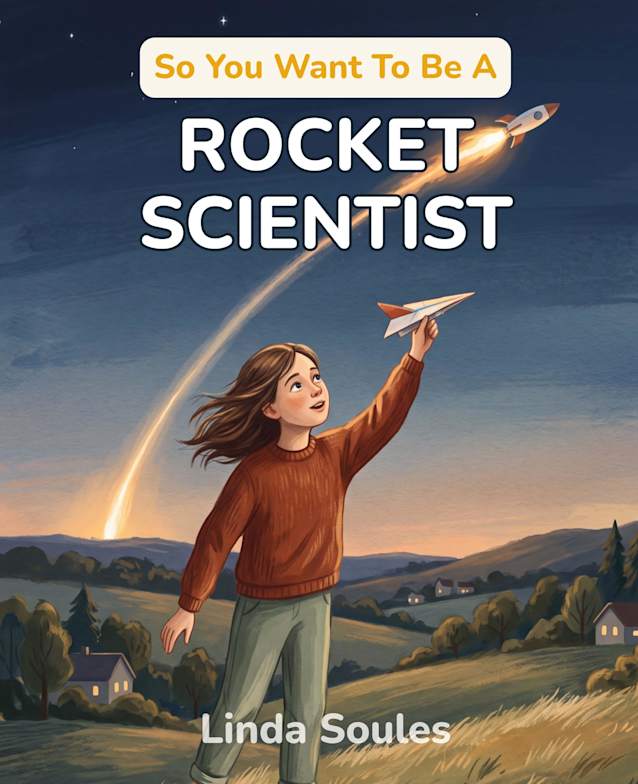
So You Want To Be A Rocket Scientist (So You Want To Be A...)
About
From the award-winning So You Want To Be A… Series
GRAND PRIZE — 2026 Purple Dragonfly Book Awards
SILVER AWARD — 2026 CIPA EVVY Book Awards, Children’s Nonfiction
What does it really take to build a rocket?
Rockets roar off the launch pad on a pillar of fire, but the real adventure starts years earlier. It begins with the engineers, scientists and builders who design, test and launch the machines that carry satellites, telescopes and astronauts into space. So You Want To Be A Rocket Scientist takes young readers inside that world, from the test stand to launch control, with true stories, surprising facts and a clear, honest look at a career in aerospace engineering.
Written for readers ages 10 to 14 and enjoyable for curious kids 8 and up, this illustrated nonfiction book makes rocket science easy to understand without talking down to young readers. No background in science is needed. Kids learn how Isaac Newton’s laws make rockets fly and why a rocket is mostly a giant flying fuel tank. They discover why rockets tip sideways after liftoff instead of going straight up, and how a satellite stays in orbit by falling around Earth without ever hitting it. A labeled diagram shows the parts of a rocket, from the fairing at the tip to the engines at the tail.
Readers will hold their breath through the “seven minutes of terror” as engineers wait to learn whether a rover landed safely on Mars. They’ll watch giant mechanical “chopsticks” catch a returning rocket booster in midair, and spend a day with a propulsion test engineer whose countdown is stopped by a wandering armadillo. Along the way, they’ll meet the people behind the rockets: a NASA chemist who proudly called himself a “nasalnaut,” the welders whose work has to be nearly perfect, and the launch teams who share jars of lucky peanuts at big moments.
The book is honest about the hard parts of the job, too. It covers explosions on the test stand, launches called off at the last minute, and a Mars spacecraft lost because of mixed-up units. Inspiring profiles introduce space pioneers from around the world, including Robert Goddard, Konstantin Tsiolkovsky, Hideo Itokawa, Yvonne Brill, Annie Easley and Ritu Karidhal. A thoughtful page on Wernher von Braun helps readers ask an important question about science and ethics: who will my work help, and who could it hurt?
Kids will also see how rocket science reaches into everyday life. Weather satellites warn families before hurricanes hit. GPS satellites guide ambulances. Technology first built for spacecraft is inside the camera in your phone.
Packed with fun facts about the Saturn V, missile mail and a top-secret wheel of cheese, plus hands-on STEM activities, a glossary of rocket science words, recommended books and websites, and practical ways to start preparing now, this book is ideal for curious kids, classrooms, homeschool families, libraries and young space fans dreaming about their future.
Part of the So You Want To Be A… career exploration series for kids, which gives young readers an honest, engaging look at real jobs and the people who do them.
Maybe the next great rocket will be yours.
Praise for this book
"So You Want to Be a Rocket Scientist by Linda Soules is an engaging and surprisingly detailed children’s book that gives young readers a fascinating look at the people who design, build, and launch rockets. Written for curious kids who wonder how things work, the book explores rocket science from several angles, including the physics behind spaceflight, the challenges engineers face, and the many careers involved in sending spacecraft into orbit. Soules has a knack for making complicated subjects approachable, using everyday comparisons to explain concepts such as thrust, gravity, and propulsion. There’s plenty of interesting information here, and the conversational writing encourages readers to imagine themselves working in the field. It’s the kind of book that could inspire a child to start asking questions about the science behind every rocket launch they see.
Soules goes beyond the excitement of liftoff to explore the careful planning, testing, teamwork, and problem-solving that make space missions possible. Readers learn about everything from computer simulations and engine testing to the importance of handling unexpected setbacks. A particularly interesting section follows a propulsion test engineer through a typical workday, giving children a sense of the responsibility and persistence the job requires. There’s also a thoughtful look at the qualities that make a good rocket scientist, including curiosity, precision, patience, and collaboration. These details help make an extraordinary profession feel like something a determined young reader could genuinely pursue.
Colorful, digitally rendered scenes show rockets soaring through dramatic skies, engineers working in busy control rooms, and children experimenting with homemade creations. Warm lighting and expressive characters give the artwork an inviting, almost cinematic quality. Some images capture the enormous scale of rockets and launch facilities, while others focus on quieter moments of concentration and teamwork. The book also includes labeled diagrams, historical portraits, and illustrations of scientific equipment that help readers visualize unfamiliar concepts. The combination of imaginative artwork and practical visual explanations makes the technical material more accessible, particularly for children who enjoy learning through pictures.
Soules also does a nice job connecting rocket science to everyday life and the wider world. Readers discover how space technology contributes to weather forecasting, navigation, and other familiar conveniences, while profiles of pioneering scientists highlight the many individuals who have shaped the field. The book even addresses the ethical responsibilities that can accompany scientific achievement. Fun facts, vocabulary explanations, suggested activities, and additional resources provide plenty of opportunities to keep exploring. With its substantial amount of text and scientific detail, So You Want to Be a Rocket Scientist is especially well suited to older elementary and middle-grade readers who enjoy nonfiction. It’s an informative, visually appealing introduction to a demanding and exciting career, with an encouraging message about where curiosity, hard work, and a willingness to keep learning can lead."
"So You Want to Be a Rocket Scientist by Linda Soules is a fun and informative book for children. Has your child ever dreamed of becoming a rocket scientist? Or maybe an engineer? Then this book will be perfect for them. This book teaches all the elements involved in building a rocket. From testing the rocket to the hardest and best parts of the job, this book covers everything you could even want or need to know. So if this is something your child is destined to be when they grow up, show them this incredible book, and it will prepare them for what waits ahead.
So You Want to Be a Rocket Scientist by Linda Soules is an amazing book that I’m glad I read. From the very first page, you are dropped right into the excitement of what it means to be a rocket scientist and much more. This would make the perfect book for any child with dreams of exploring the sky one day. It certainly had me intrigued about all the different job roles that are involved. It is jam-packed with useful and informative material for children and maybe even some adults to start their journey into the field. And don’t worry, it’s not all information; there are also many illustrations to keep young readers' attention. I highly recommend this book to anyone with ambitious children looking for an adventure. Keep up the great work, Linda; I’m sure you’ve inspired many young readers to take the leap."
"Becoming a rocket scientist requires a lot of dedication and hard work. However, many children dream of pursuing this career because it allows them to design machines that carry satellites and people into space. They can learn more about this profession in So You Want To Be a Rocket Scientist. Linda Soules begins by clearly explaining that this job requires patience and that most rocket scientists never travel to space. In reality, they are aerospace engineers, and each one typically specializes in a specific part of the rocket. She then describes the rocket’s components, how it works, the fuel, and other factors. Later, she explains various aspects of the career in detail, such as the people they work with and the tools they learn to use.
I loved Linda Soules’ explanations because she covers complex topics like rocket fuel and launch procedures using accessible language and clear examples. She also explains real terms used in a launch control room and what a typical workday is like, but what I liked best was how she discusses the skills needed for this profession. For example, she tells young readers that a lot of patience is required because building a rocket takes years, while also encouraging them to develop the necessary skills and a love for math, physics, and chemistry. In addition, the inspiring illustrations show children what this profession involves. So You Want To Be a Rocket Scientist will teach children the importance of teamwork and of using their imaginations and creativity."
"Have you ever wondered what it takes to send a rocket into space? In So You Want to Be a Rocket Scientist by Linda Soules, readers find out what goes into making that happen. There are many people involved, and each has an important role. The book explains how rockets work, what their various parts are called, and what the professionals do before, during, and after a launch. We also learn about the tools they use and some of the challenges they face. Sometimes things don't go as planned, even after months of preparation. There's a section that describes a typical day on the job, from early morning until evening. Soules also introduces us to some real rocket scientists, including Robert Goddard, Yvonne Brill, and Annie Easley. There are fun facts, interesting terms, and even suggestions for kids who might want to pursue this career. Could you be one of them someday?
So You Want to Be a Rocket Scientist by Linda Soules caught my attention immediately. I especially enjoyed the parts about the real people in the field. I wasn't familiar with all of them, so it was fascinating to learn what they contributed and some of the difficulties they faced. I also liked that Soules talked about what happens when things don't go according to plan. After all, not every rocket launch is going to be a success! The writing was easy to follow, even when explaining some complicated information. I could see teachers sharing this with older elementary students during a science lesson. It would be fun to have the students make their own balloon rocket and see how far they go. I loved the illustrations, too. There was so much to look at, and I was happy to see both men and women represented. I'd recommend this book to kids who have an interest in space or are curious about what rocket scientists actually do."