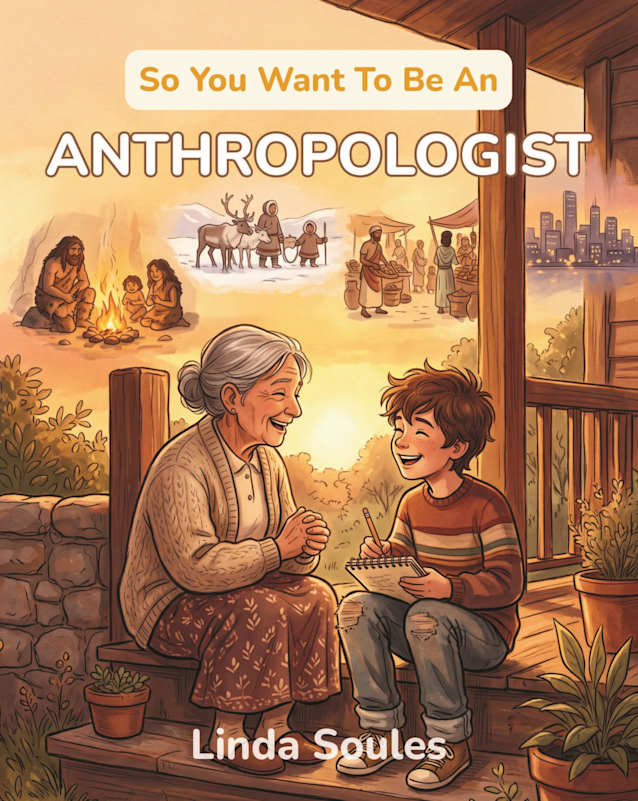
So You Want To Be An Anthropologist (So You Want To Be A...)
About
Why do people sing to you once a year, watch you blow out fire on top of a cake, and then happily eat the cake you just blew all over?
Anthropologists ask questions like that for a living. They study people everywhere and across all of time, from families who herd reindeer across the Arctic to the kids sitting next to you at lunch. So You Want To Be An Anthropologist is an engaging, beautifully illustrated introduction to anthropology for kids ages 10 to 14, and a rewarding read-aloud for curious readers 8 and up.
Young readers discover what anthropologists really do across the field’s four branches: cultural, biological, linguistic, and archaeological. They learn how anthropologists live alongside the people they hope to understand and pick up new languages. They see why the most important parts of any culture are often the ones nobody explains out loud. A vivid day-in-the-life chapter puts readers in a coastal fishing town eight months into fieldwork. There they haul crates at dawn, interview a retired captain, and taste a mystery snack nobody will name.
Every chapter is packed with true stories kids won’t forget. Readers meet a nine-year-old boy who spotted the first bone of a new human relative almost two million years old. They learn how scientists read a woman’s DNA from a lump of tar she chewed like gum 5,700 years ago, and why some archaeologists lick bones. They see how bedtime songs about a giant wave saved nearly everyone on an Indonesian island during the 2004 tsunami. They also learn how a Neanderthal who was blind in one eye, hard of hearing, and unable to use one arm survived for years because others cared for him.
The book is honest about the hard parts too: loneliness, culture shock, and the long road to a career. It also covers the field’s painful history and the important work of returning ancestors and sacred objects to Native nations. Inspiring profiles of Franz Boas, Zora Neale Hurston, Ella Cara Deloria, Mary Leakey, Zeresenay Alemseged, and Clyde Snow show the remarkable range of people who have shaped the study of human origins and world cultures.
Kids will laugh at the field report on “The Curious Customs of Grown-Ups,” bust myths about dinosaurs and treasure hunters, and explore twelve surprising fun facts. They will also find simple activities to start right away, like keeping a field notebook and interviewing a grandparent. A glossary, related careers, and curated books, websites, and organizations round out the book. That makes it a valuable resource for homeschool families, social studies classrooms, librarians, and parents looking for meaningful career exploration and STEM books for kids.
At its heart, this book teaches empathy, cultural understanding, and scientific thinking. It shows young readers that every custom makes sense from the inside, including their own.
Praise for this book
"So You Want To Be An Anthropologist by Linda Soules is part of the So You Want To Be series, an introduction to the study of human life for young readers. Anthropology is split into four branches (cultural, biological, archaeological, and linguistic), and the book shows what each one looks like in practice. You’ll follow a research project from the first question through fieldwork, lab analysis, and writing up the results, and you’ll see why those findings go back to the communities involved. Along the way, you’ll visit farming villages in the Andes, the Ethiopian desert and Arctic fishing towns, and even a modern landfill, where researchers sorted through trash to find out what people really eat and drink. You’ll learn how recordings made in 1890 were brought back to life, how a father and son uncovered ancient human relatives in South Africa, and what the career involves, from years of study to what the job pays.
So You Want To Be An Anthropologist by Linda Soules is clearly organized, with short chapters, fun fact boxes, and plenty of real examples, so it’s easy to dip in and out of it. Linda talks to the reader directly and explains big ideas simply, like comparing culture shock to your first week at a new school. She doesn’t hide the tougher side of the subject either, and it’s good to see a children’s book own up to anthropology’s past mistakes, including taking human remains and sacred objects without permission. There’s humor too. The Nacirema story (read it backward) and the field report on grown-ups are a lot of fun, and they make kids look at everyday habits in a different way. Near the end, a section called Could This Be Your Job? helps readers decide if it suits them, and there’s a glossary and a list of further reading. If your child is always asking why people do the things they do, this book shows them that curiosity could be the start of a career, and that every custom makes sense once you see it from the inside."
"Have you ever found a hidden treasure, like an arrowhead? Have you wondered who left it there so many years ago? Are you full of questions about why people do what they do and what makes each person and each community so uniquely different? Perhaps you would make a good anthropologist. In Linda Soules’ So You Want To Be An Anthropologist, you can explore the many possibilities of what this career choice offers. You can visit far away places, or just work close to home. You can visit with people and ask many questions about their lives and their customs – all the ‘why’ questions you want to ask. While you study a group of people, you’ll live near them, listen to them, and not only learn about them, but also learn to speak their language. You’ll learn all about the four branches of anthropology: the cultural, biological, linguistic, and archaeological branches. It’s a fascinating career choice and one that will inspire you to continue learning as you study people.
Linda Soules’ book, So You Want To Be An Anthropologist, is part of the fascinating So You Want To Be series. This book explores the lives and careers of anthropologists. The book clearly lays out what an anthropologist is and what they do. It provides examples of famous anthropologists, interesting anthropological finds, and even a touch of humor as they follow some of the customs of people, like that curious brown drink they must consume every morning before uttering a word to anyone. The end of the book provides a lengthy glossary of anthropological terms, a list of related careers and what one would need to become an anthropologist (like literary skills and the ability to ask questions and listen), and a list of books and resources for further study. The illustrations help promote this as a fascinating career choice. This is a great addition to the career-based series of books."
"Have you ever wondered why people sing to you on your birthday or blow out candles on a cake? Linda Soules doesn’t shy away from the quirky, confusing things people do; instead, she uses them as the jumping-off point for So You Want To Be An Anthropologist, giving kids a look at what studying human nature involves. She skips abstract theories to ground the profession’s four major pillars -- cultural, biological, linguistic, and archaeological -- in concrete details young readers can grasp. One moment you’re learning how the discipline works, and the next you’re taken right into a coastal fishing village at dawn, hauling heavy crates and drinking coffee with seasoned boat captains.
Historical figures like Franz Boas, Zora Neale Hurston, and Mary Leakey weave through the chapters, too, offering clear examples of how very different people ended up shaping our understanding of where we come from. You quickly realize that while field notebooks and trowels matter, an anthropologist's real superpower is pure, judgment-free curiosity. What makes So You Want To Be An Anthropologist stand out is how deeply it respects the audience. It skips Hollywood treasure-hunter tropes in favor of the actual, gritty science, like extracting ancient DNA out of prehistoric chewing gum or examining fossilized coprolites. Linda Soules pulls off a rare balancing act, pairing rigorous technical details with warm storytelling. For any middle-grade reader curious about how people tick, it is an absolute must-read. The author has a way of planting seeds that stick: teaching kids how to think critically, care deeply about others, and see the world through someone else’s eyes."