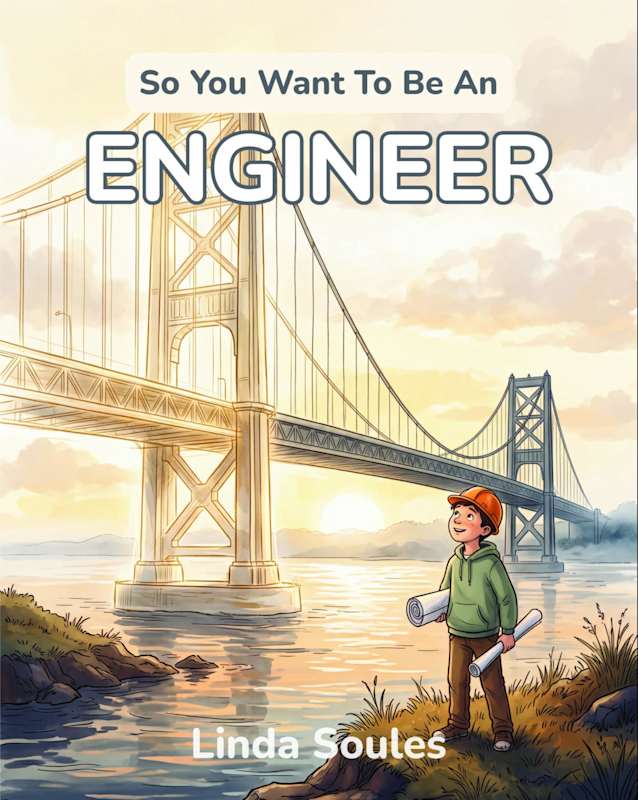
So You Want To Be An Engineer (So You Want To Be A...)
About
From the award-winning So You Want To Be A… Series
GRAND PRIZE — 2026 Purple Dragonfly Book Awards
SILVER AWARD — 2026 CIPA EVVY Book Awards, Children’s Nonfiction
Why do engineers fire chickens at airplane windshields? Why did a woodpecker ground a space shuttle? And how did a melted candy bar lead to the microwave oven? This illustrated STEM book for kids answers those questions and many more. It shows young readers what engineers really do, how they think, and why breaking things on purpose is one of the most important parts of the job.
Kids ages 10 to 14, and curious readers as young as 8, will discover the many kinds of engineering. Civil engineers design bridges and the water systems that reach their faucets. Mechanical engineers build machines, from car engines to escalators. Biomedical engineers create prosthetic hands and cochlear implants, aerospace engineers send spacecraft into space, and software engineers write the code that runs video games and traffic lights. Readers learn the engineering design process step by step, from brainstorming and building a prototype to testing it until it breaks and trying again.
Real stories make the ideas stick. Readers spend a day as a biomedical engineer building a prosthetic hand for an eleven-year-old who wants to tie his own shoes. They find out how a college student’s homework question helped save a New York skyscraper, why the Tacoma Narrows Bridge twisted itself apart in 1940, and how Bubble Wrap started as wallpaper nobody wanted. They meet engineering heroes, including Emily Warren Roebling, who saw the Brooklyn Bridge to completion, and Mary Jackson, NASA’s first Black female engineer. They also meet Margaret Hamilton, whose software helped land astronauts on the Moon, Nobel Prize winner Shuji Nakamura, and William Kamkwamba, who built a windmill from scrap as a teenager.
The book is honest about the challenges as well as the rewards. It covers the long hours, the tough design reviews, and the responsibility of keeping people safe. Along the way it serves up world records, myth-busting, odd engineering traditions, and hands-on activities kids can try this week, like the Marshmallow Challenge. A glossary, questions engineers ask, and a list of books, websites, competitions, and organizations help readers keep exploring.
Part of the award-winning So You Want To Be A… career exploration series, this book is a natural fit for STEM classrooms, homeschool science units, career days, and library collections. It also makes a thoughtful gift for any kid who loves building, tinkering, coding, robotics, or taking things apart to see how they work. Parents and teachers will find plenty to talk about, too.
Praise for this book
"Do you like to ask the question Why? For example, why or how did a melted candy bar help develop the concept of a microwave oven? Perhaps you’re an engineer in the making, and you didn’t know it. Well, here’s the book for you: Linda Soules’s So You Want To Be An Engineer. Did you know that engineers are really thinkers, and it’s these thinkers that create new things in an attempt to make the world a better place? Engineers create, they build, they ask questions, and they even break things on purpose just so they can identify the parts and what makes the broken object something that works effectively (or not).
Linda Soules’s book, So You Want To Be An Engineer, is another great addition to the So You Want To Be… series. It’s a kids’ guide to engineering, design, problem-solving, and the inventive thinkers who build bridges, buildings, and the world around us. Like the other books in this series, this one explores some of the history of engineering, showing young people what’s possible for a creative thinker, one who wants to do things differently and perhaps even find a better way to do things. The language is suitable for the 10 to 14 age group, and the bullet format with bold headings makes it easy to follow, so readers can either read from beginning to end, or pick and choose sections to focus on. The illustrations are superb and help develop the ‘creativity’ aspect of this career. There are interesting stories about engineering projects, famous engineers, and the book includes a comprehensive glossary of engineering terms, suggestions of what young readers can do now to prepare for this potential career opportunity, and a list of resources to help young readers learn more about engineering. Another great book in an ever-growing series."
"So You Want To Be An Engineer by Linda Soules is an excellent choice for children who are eager to learn what engineers really do. The author introduces engineers as creative problem solvers who can be found anywhere from construction sites to hospitals and NASA. They create the devices and systems that we use every day. Soules explains the tools used by engineers, the significance of accurate calculations, and the safety measures they take. Also, there is information about the history of engineering, describing its most important discoveries and mistakes made by engineers before. Along the way, you find out what makes a good engineer and why the world needs them now more than ever.
So You Want To Be An Engineer isn’t just packed with educational facts; it’s actually inspiring. The book is a perfect example of the way in which engineers design the world around us. Engineers create everything from massive skyscrapers to small hearing aids. Linda Soules does an amazing job of honoring what engineers do and revealing how they see the world and operate. She includes history, stories about famous engineers, and even a few jokes to make the book interesting and easy to follow. She dispels many popular misconceptions about engineering and proves that it is more than just calculations and machinery; it is about teamwork and finding joy in helping others. Soules includes games and hands-on activities you can try at home or school, so you experience a bit of engineering for yourself. The colorful, realistic illustrations tie everything together and make the whole book more engaging. It’s the kind of book that pushes aspiring young engineers to experiment, problem-solve, and help shape the world for the better."
"When you hear the word 'engineer,' what comes to mind? Maybe someone building a bridge or designing a machine. In So You Want to Be an Engineer by Linda Soules, children discover there's more to this profession than meets the eye. There are so many different kinds of engineering. For example, some engineers help create artificial limbs or work on roller coasters to make sure they're safe to ride. Others even help develop the technology used in space. But what happens when something they built doesn't work? That's part of the job, too! Kids get an up-close look at how designs are tested to figure out what needs to be changed. Children also get a glimpse of the equipment these professionals use, what their days are like, and some of the tougher parts of the job. Readers can learn about individuals who made their mark in this field, including Mary Jackson and Emily Warren Roebling. Soules even includes a few activities to try at home. Could engineering be the career for you?
Reading So You Want to Be an Engineer by Linda Soules taught me so much! I hadn't realized how many different careers fall under engineering. It made me think of engineers as inventors and fixers who are always looking for solutions. Soules writes conversationally, breaking down a lot of material into manageable sections that children can read at their own pace. As an educator, I’m sure older students would enjoy learning about this interesting occupation. It would also fit perfectly into a classroom discussion about problem-solving. Afterward, a STEM challenge could be to build a bridge using everyday materials. The colorful illustrations show both men and women as engineers, which I appreciate because boys and girls should see that these opportunities are open to everyone. Curious kids who like figuring out how things work should pick this up. This title belongs in schools, libraries, and homes everywhere. My grandfather, whose wheels were always spinning, used to say, 'Measure twice, cut once.' That advice captures the careful thinking behind engineering."